


TL;DR
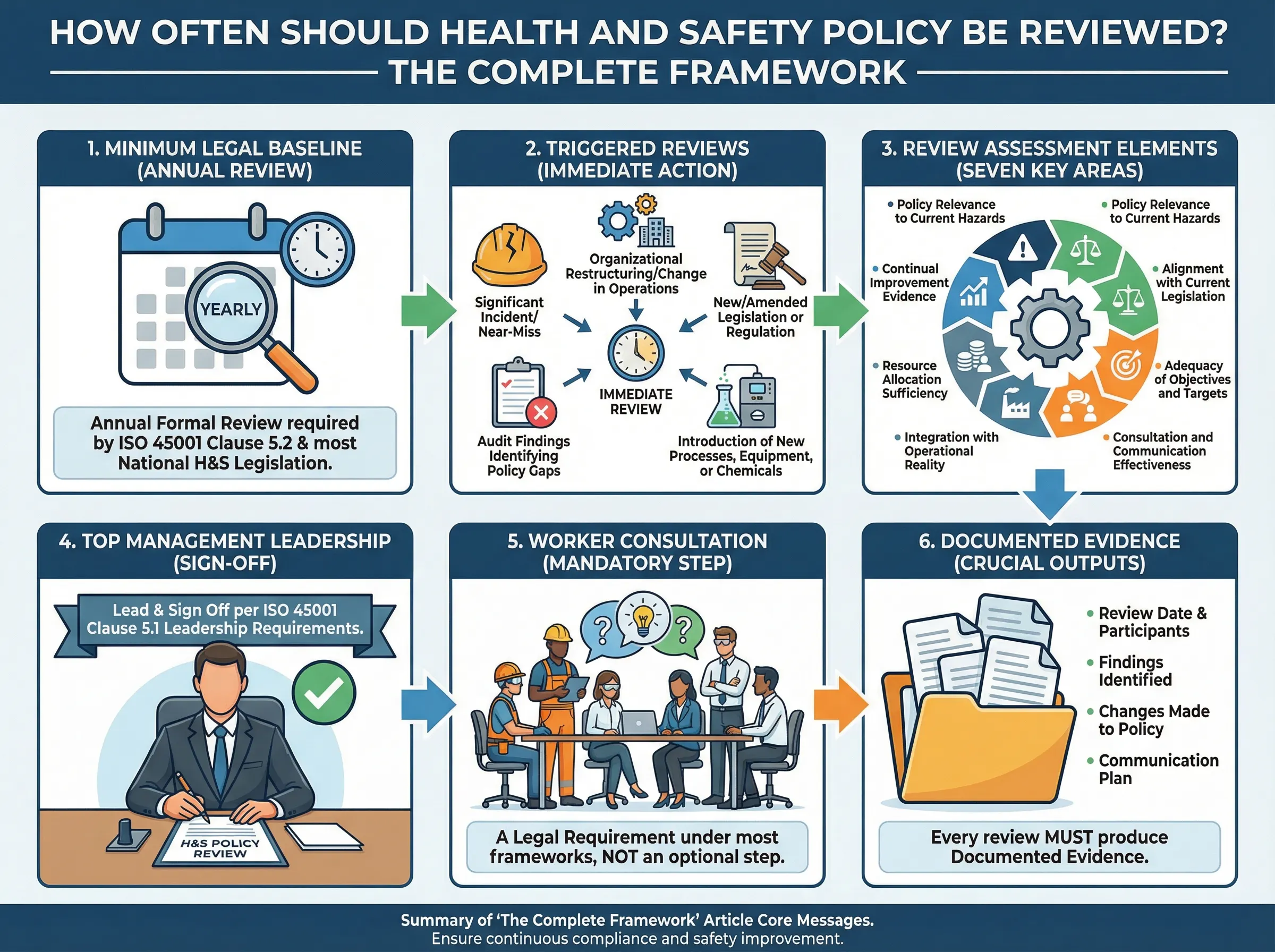
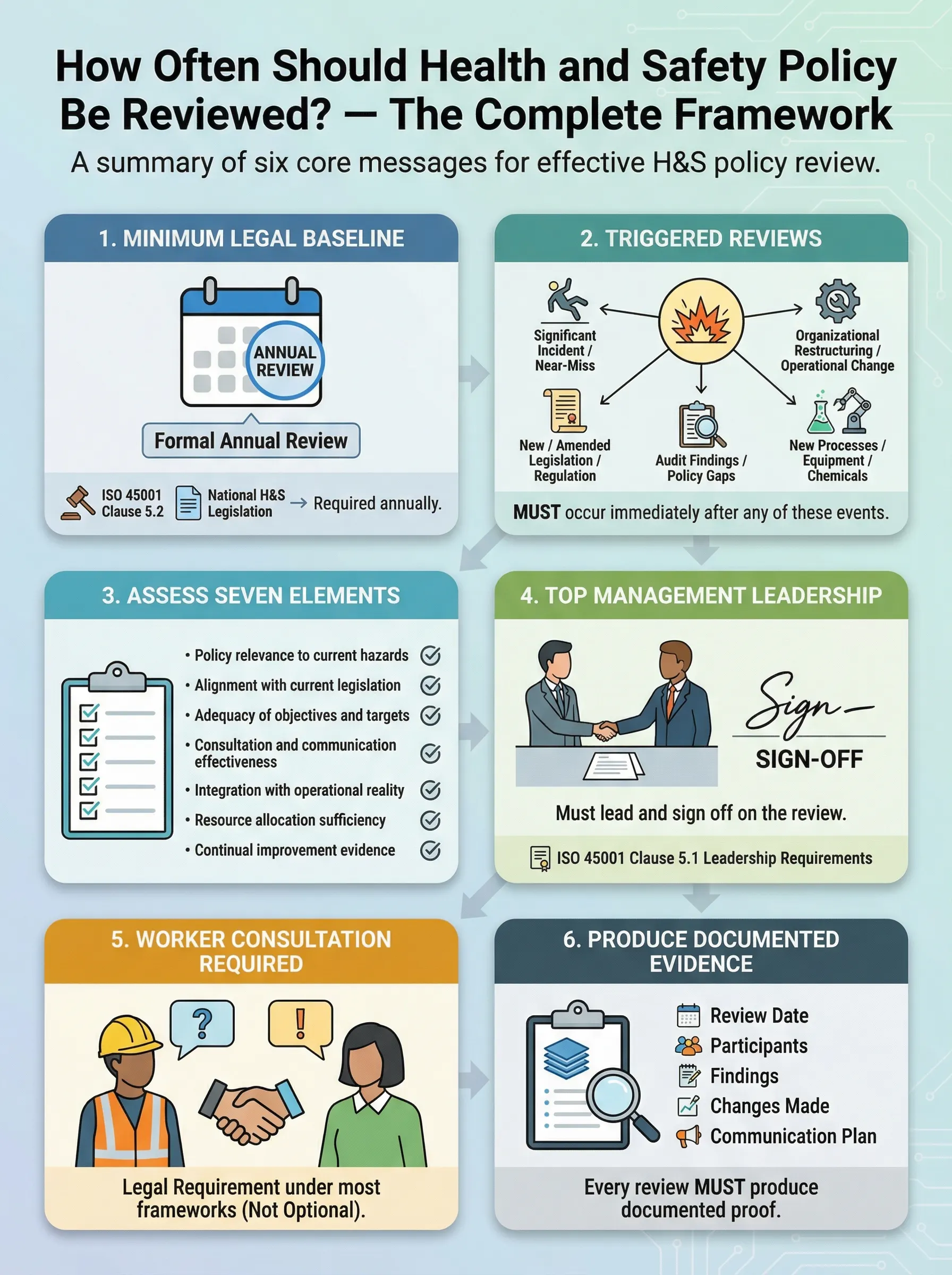
Annual review is the baseline, not the benchmark: Most regulatory frameworks and ISO 45001 require at least one formal policy review per year — but treating this as sufficient is one of the most common compliance failures I encounter during audits.
Triggered reviews matter more than scheduled ones: Any significant incident, organizational change, new legislation, or audit finding should initiate an immediate policy review regardless of where you are in the annual cycle.
A policy nobody reads protects nobody: The review process must include verification that the policy is communicated, understood, and actively implemented — not just signed off by top management and filed.
Management review is the mechanism, not a formality: ISO 45001 Clause 9.3 and most national regulations tie policy review directly to management review — if your management review is a rubber stamp, your policy review is worthless.
Document everything: Every review cycle needs documented evidence of what was assessed, what changed, who approved it, and how changes were communicated — this is what regulators and auditors actually look for.
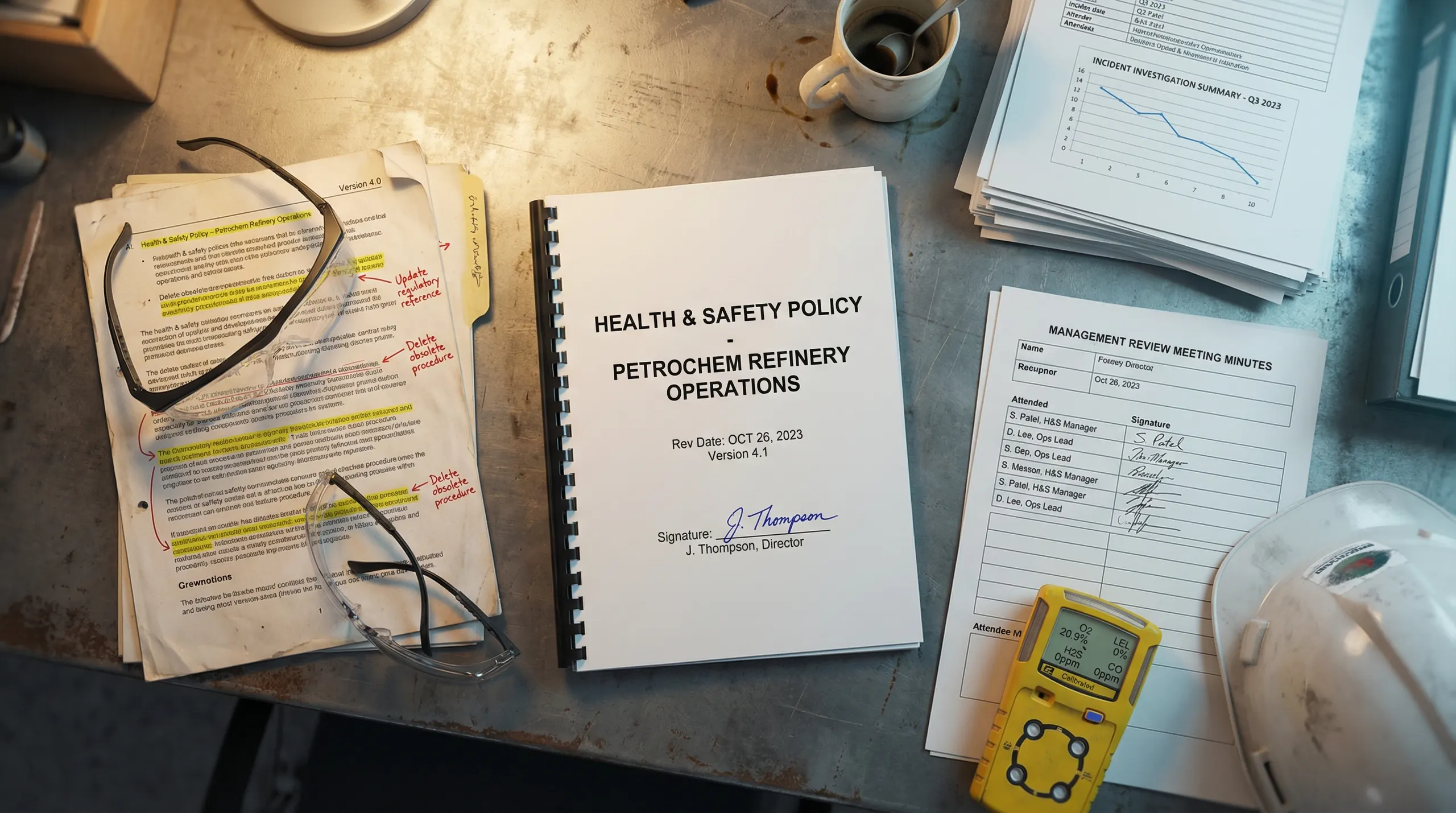
The audit had been going smoothly until I pulled the health and safety policy binder off the shelf. The document was dated three years earlier, referenced legislation that had since been amended, listed a managing director who had left the company eighteen months ago, and described operational activities the site no longer performed. When I asked the HSE manager when it was last reviewed, he pointed to an annual signature page — signed each year by the current director — with no evidence that anyone had actually read the content, assessed its relevance, or changed a single word. The signatures were there. The review was not.
That scenario is not unusual. Across hundreds of management system audits in construction, petrochemical, manufacturing, and logistics operations, I have found that health and safety policy review is one of the most poorly executed compliance requirements in occupational safety management. Organizations treat it as a calendar task rather than a governance function. The consequences range from regulatory non-compliance and audit non-conformities to something far worse — a policy that fails to protect workers because it no longer reflects the actual risks they face. This article covers the legal and standards-based requirements for how often health and safety policy should be reviewed, the triggers that demand immediate review outside any schedule, the practical steps for conducting a meaningful review, and the mistakes that turn this critical process into a paper exercise.
What Does "Reviewing" a Health and Safety Policy Actually Mean?
Before discussing frequency, the concept itself needs clarification. A health and safety policy review is a formal, documented assessment of whether the policy remains suitable, adequate, and effective for the organization's current operations, hazards, legal obligations, and strategic direction. It is not a re-signing ceremony.
The distinction matters because the most common failure I document in audit findings is organizations that confuse endorsement with review. These are fundamentally different activities, and understanding the gap between them is the first step toward compliance:
Endorsement is a signature confirming top management's continued commitment. It takes five minutes and changes nothing in the document.
Review is an evidence-based evaluation that examines every element of the policy against current operational reality, legal requirements, incident history, audit findings, and worker feedback — and results in documented decisions about what stays, what changes, and what gets added.
ISO 45001:2018, Clause 5.2 requires that the OH&S policy is "appropriate to the purpose, size and context of the organization and to the specific nature of its OH&S risks and OH&S opportunities." A policy that has not been assessed against current context cannot satisfy this requirement — regardless of how many signatures it carries.
Pro Tip: During your next policy review, print the current policy and hand it to five frontline supervisors. Ask them to circle anything that does not match what actually happens on site. Their feedback will reveal more gaps than any desk-based review ever could.
How Often Should Health and Safety Policy Be Reviewed? The Legal and Standards-Based Answer
The straightforward answer is at least annually — but the complete answer is more nuanced, and understanding the distinction between scheduled and triggered reviews is what separates compliant organizations from genuinely safe ones.
Scheduled Review Frequency
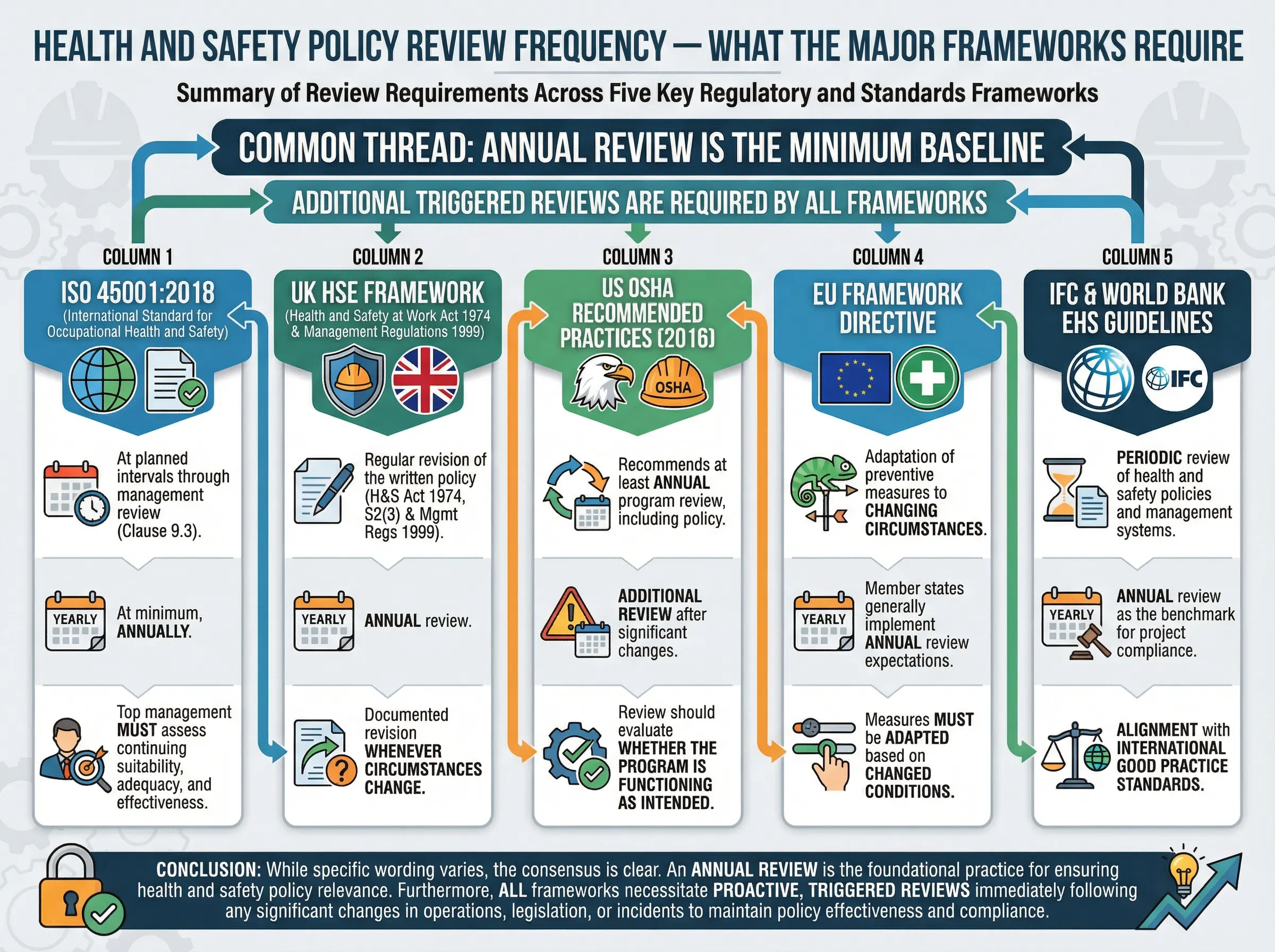
Most regulatory frameworks and international standards converge on an annual minimum. The specific requirements vary by jurisdiction, but the principle is consistent across the frameworks that govern the majority of global operations:
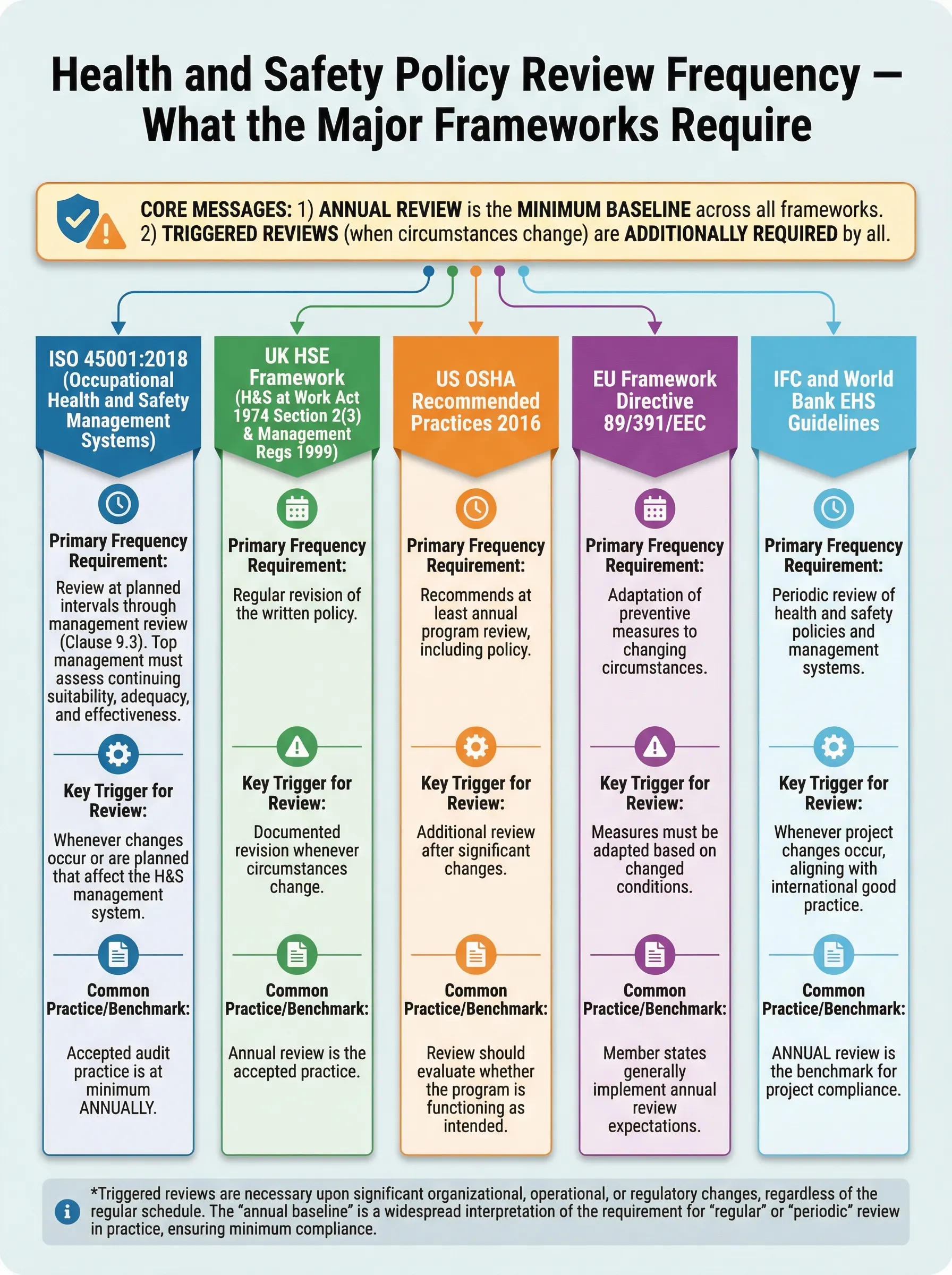
ISO 45001:2018 (Clause 9.3 — Management Review): Requires top management to review the OH&S management system, including the policy, at "planned intervals" to ensure its continuing suitability, adequacy, and effectiveness. While the standard does not prescribe an exact frequency, the expectation in audit practice — and the interpretation applied by accredited certification bodies — is at minimum annually.
UK Health and Safety at Work etc. Act 1974 (Section 2(3)): Requires employers to prepare and revise a written health and safety policy. The HSE UK's Approved Code of Practice to the Management of Health and Safety at Work Regulations 1999 specifies that the policy must be reviewed and updated regularly, with annual review as the accepted industry practice.
OSHA (US): Does not mandate a specific policy review frequency in general industry standards, but OSHA's Recommended Practices for Safety and Health Programs (2016) explicitly recommend reviewing the program — including policy — at least annually and whenever a significant change occurs.
EU Framework Directive 89/391/EEC: Requires employers to adapt preventive measures to account for changing circumstances and to improve existing situations. Member state transpositions generally interpret this as requiring regular policy review, with annual review as the common implementation standard.
Triggered Reviews — When the Schedule Doesn't Matter
The scheduled annual review is the floor, not the ceiling. Every framework listed above also requires — or strongly recommends — policy review whenever specific triggers occur. In practice, triggered reviews are more important than the annual cycle because they respond to actual changes in risk.
These are the events that should initiate an immediate, unscheduled policy review regardless of when the last review took place:
Significant workplace incident, fatality, or dangerous occurrence: Any event that reveals a failure in hazard controls, risk assessment, or safety management demands an assessment of whether the policy framework was adequate.
Organizational restructuring: Mergers, acquisitions, downsizing, changes in top management, or shifts in operational scope can fundamentally alter the context the policy was written for.
New or amended legislation: When regulatory requirements change, the policy must be assessed for alignment before the compliance deadline — not at the next annual review.
Major audit findings or enforcement actions: A non-conformity raised against the policy during an internal audit, external certification audit, or regulatory inspection is an immediate trigger.
Introduction of new processes, equipment, or chemicals: Any change that introduces new hazards or alters existing risk profiles requires a policy relevance check.
Expansion into new geographies or sectors: Operating in a new jurisdiction or industry brings new legal requirements and hazard profiles that the existing policy may not cover.
Significant changes in workforce composition: A large influx of contractors, temporary workers, or workers with different language or training backgrounds can expose gaps in policy communication and applicability.
Findings from worker consultation or feedback: If workers or safety representatives raise concerns that the policy does not reflect site reality, that feedback is a trigger — not a suggestion for next year's review.
Pro Tip: Maintain a "Policy Review Trigger Log" — a simple register where incidents, legislative changes, audit findings, and organizational changes are recorded with a flag for whether a policy review was initiated. During external audits, this log is powerful evidence of a responsive, living management system rather than a calendar-driven one.
What Must Be Assessed During a Health and Safety Policy Review?
Knowing when to review is only half the requirement. The quality of the review itself determines whether the policy actually protects workers or merely satisfies a filing obligation. I have seen organizations that dutifully conduct annual reviews but assess nothing of substance — they re-read the document, confirm it "still looks right," and sign it off. That is not a review. That is a ritual.
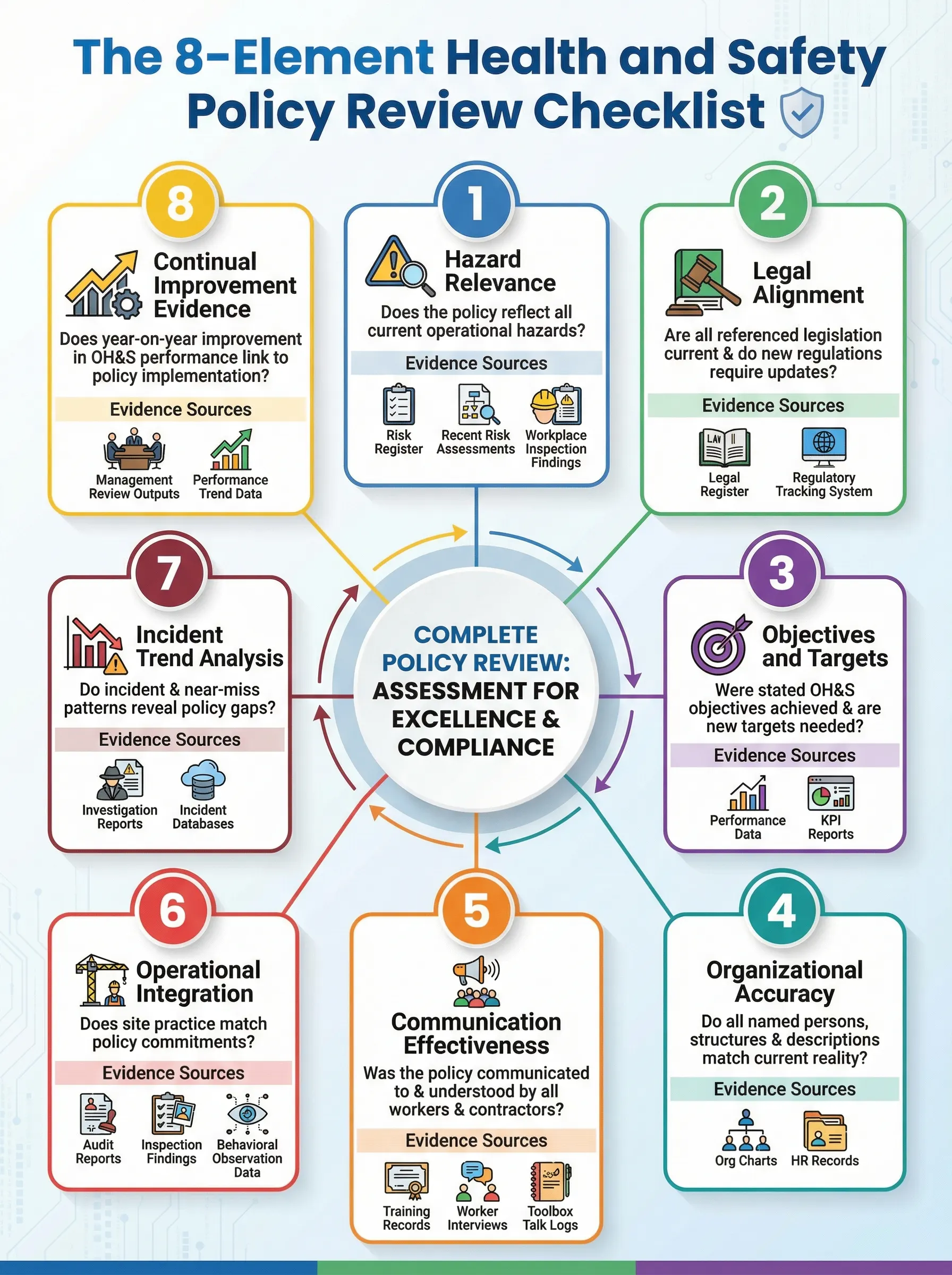
A meaningful policy review must systematically assess every component of the policy against current evidence. The following elements represent the minimum scope for a thorough review:
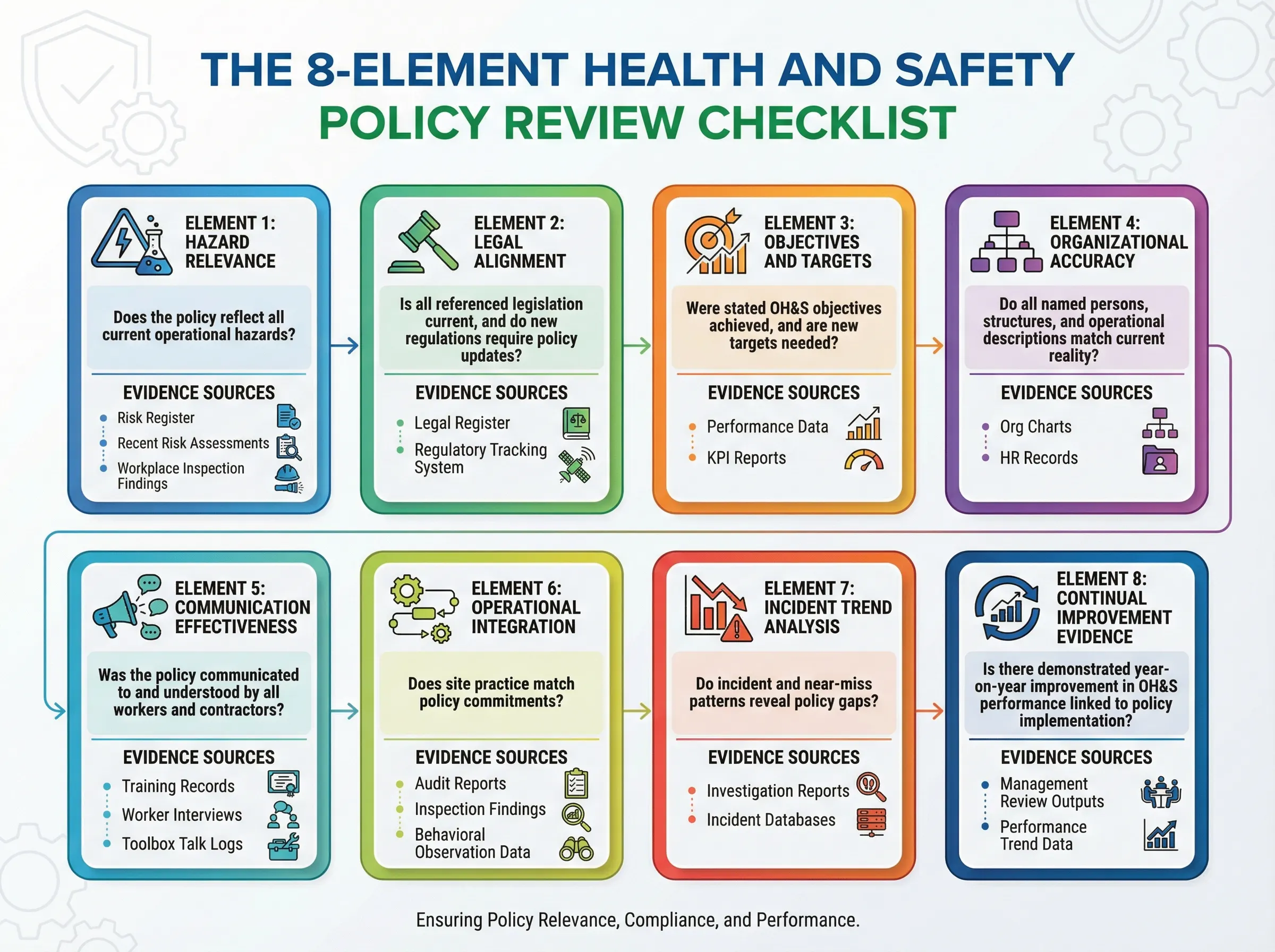
Relevance to current hazards and risks: Does the policy reflect the actual hazard profile of current operations? Have new hazards emerged since the last review? Have any previously identified hazards been eliminated? Cross-reference against the current risk register and recent risk assessments.
Alignment with current legislation and standards: Has any applicable legislation been introduced, amended, or repealed? Are all regulatory references in the policy still accurate? Are any new compliance obligations missing from the policy framework?
Adequacy of stated objectives and targets: Were the OH&S objectives referenced in the policy achieved? Are the targets still relevant and measurable? Do they reflect the organization's current risk priorities?
Organizational accuracy: Does the policy reference the correct organizational structure, management names, reporting lines, and operational scope? Are all named responsible persons still in their roles?
Consultation and communication effectiveness: Was the policy effectively communicated to all workers, contractors, and relevant interested parties? Is there evidence that workers understand the policy and their roles within it? Were workers and safety representatives consulted during the review process?
Integration with operational reality: Does what the policy states actually happen on site? Are the commitments in the policy matched by resource allocation, training programs, and management behavior? This is where the gap between paper and practice lives — and where auditors focus.
Incident and near-miss trends: Do recent incidents, near-misses, and occupational health data indicate areas where the policy framework is insufficient? Are there patterns that suggest a systemic failure the policy should address?
Continual improvement evidence: Can the organization demonstrate that the policy and its implementation have improved since the last review? ISO 45001 Clause 10.3 requires continual improvement — the policy review must evidence this.
Review Element | Evidence Source | Key Question |
|---|---|---|
Hazard relevance | Risk register, risk assessments, workplace inspections | Does the policy cover all current hazards? |
Legal alignment | Legislation tracker, regulatory updates, legal register | Are all regulatory references current and complete? |
Objectives and targets | OH&S performance data, KPI reports | Were objectives achieved? Are new targets needed? |
Organizational accuracy | Org charts, role descriptions, management changes | Are all names, roles, and structures correct? |
Communication effectiveness | Training records, toolbox talks, worker interviews | Do workers know and understand the policy? |
Operational integration | Site inspections, audit reports, observation data | Does site practice match policy commitments? |
Incident trends | Incident database, investigation reports, near-miss logs | Do incidents reveal policy gaps? |
Continual improvement | Year-on-year performance comparison, management review minutes | Is the system getting better? |
Who Is Responsible for the Policy Review?
Responsibility for the health and safety policy review is not an HR function, a safety department task, or a consultant's deliverable. Every major framework places this responsibility squarely with top management — and for good reason. The policy is the organization's highest-level commitment to worker safety. Its review is a governance function.
Top Management Ownership
During an ISO 45001 certification audit at a manufacturing facility in Central Europe, I asked the plant director when the OH&S policy was last reviewed and what changes resulted. He turned to the HSE manager and said, "You handle that, don't you?" That single response generated a major non-conformity against Clause 5.1 (Leadership and Commitment). The policy review is not delegatable in terms of accountability — the HSE team facilitates, but top management owns it.
The specific responsibilities that frameworks assign to leadership during the review process include the following obligations:
Leading the management review meeting where the policy is formally assessed (ISO 45001 Clause 9.3)
Ensuring adequate resources are allocated for the review process, including time for worker consultation
Making and approving decisions about policy changes based on review findings
Signing the revised policy with a clear date and version control reference
Ensuring communication of any changes to all affected workers, contractors, and interested parties
Demonstrating personal commitment to the policy's content — not just its existence
ISO 45001:2018, Clause 5.1(a) requires top management to take "overall responsibility and accountability for the prevention of work-related injury and ill health, as well as the provision of safe and healthful workplaces and activities." A policy review without top management's substantive participation fails this requirement.
Worker Consultation — Not Optional
One of the most frequently missed requirements in policy review is meaningful worker consultation. This is not a best practice recommendation — it is a legal obligation under most frameworks.
The regulatory basis for worker involvement during policy review is well established and carries enforcement weight:
ISO 45001 Clause 5.4 requires consultation with and participation of workers and worker representatives in the development, planning, implementation, performance evaluation, and actions for improvement of the OH&S management system — which includes the policy.
UK Safety Representatives and Safety Committees Regulations 1977 and the Health and Safety (Consultation with Employees) Regulations 1996 require consultation with safety representatives or employees directly on matters affecting their health and safety, which explicitly includes policy review.
EU Framework Directive 89/391/EEC, Article 11 requires balanced participation and consultation of workers on all questions relating to safety and health at work.
In my experience, the policy reviews that produce the most meaningful improvements are those where frontline workers and supervisors are directly involved — not just consulted after the fact through a survey nobody reads. Bring workers into the room. Ask them what in the policy does not match their daily reality. Their answers are the most valuable input the review process can receive.
Pro Tip: Schedule a dedicated "Policy Reality Check" session with a cross-section of frontline workers two weeks before the formal management review. Present the current policy in plain language, ask them to identify three things that match site reality and three things that do not. Document their input and present it as formal evidence during the management review. This single step has resolved more audit findings for my clients than any other intervention.
Common Mistakes That Turn Policy Review Into a Paper Exercise
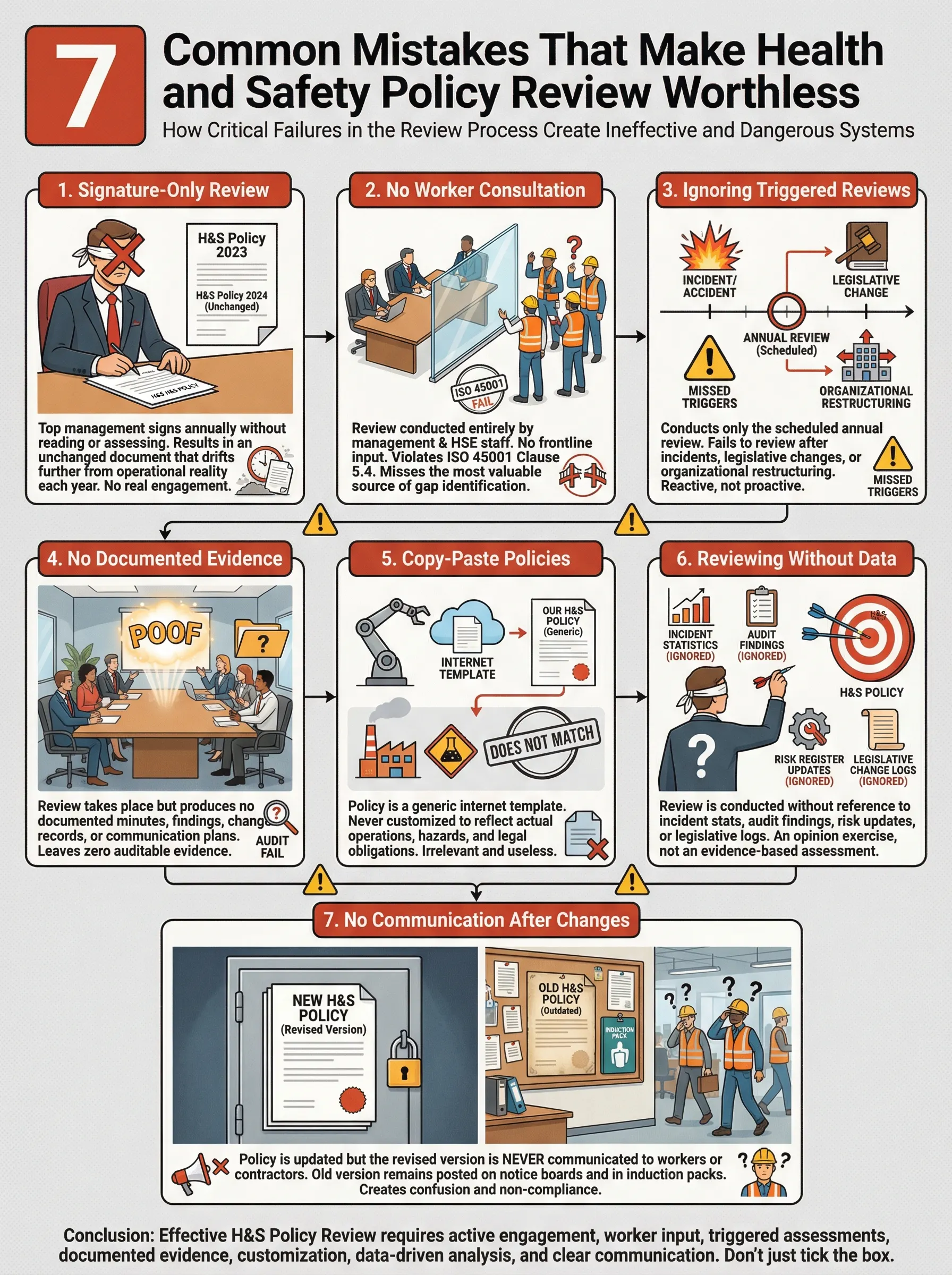
After conducting over two hundred management system audits across multiple continents and industries, I have catalogued a consistent set of failures that reduce the policy review from a governance function to a checkbox. Recognizing these patterns is the first step toward eliminating them from your own process.
The following mistakes appear repeatedly in organizations that receive non-conformities during certification and surveillance audits:
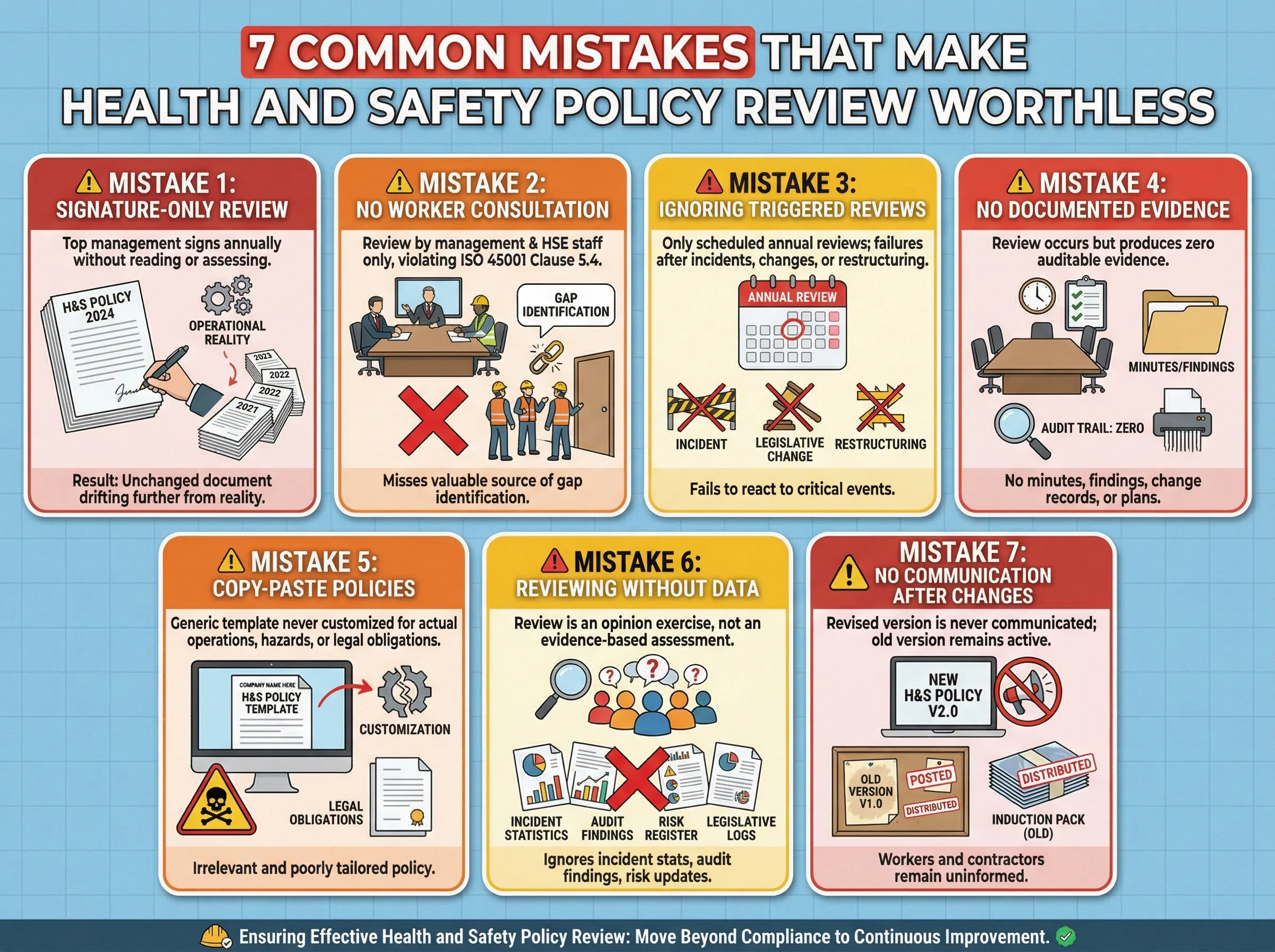
The annual signature ceremony: The policy is printed, the director signs it, the date is updated, and the document is filed. Nothing in the content is assessed, no evidence is consulted, and no workers are involved. This is the single most common failure — and the easiest for an auditor to identify.
No documented evidence of review: The organization claims the review happened but cannot produce meeting minutes, attendance records, review findings, change records, or communication evidence. Under ISO 45001 Clause 7.5, if it is not documented, it did not happen — at least as far as the auditor is concerned.
Generic template policies never customized: The policy was downloaded from the internet or provided by a consultant and has never been tailored to the organization's actual hazards, operations, or legal context. During review, nobody notices because nobody checks it against reality.
HSE department conducts the review in isolation: The safety team reviews the policy internally, makes minor edits, and presents it to management for signature. Top management has no substantive involvement. Workers are never consulted. The review technically occurred but violates the leadership and consultation requirements of virtually every framework.
Reviewing without data: The review meeting happens without anyone bringing incident statistics, audit findings, risk register updates, legislative change summaries, or worker feedback. The assessment becomes a subjective opinion exercise rather than an evidence-based evaluation.
Ignoring trigger events between annual reviews: A major incident occurs in March. The annual review is scheduled for September. Nobody reviews the policy after the incident. By September, the urgency has passed and the opportunity for responsive improvement is lost.
Failing to communicate changes: The policy is reviewed and updated, but the revised version is not communicated to workers, contractors, or visitors. The old version remains on notice boards, in induction packs, and on the company intranet. The update exists only in the management file.
A Practical Framework for Conducting an Effective Policy Review
Theory is useful, but what most HSE professionals need is a workable process they can implement on their next review cycle. The following framework synthesizes the requirements of ISO 45001, UK HSE guidance, and OSHA's recommended practices into a step-by-step process that satisfies auditors and — more importantly — actually improves the policy.
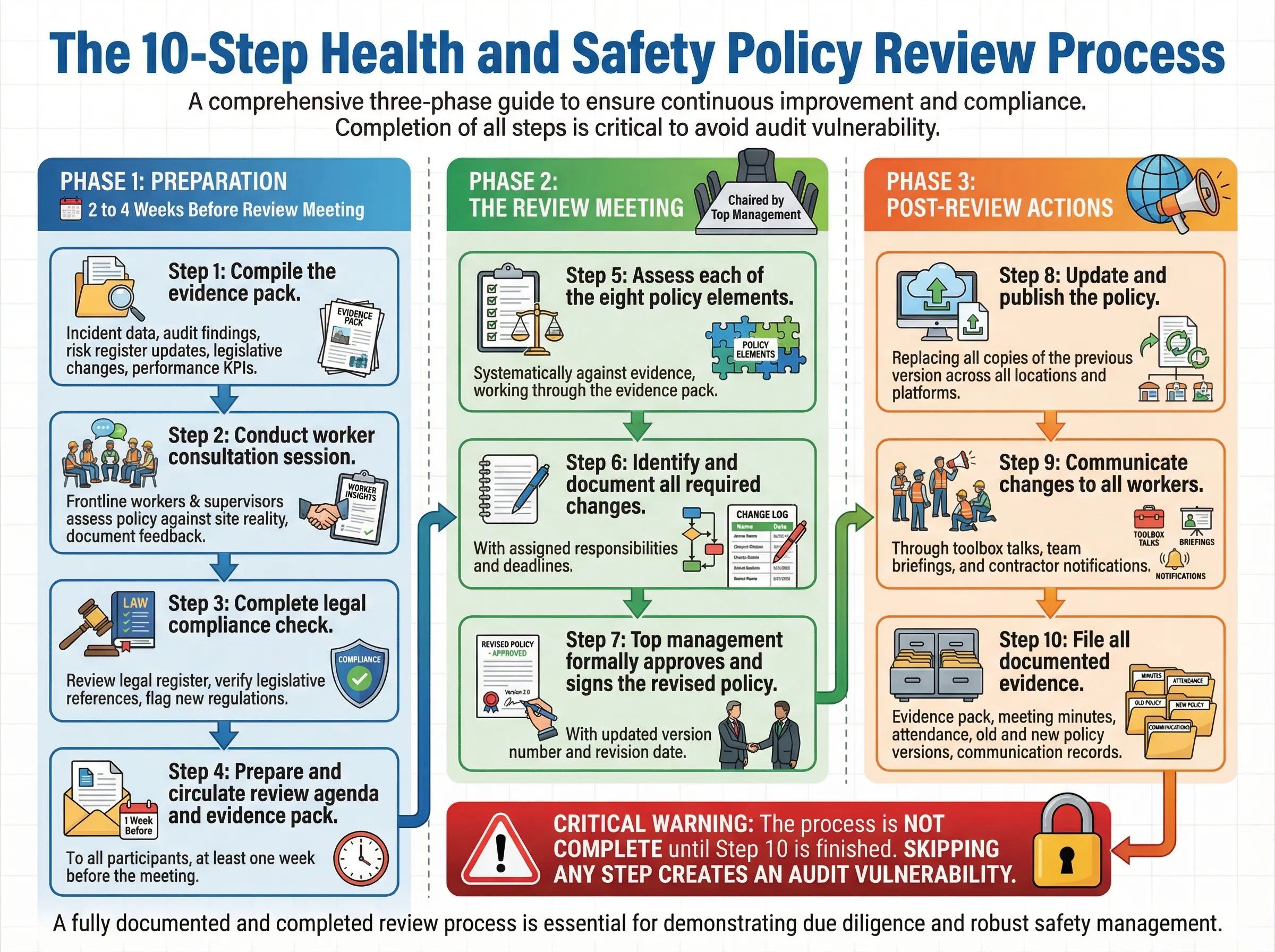
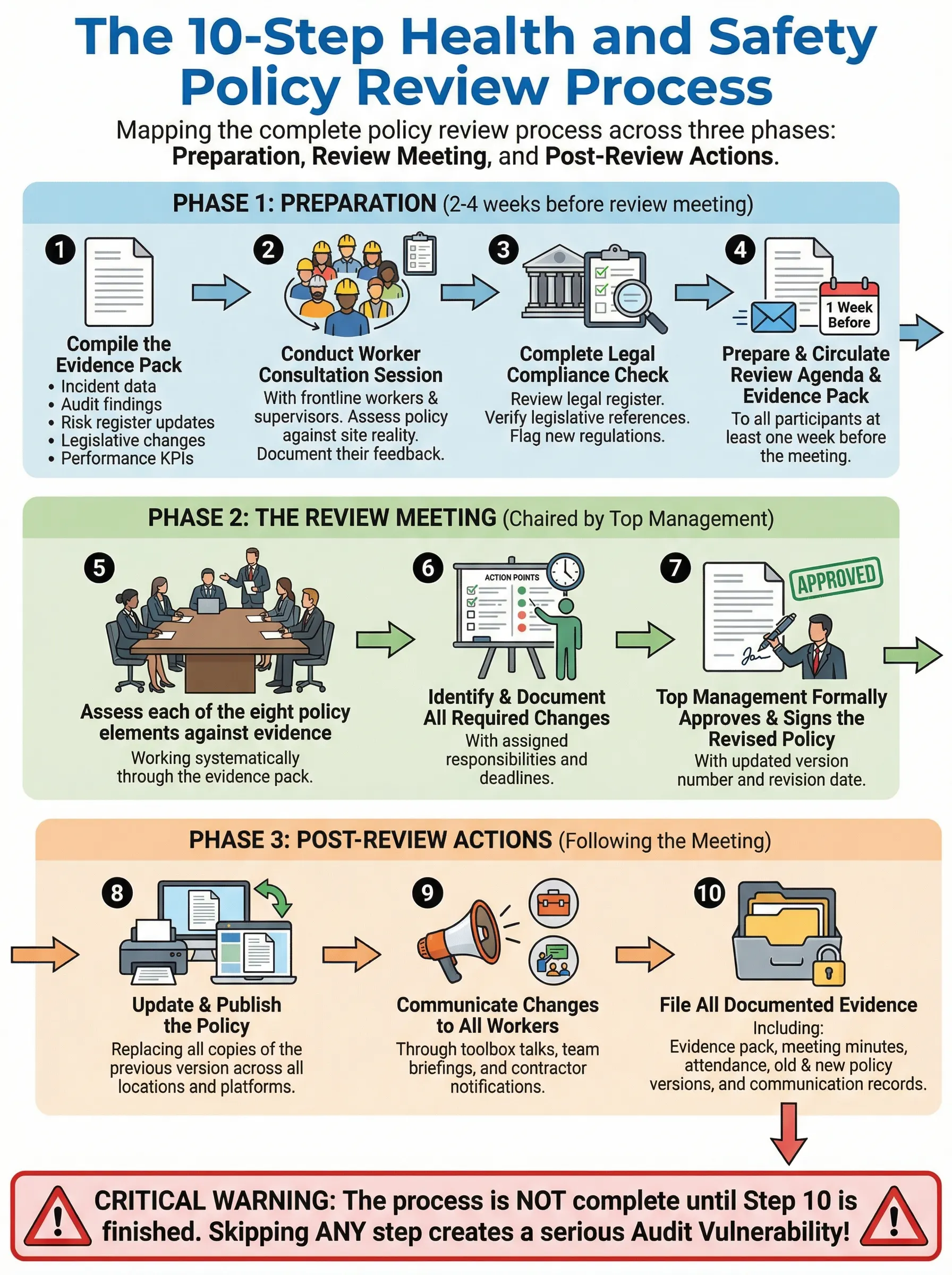
Phase 1: Preparation (2–4 Weeks Before the Review Meeting)
Effective policy review starts well before the meeting room is booked. The preparation phase determines whether the review will be evidence-based or opinion-based — and auditors can tell the difference immediately.
Compile the evidence pack: Gather incident and near-miss data since the last review, internal and external audit findings, risk register updates, legislative change summaries, worker consultation feedback, OH&S performance KPIs, and management of change records.
Conduct the worker consultation session: Bring a cross-section of frontline workers and supervisors together to assess the current policy against site reality. Document their feedback formally.
Complete the legal compliance check: Review the legal register and verify that all legislative references in the policy are current. Flag any new regulations that may require policy updates.
Prepare the review agenda: Circulate the evidence pack and a structured review agenda to all participants at least one week before the meeting. The agenda should cover each of the eight review elements outlined earlier in this article.
Phase 2: The Review Meeting
The review meeting is where decisions are made, and it must be chaired by a member of top management — not delegated to the HSE department.
Assess each policy element against evidence: Work through the eight review elements systematically, referencing the evidence pack for each. Record findings, decisions, and actions for each element.
Identify required changes: Document every change needed — from minor wording updates to substantive commitments or scope modifications. Assign responsibility and deadlines for each change.
Approve the revised policy: Top management formally approves the updated policy, signs the new version with a clear revision date and version number, and authorizes its communication.
Phase 3: Post-Review Actions
The review is not complete when the meeting ends. The actions that follow determine whether the review translates into real improvement.
Update and publish the policy: Implement all agreed changes, update version control records, and replace all copies of the previous version — on notice boards, intranets, induction materials, and contractor documentation.
Communicate changes to all workers: Brief all workers, supervisors, contractors, and visitors on what changed and why. Use toolbox talks, team briefings, or dedicated communication sessions — not just an email.
File documented evidence: Archive the evidence pack, meeting minutes, attendance records, old and new policy versions, change records, and communication evidence. This is the audit trail that proves the review happened and was meaningful.
How to Document the Review for Audit and Regulatory Compliance
Documentation is where many organizations fall apart — not because they did not conduct a review, but because they cannot prove it. I have audited sites where genuinely good discussions happened during management review meetings, substantive decisions were made, and the policy was meaningfully improved — but the only record was a one-line entry in meeting minutes reading "H&S policy reviewed and approved." That is not sufficient evidence for any auditor or regulator.
A defensible policy review record must include these documented elements as a minimum:
Review meeting minutes: Including date, attendees (with roles), agenda items discussed, evidence considered, findings for each review element, decisions made, and actions assigned with owners and deadlines.
Attendance record: Signed attendance sheet showing top management participation and worker representative involvement.
Evidence pack contents list: A record of what data and documents were considered during the review — this demonstrates the review was evidence-based.
Worker consultation records: Documentation of how workers were consulted, when, what feedback was received, and how it was considered during the review.
Change record: A clear document showing what was changed in the policy, why, and who approved the change. A redline comparison between old and new versions is excellent practice.
Version control: The updated policy must show a clear revision number, revision date, approved-by signature, and next review date.
Communication evidence: Records showing how and when the updated policy was communicated to workers, contractors, and interested parties — including training records, toolbox talk sheets, or email distribution logs.
Pro Tip: Create a standardized "Policy Review File" template that includes tabs or sections for each documentation element listed above. Use the same template every review cycle. After three years, you will have a consistent, auditable archive that demonstrates continual improvement across review cycles — which is exactly what ISO 45001 certification auditors look for during surveillance audits.
Policy Review Frequency: Getting the Interval Right for Your Organization
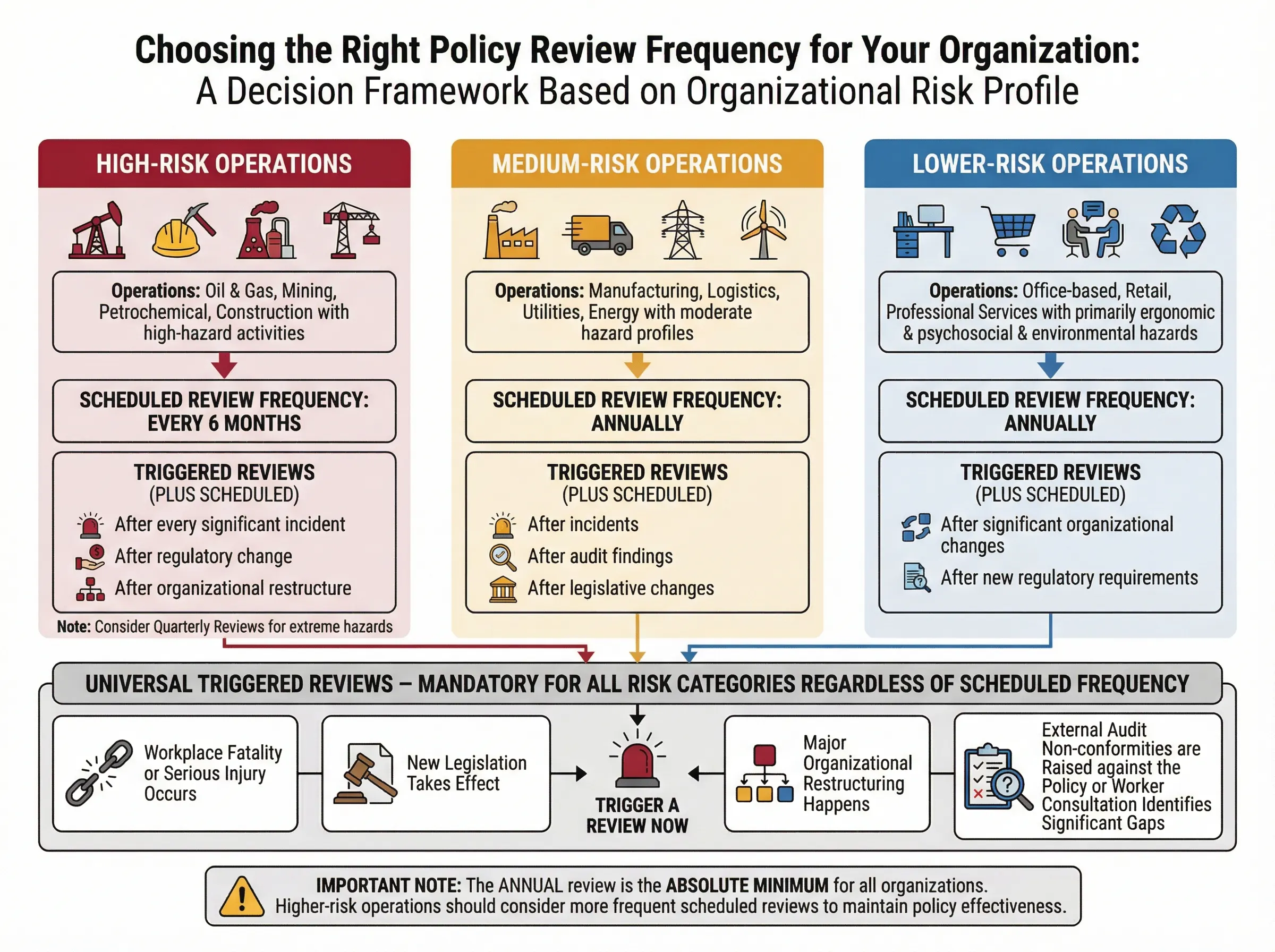
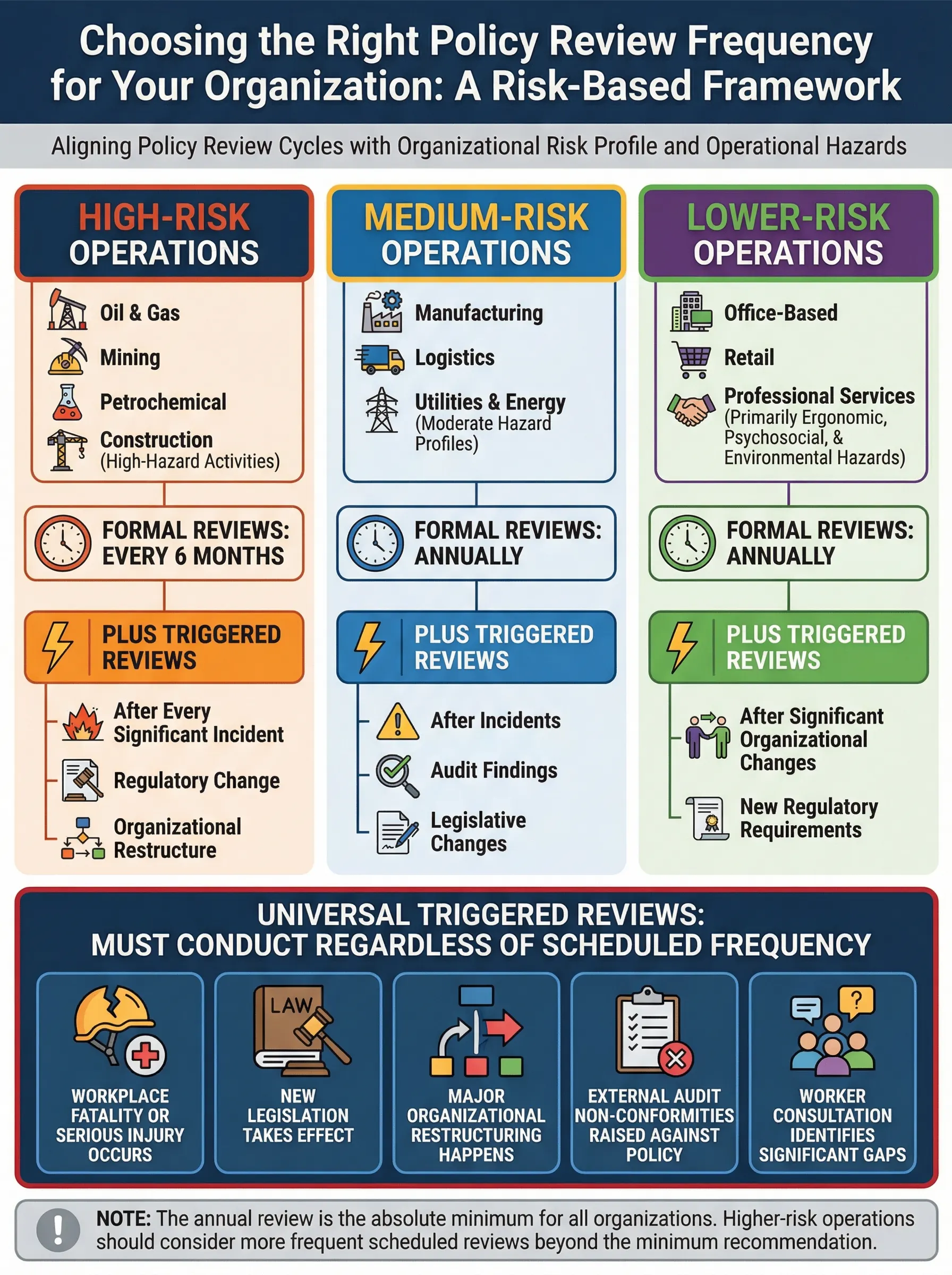
While annual review is the regulatory baseline, the optimal frequency depends on your organization's risk profile, rate of change, and operational complexity. A static office environment and a dynamic construction site with rotating subcontractors have fundamentally different review needs — and applying the same interval to both is a compliance shortcut, not a risk management strategy.
The factors that should influence your review frequency beyond the annual minimum include the considerations that distinguish mature safety management systems from minimum-compliance approaches:
Industry hazard level: High-hazard industries (oil and gas, mining, petrochemical, construction) should consider semi-annual formal reviews. The rate of change in hazard profiles, workforce composition, and regulatory requirements in these sectors makes annual review insufficient in many cases.
Rate of organizational change: Companies undergoing rapid growth, restructuring, mergers, or diversification need more frequent reviews because the operational context the policy was written for is shifting continuously.
Incident frequency and severity: If your organization is experiencing a rising trend in incidents or near-misses, waiting for the scheduled annual review to address potential policy gaps is a failure of safety leadership.
Regulatory environment: Jurisdictions with actively evolving safety legislation — or organizations operating across multiple jurisdictions — may need more frequent reviews to maintain legal compliance.
Workforce stability: High turnover, reliance on temporary workers, or frequent contractor changes mean the people the policy is supposed to protect are constantly changing. More frequent reviews ensure the policy and its communication remain relevant.
Conclusion
A health and safety policy that is not reviewed is a promise that has not been kept. It sits in a management file, carrying the weight of legal obligation and moral commitment, while the workplace it was supposed to govern has moved on — new hazards, new people, new regulations, new risks. The annual review cycle exists not because regulators enjoy paperwork, but because the gap between a written policy and operational reality grows wider with every month it goes unchecked. Review is the mechanism that closes that gap.
How often should health and safety policy be reviewed? At minimum, annually. In practice, as often as the organization and its risks demand it. Every significant incident, every legislative change, every audit finding, and every piece of worker feedback is a signal that the policy's relevance should be re-examined — not at the next scheduled review, but now. The organizations I have seen sustain the strongest safety performance over time are those that treat policy review as a continuous governance responsibility rather than a calendar obligation.
The policy is not a document. It is a declaration that the organization values human life above production, profit, and convenience. If that declaration is not tested against reality regularly, rigorously, and honestly — with workers in the room and evidence on the table — then it protects no one. And a policy that protects no one is worse than no policy at all, because it creates the illusion of safety where none exists.

Comments
Loading...