



I was auditing a multinational port expansion project when a heavy-lift crane operator suddenly shut down his engine mid-shift and walked off the cab. The wind speeds had spiked to 35 knots, exceeding the crane's safe operating limit, but the shift supervisor was screaming at the operator from the ground, threatening termination for delaying the critical path. As the site's Regulatory and Compliance Advisor, I immediately intervened, shielding the operator and citing the exact legal mechanism that protected him: his right to refuse unsafe work. The operator wasn't being difficult; he was exercising a fundamental, life-saving right that many workers don't even know they possess.
Global safety standards, specifically ILO Convention 155 (Article 19) and Recommendation 164 (Paragraph 16), form the legal and ethical backbone of occupational health and safety. These frameworks matter because they establish a crucial social contract on high-risk sites: workers are granted powerful rights to protect themselves from harm, but in return, they shoulder the serious responsibility of following safety rules and protecting their peers. This article breaks down exactly how these international mandates apply to daily operations, translating bureaucratic legal text into practical field reality so workers know their rights and responsibilities, and management knows how to enforce them fairly.
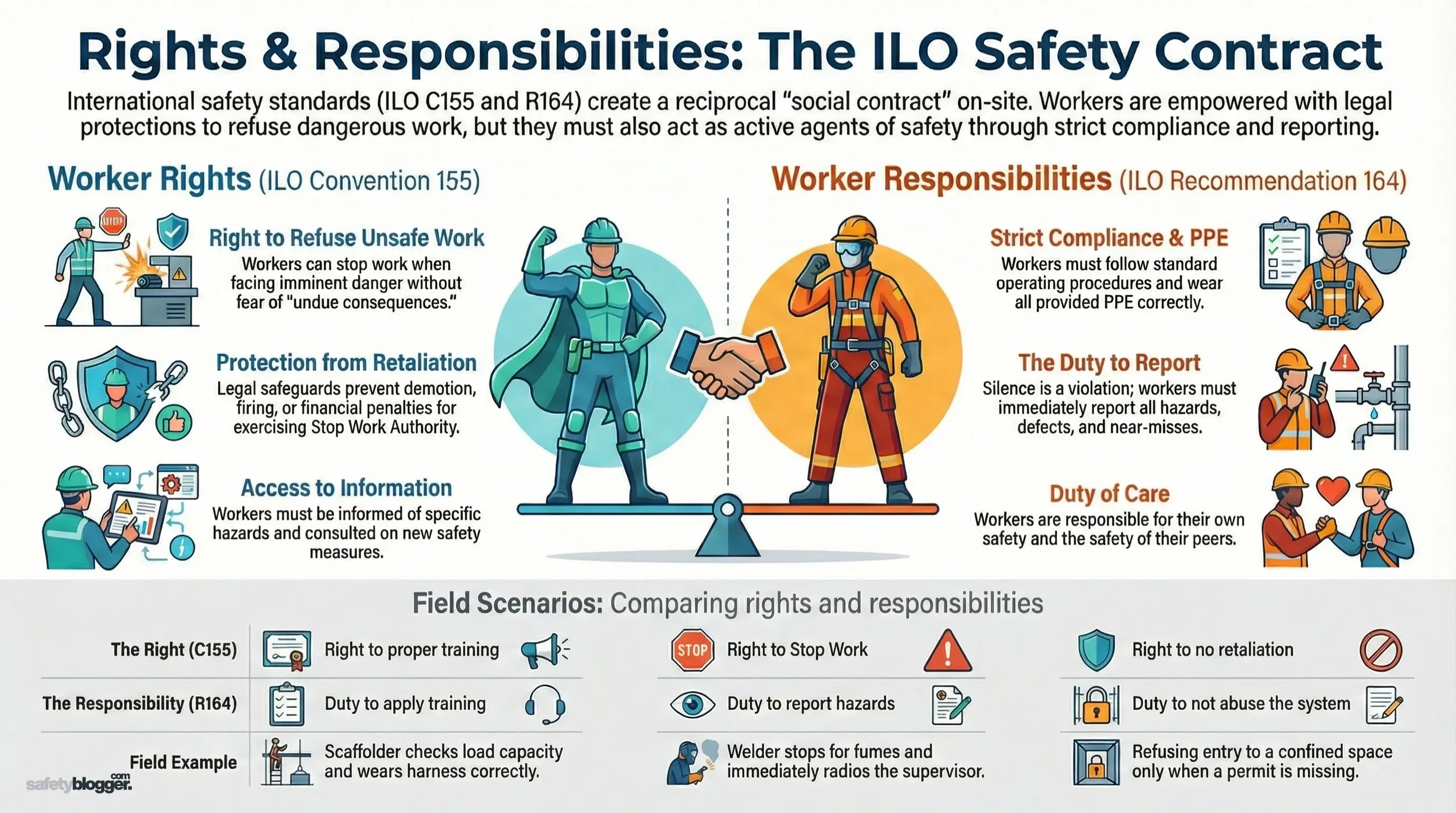
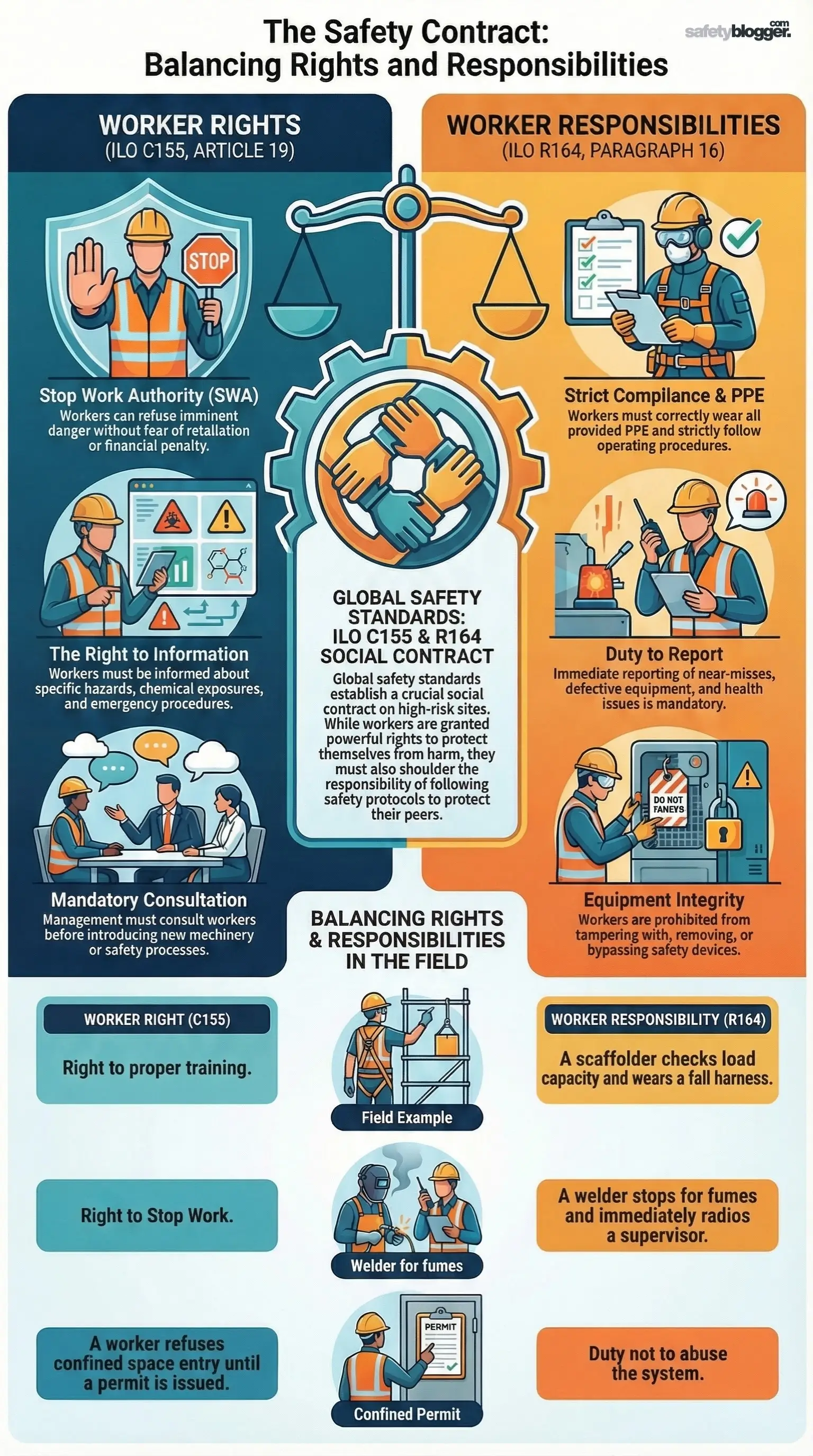
The Worker’s Right to Refuse Unsafe Work (C155, Article 19)
Article 19 of ILO Convention 155 explicitly mandates that workers must be protected from "undue consequences" when they remove themselves from a work situation that presents an imminent and serious danger. In the field, this is commonly operationalized as Stop Work Authority (SWA).
Far too often, workers are pressured to push through hazards under the guise of "getting the job done." Article 19 exists to legally break that pressure. On my sites, I make it clear to management that a worker’s perception of danger is enough to trigger a pause. The right includes:
Protection from Retaliation: Workers cannot be fired, demoted, or financially penalized for stopping a job they reasonably believe is unsafe.
Access to Information: Workers have the right to be informed about the specific hazards of their tasks, including chemical exposures, structural risks, and emergency procedures.
Consultation: Workers and their safety representatives must be consulted on health and safety measures before new machinery or processes are introduced.
Regulatory Reality: "A worker who has removed himself from a work situation which he has reasonable justification to believe presents an imminent and serious danger to his life or health shall be protected from undue consequences..." – ILO C155, Article 19(f)
The Worker’s Responsibility to Protect (R164, Paragraph 16)
While C155 grants rights, ILO Recommendation 164, Paragraph 16, outlines the equally vital responsibilities. A worker is not a passive bystander in their own safety; they are active agents who must take reasonable care of themselves and those around them.
In heavy industry, one worker's negligence can kill a co-worker in seconds. Therefore, the "duty of care" is strictly enforced. R164 mandates that workers must cooperate with their employer to fulfill safety obligations. Practically, this means:
Compliance with Procedures: Strict adherence to safety protocols, Permits to Work (PTW), and standard operating procedures (SOPs).
Proper Use of PPE: Wearing the provided PPE correctly—not modifying it, abandoning it, or using it inappropriately.
No Tampering: Workers are strictly prohibited from disconnecting, changing, or removing safety devices, such as machine guards, interlocks, or gas detection alarms.
The Duty to Report Hazards and Incidents
Another core responsibility under R164 is the immediate reporting of hazards, near-misses, and accidents. Silence is the greatest enemy of safety on any industrial site.
If a worker notices a frayed sling, a bypassed gas monitor, or a pool of hydraulic fluid, keeping quiet is a violation of their professional responsibility. Management cannot fix what they do not know about. I have investigated fatalities that occurred because a worker saw a missing handrail hours before the incident but assumed "someone else would report it." Under R164, reporting is not optional; it is mandatory.
Report defective equipment or tools immediately and tag them out of service.
Report any physical discomfort or health issues resulting from work (e.g., heat stress symptoms, chemical inhalation).
Report near-misses without fear of blame, as these are the leading indicators of future fatalities.
Field Application: Balancing Rights and Responsibilities
Translating these ILO frameworks into daily site culture requires clear communication and visible enforcement. It is not enough to post a legal notice on a bulletin board; it must become part of the daily workflow.
The Right (C155 - Art. 19) | The Responsibility (R164 - Para. 16) | Field Example |
Right to proper training & info. | Responsibility to attend training and apply it. | A scaffolder demands to see the load capacity (Right), but must also wear their fall arrest harness correctly (Responsibility). |
Right to Stop Work. | Responsibility to report the hazard immediately. | A welder stops hot work due to gas fumes (Right) and immediately radios the supervisor (Responsibility). |
Right to protection from retaliation. | Responsibility to not abuse the Stop Work system. | A worker refuses entry into a confined space without a permit (Right), rather than using it as an excuse to avoid work. |
Pro Tip: During daily Toolbox Talks, do not just recite rules. Actively ask your crew, "What condition today would make you use your Stop Work Authority?" This validates their Article 19 rights publicly and reinforces their R164 responsibility to stay vigilant.
Conclusion
The balance between ILO C155 Article 19 and R164 Recommendation 16 is the foundation of a surviving safety culture. Rights and responsibilities are two sides of the same coin: you cannot have a safe site without both. As HSE professionals and site leaders, we must aggressively defend a worker's right to say "no" to danger, while equally holding them accountable to their duty of care.
Ultimately, safety legislation is not about compliance audits or avoiding fines; it is about human preservation. A worker's life is infinitely more valuable than any project deadline. When we empower workers with their rights and equip them with their responsibilities, we ensure that the people who build our world get to go home to their families at the end of the shift.





Comments
Loading...