


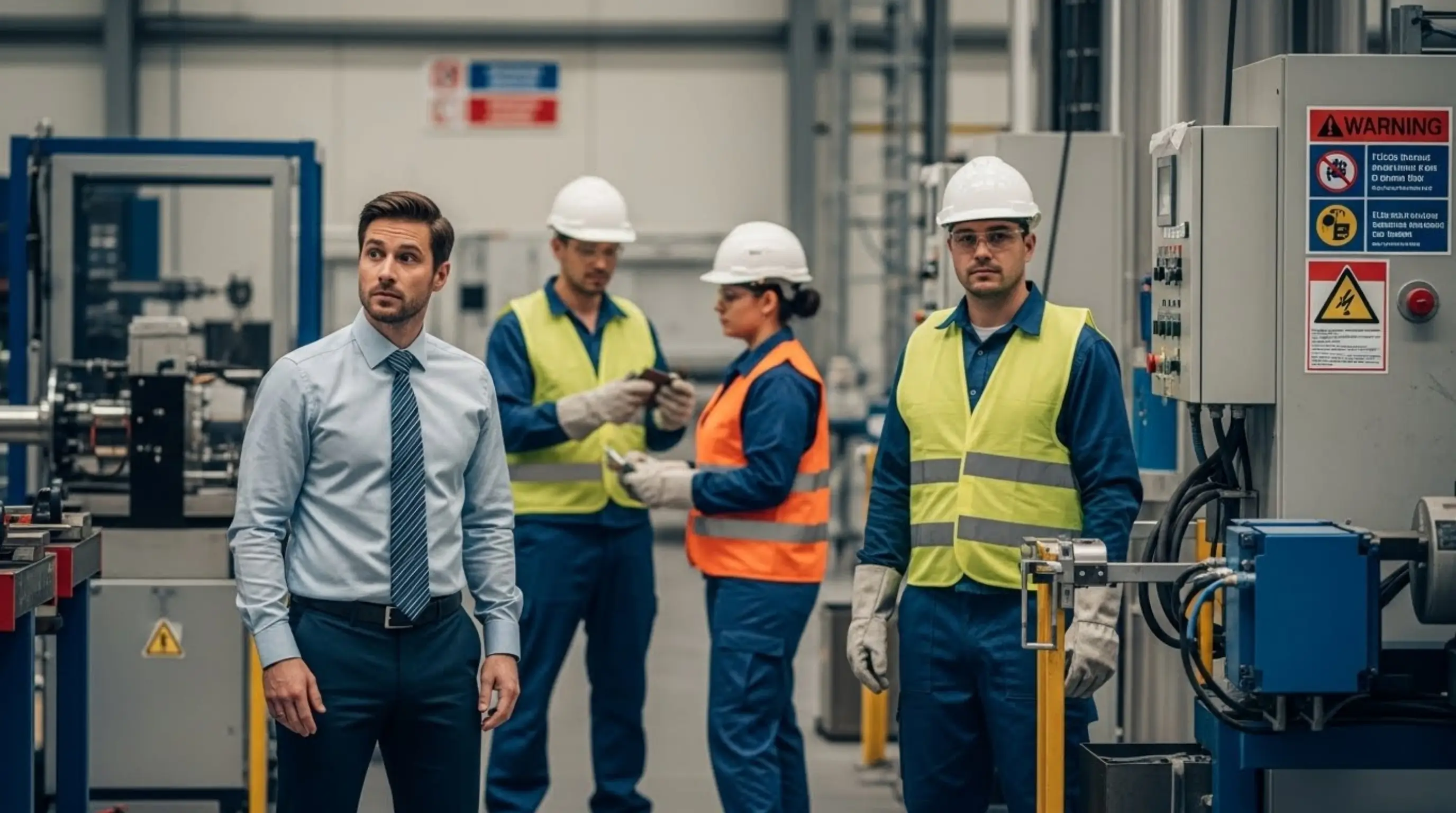
I once had to physically pull a senior client back by his high-visibility vest because he was about to step directly into the swing radius of an excavator. He wasn’t reckless; he was just looking up at the new piping rack we were installing, completely oblivious to the reversing alarm sounding three meters behind him. If I hadn’t been standing at his shoulder, that site tour would have turned into a fatality investigation.
That moment highlights exactly why visitors are often the most vulnerable people on any job site. While your daily workforce has developed a "safety sixth sense" through routine and repetition, visitors—whether they are clients, auditors, vendors, or corporate leadership—enter your site with a dangerous knowledge gap. They lack the muscle memory for your specific hazards, and without strict controls, that ignorance can be deadly.
1. The "Hazard Awareness" Deficit
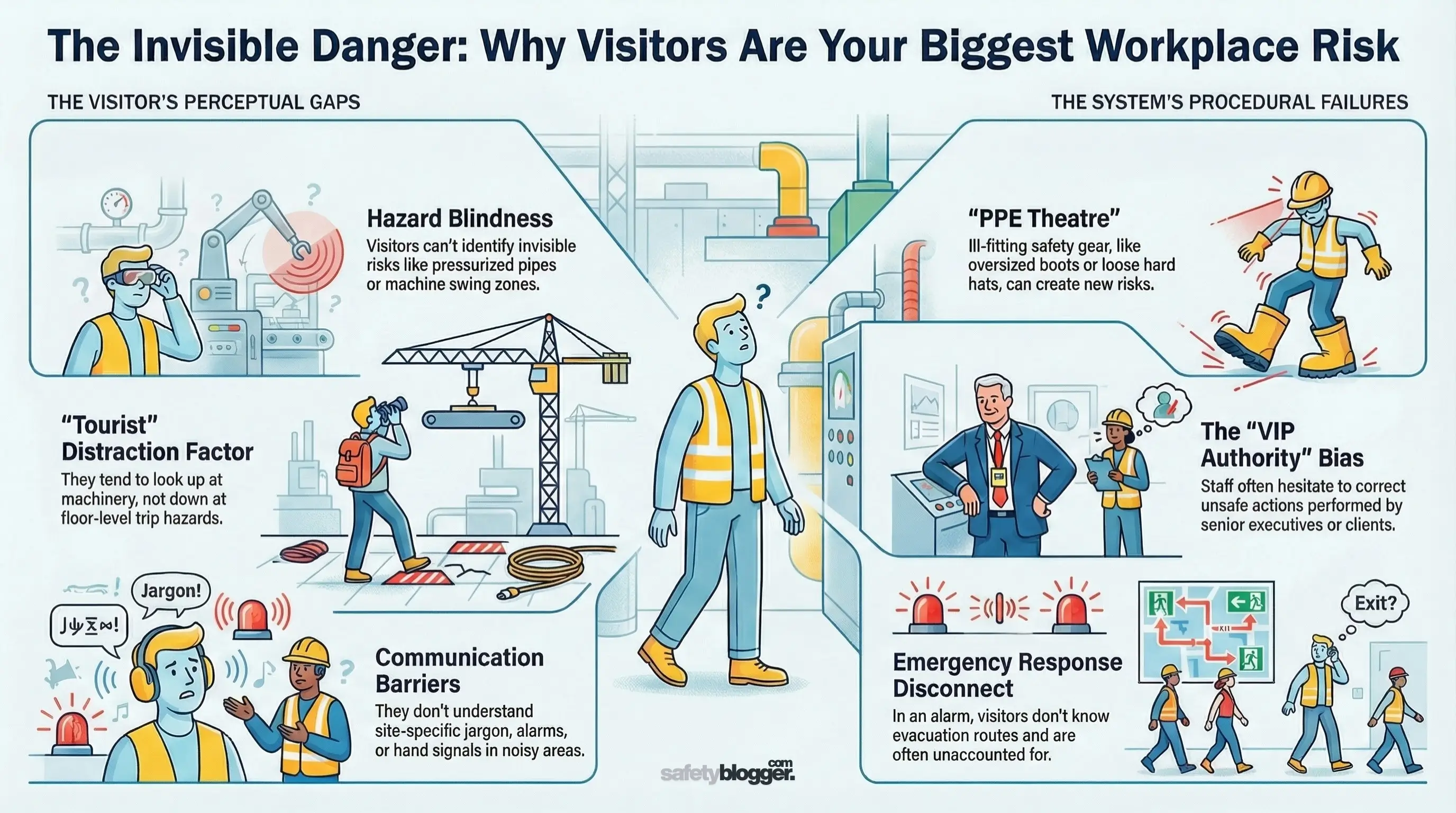
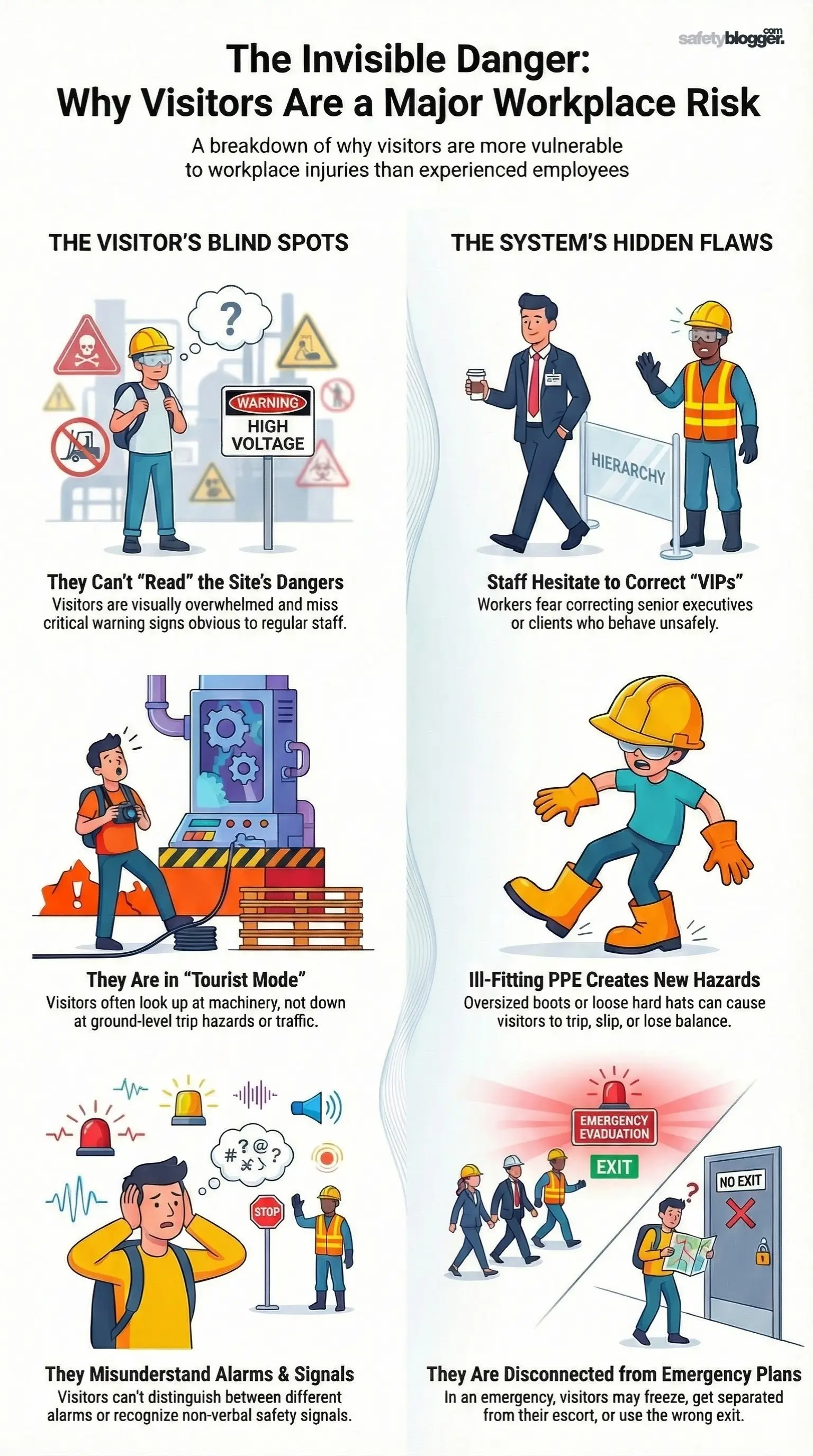
The primary reason visitors are at higher risk is the lack of site-specific hazard anticipation. An experienced employee walking through a chemical plant knows instinctively that a hissing sound might mean a steam leak, or that a specific floor marking indicates a forklift crossing. They don't just see the plant; they read it. Visitors, however, are visually overwhelmed and unable to filter critical warning signs from background noise.
Invisible Risks: Visitors cannot identify "stored energy" risks, such as pressurized pipes or tensioned cables, which look harmless but can be lethal if disturbed.
The "Line of Fire": Employees know exactly where a crane load will swing or where a pressure relief valve vents; visitors frequently position themselves directly in these "lines of fire" to get a better view.
Sensory Overload: The sheer volume of new sights, smells, and loud industrial noises creates cognitive tunneling, preventing them from noticing subtle indicators of danger.
2. The "Tourist" Distraction Factor
When employees walk the floor, they are usually focused on a task or a destination. When visitors walk the floor, they are often in "tourist mode." They tend to look up—at the high ceilings, the crane movements, or the impressive machinery—rather than down at where they are placing their feet.
Photography Risks: I have seen visitors walk backward into traffic lanes while trying to frame a photograph of a facility.
Tripping Hazards: Visitors looking at overhead assets miss common floor-level hazards like uneven expansion joints, bund walls, or temporary cabling.
Loss of Peripheral Vision: When focused on a tour guide or a specific piece of equipment, visitors lose their spatial awareness regarding moving vehicles or closing doors.
3. "PPE Theatre" vs. Effective Protection
We often fall into the trap of "PPE Theatre" with visitors—handing them a hard hat and a vest and assuming they are safe. In reality, ill-fitting or unfamiliar Personal Protective Equipment (PPE) can introduce new risks rather than mitigating them.
Ill-Fitting Footwear: Oversized visitor safety boots create a massive trip hazard, particularly on metal grating or stairs.
Hard Hat Instability: Visitors often do not ratchet their helmets tight; when they look up or down, the helmet slips, causing them to grab it and lose their balance or grip on handrails.
Vision Impairment: Visitors unfamiliar with safety glasses often suffer from fogging in humid areas or struggle to see clearly if wearing them over prescription glasses.
4. The "VIP Authority" Bias
A dangerous psychological dynamic occurs when the visitor is a senior executive, a client, or a regulator. Site workers and even supervisors often feel intimidated and hesitate to correct unsafe behaviors exhibited by these "VIPs," allowing them to wander into areas where regular employees would be stopped immediately.
Hesitation to Intervene: Frontline workers may fear disciplinary action if they shout "Stop!" at a person in a suit, even if that person is walking under a suspended load.
Protocol Bypassing: VIP visitors often skip standard security checks or shortcut safety briefings because they are "short on time," missing critical site-specific warnings.
The "Halo Effect": Visitors often assume that because they are with the Site Manager, a magical bubble of safety surrounds them, leading them to lower their guard completely.
5. Undisclosed Medical Vulnerabilities
With employees, we conduct medical check-ups and fitness-for-duty assessments. We know who has vertigo, who has asthma, and who has a heart condition. With visitors, we are flying blind. We often expose them to physical stressors their bodies cannot handle.
Physical Exertion: Walking up four flights of industrial stairs or navigating a humid boiler room can trigger cardiac events in visitors who are accustomed to sedentary office environments.
Vertigo and Heights: A visitor may not realize the site involves walking on open-grid Gantries at height until they are halfway across, leading to panic and freezing.
Chemical Sensitivity: Visitors may have undiagnosed sensitivities to specific industrial vapors or dusts that regular workers tolerate without issue.
6. Communication and Jargon Barriers
Industrial sites speak a specific language of acronyms, hand signals, and alarms. Visitors are fluent in none of these. In high-noise environments where verbal communication is impossible, this barrier becomes critical.
Misinterpreting Alarms: A visitor cannot distinguish between a "Process Warning Alarm" (stay put) and a "Gas Release Alarm" (evacuate uphill/upwind).
Unrecognized Hand Signals: A banksman signaling a crane operator to "stop" might be interpreted by a visitor as a wave or a signal that the path is clear.
Language Barriers: On international projects, visitors may not speak the operational language of the site, making verbal warnings from workers ineffective during a crisis.
7. The Emergency Response Disconnect
If the site evacuation alarm triggers right now, your employees know exactly what to do. They rely on drilled muscle memory. Visitors do not have this conditioning. In an emergency, the natural human response to an unknown alarm is to freeze or look to others for cues.
Separation Anxiety: If a visitor is separated from their escort (e.g., using the restroom) during an alarm, they have zero knowledge of escape routes.
Incorrect Egress: Visitors instinctively try to exit the way they entered, which might mean walking toward the fire or hazard, rather than using the nearest emergency exit.
Accountability Gaps: During the roll-call at the muster point, visitors are often forgotten or unaccounted for because they are not on the standard team rosters.
Conclusion
Visitors don't get hurt because they are clumsy; they get hurt because we fail to bridge the gap between their ignorance and our industrial reality. We cannot rely on a five-minute video induction to replace ten years of field experience.
If you are hosting visitors, your duty of care is absolute. You must be their eyes and ears. Never let a visitor walk more than arm's length from an escort, and never assume they see the danger just because it's obvious to you. In safety, what is obvious to the expert is often invisible to the guest.

Comments
Loading...