
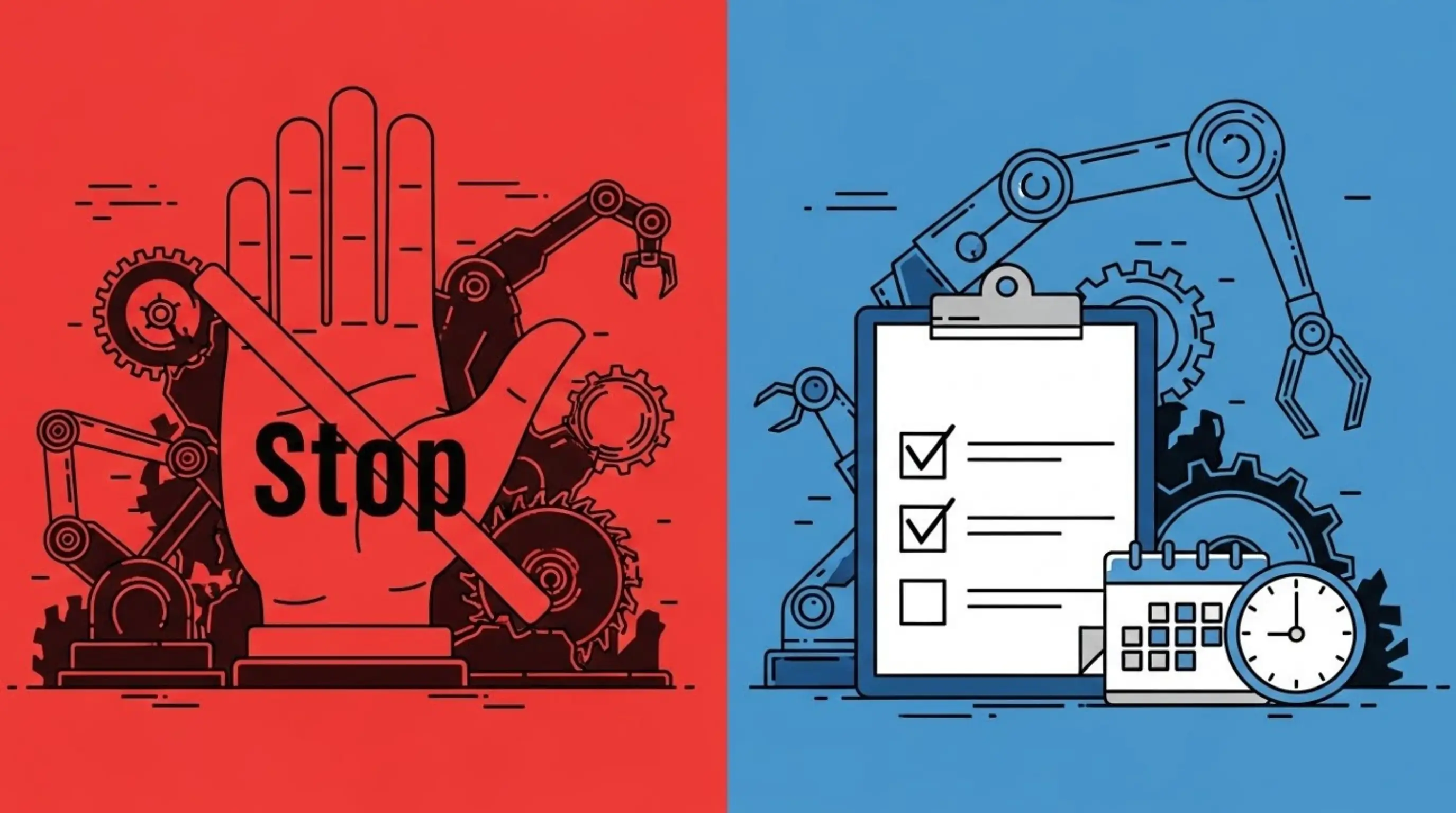
I remember the distinct, heavy silence that fell over a site office in Aberdeen when an HSE Inspector placed a Section 22 Prohibition Notice on the Project Manager’s desk. It wasn’t a negotiation; it was a statutory command that immediately ceased a critical lifting operation, costing the project thousands of pounds per hour. At that moment, the theory of "safety culture" collided violently with the reality of criminal law. For any HSE professional or site leader, understanding the mechanics of these notices is not just about passing an exam; it is about business survival and protecting your personal liberty.
This article dissects the statutory arsenal available to safety inspectors, primarily focusing on the UK Health and Safety at Work etc. Act 1974 (HSWA), which serves as a model for many global frameworks. I will break down the specific legal triggers for Improvement and Prohibition Notices, the internal "Enforcement Management Model" (EMM) inspectors use to decide your fate, and the financial sting of Fee For Intervention (FFI). We will move beyond textbook definitions to look at the strategic responses required when an inspector opens their notebook.
The Statutory Authority: Power of the Inspector
The authority of a safety inspector is immense and often underestimated until it is exercised. Under Section 19 of the HSWA, inspectors are appointed with powers that, in specific contexts, exceed those of the police. They do not need a warrant to enter your facility, they do not need permission to interview your staff, and they do not need your agreement to seize evidence.
However, the power to inspect is distinct from the power to enforce. When an inspector identifies a gap between your operations and the legal standards, they have a range of options. These range from verbal advice for minor issues to prosecution for major failures. The Enforcement Notice sits in the middle: it is a formal, legal instruction to remedy a breach.
The Foundation of "Opinion"
Crucially, the issuance of a notice relies on the inspector's opinion. The legislation specifically states "if the inspector is of the opinion that...".
This means they do not need to prove the breach in a court of law before issuing the notice.
The notice is effective immediately (or on the specified date).
The burden shifts to you, the duty holder, to prove them wrong through an appeal if you disagree.
Pro Tip: Never argue regarding an inspector's "opinion" with aggression. If you believe they are factually incorrect, present the evidence (maintenance logs, training records) immediately and calmly. An opinion can be changed on-site with data; it is much harder to change once written on a notice.
The Improvement Notice (Section 21)
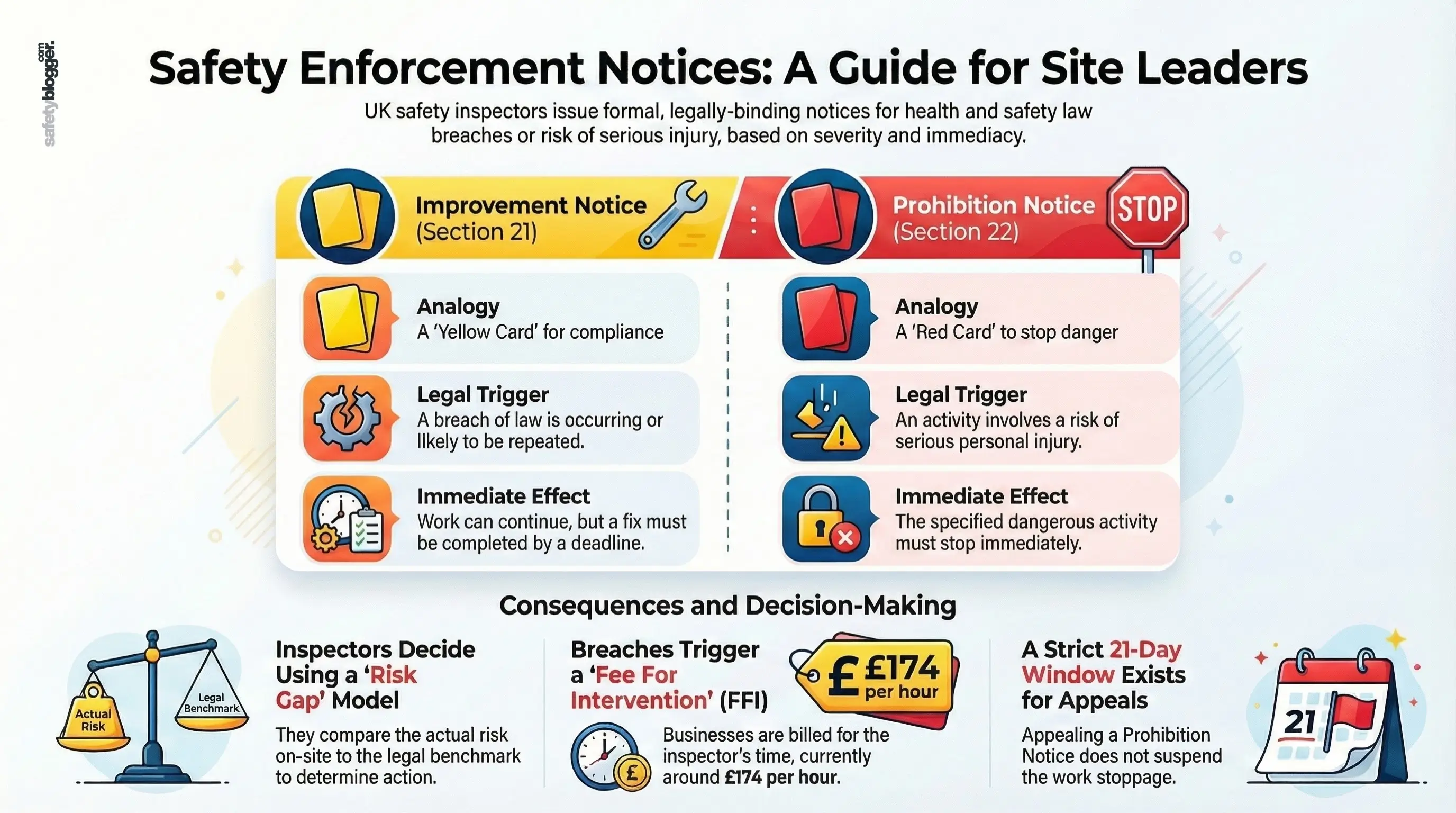
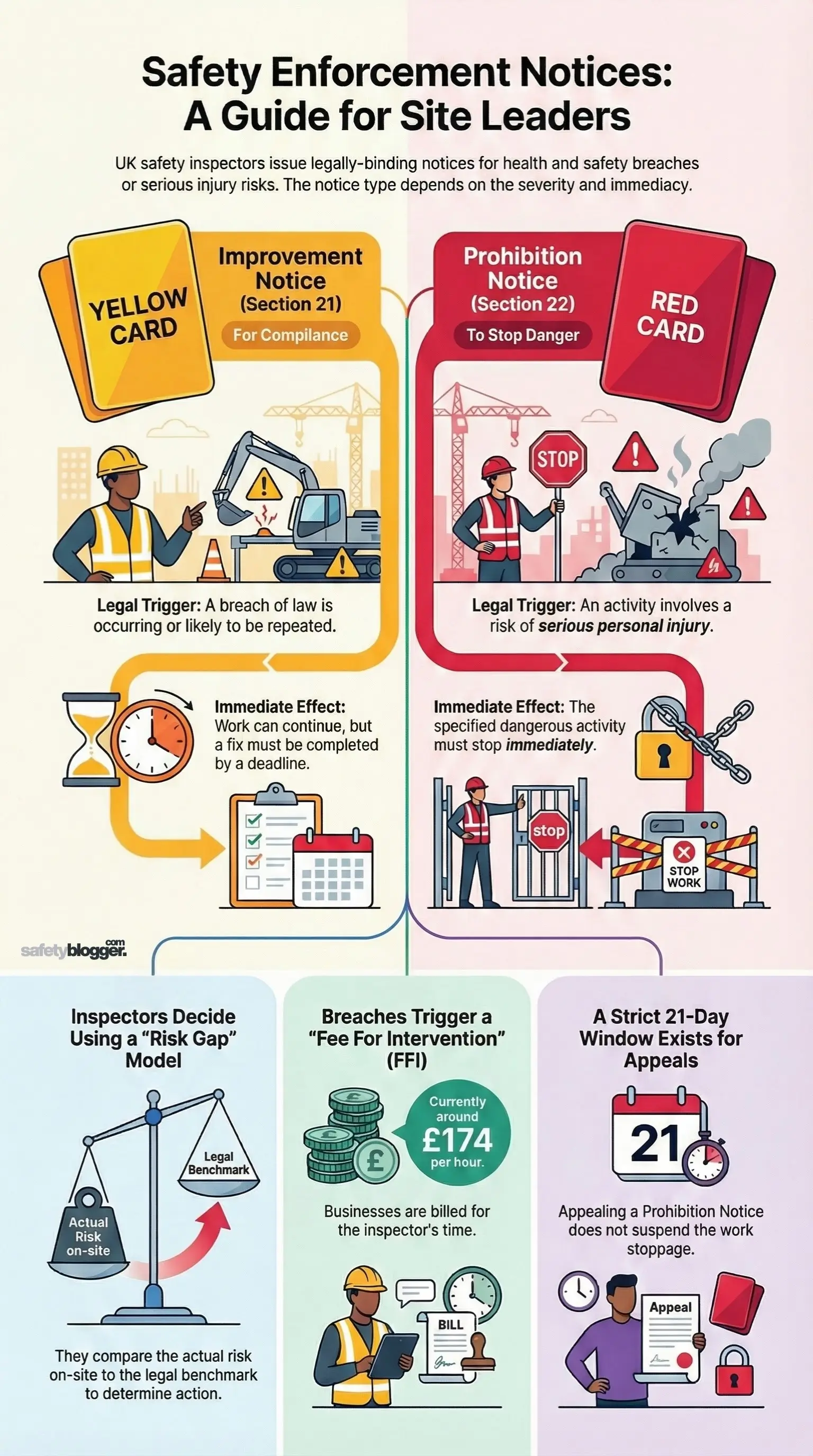
The Improvement Notice is the corrective workhorse of the regulatory world. It is used when a breach is serious enough to warrant formal action, but does not pose an immediate risk of serious personal injury. I have seen these issued most frequently for systemic failures: lack of risk assessments, poor training records, or welfare facility deficiencies.
The Legal Trigger
Under Section 21 of HSWA, an inspector serves this notice if they are of the opinion that a person:
Is contravening one or more relevant statutory provisions.
Has contravened a provision in circumstances that make it likely the contravention will continue or be repeated.
The key phrase here is "likely to continue." You cannot receive an Improvement Notice for a past mistake that has already been fixed and cannot happen again. It is a forward-looking instrument designed to secure future compliance.
The Compliance Period
The notice must specify the regulation being breached and set a time limit for the work to be completed.
Minimum Period: The period cannot be less than 21 days.
Reason: This aligns with your statutory right to appeal (see Section 6).
Extension: An inspector can extend this period, but only if you ask for the extension before the original deadline expires.
Field Experience: If you receive an Improvement Notice, do not just file it. Create a project plan. If you see you will miss the deadline due to supply chain issues (e.g., waiting for parts for a guarded machine), apply for an extension in writing immediately. Inspectors are usually reasonable if you show progress; they are ruthless if you simply ignore the date.
The Prohibition Notice (Section 22)
This is the "red card." A Prohibition Notice stops work dead. I have managed the aftermath of these notices on major construction projects, and the disruption is total. Unlike the Improvement Notice, this tool is used when the risk is too high to allow operations to continue for even one more minute.
The Legal Trigger
Under Section 22, an inspector serves this notice if they are of the opinion that an activity:
Involves, or will involve, a risk of serious personal injury.
Note the difference: Section 21 requires a breach of law. Section 22 theoretically does not—it only requires a risk of serious injury (though in practice, a breach is almost always cited).
Immediate vs. Deferred
Immediate Prohibition: The most common form. The activity must stop instantly. This is typical for work at height without guardrails, unshored excavations, or bypassing safety interlocks on machinery.
Deferred Prohibition: The inspector sets a future time for the stop. I have seen this used in chemical processing where an immediate emergency shutdown would be more dangerous than a controlled, phased shutdown over a few hours.
The "Serious Personal Injury" Threshold
The risk must be significant. We are talking about broken bones, amputations, permanent health damage (like silicosis), or death. A trip hazard on a flat floor rarely triggers a Prohibition Notice; a fall hazard from a roof always will.
The Enforcement Management Model (EMM)
Inspectors do not flip a coin to decide which notice to serve. They use a logical framework called the Enforcement Management Model (EMM). Understanding this model allows you, as a Regulatory Affairs Advisor or Manager, to predict the outcome of an inspection.
The Risk Gap
The inspector calculates the "Risk Gap." They compare the Actual Risk (what they see on your site) against the Benchmark Risk (what the risk would be if you followed the law).
Extreme Gap: Usually triggers Prohibition.
Substantial Gap: Usually triggers Improvement Notice.
Nominal Gap: Usually triggers advice or a letter.
Duty Holder Factors
This is where your management attitude matters. The inspector adjusts their enforcement action based on:
History: Do you have previous notices?
Confidence: Do you appear competent? Is your management system robust?
Intent: Was this a mistake, or are you cutting corners for profit?
If you have a "Substantial Gap" but you are hostile, have a bad history, and show no competence, the inspector will escalate their action—potentially moving from a notice to a prosecution.
Fee For Intervention (FFI)
In the UK, if you receive a notice, you pay for it. The HSE operates under a "Polluter Pays" principle known as Fee For Intervention.
Material Breach
If an inspector identifies a "Material Breach"—which is any breach serious enough to warrant a formal notification (letter or notice)—you are liable for the costs.
You pay for the inspector's time on site.
You pay for the time spent writing the notice.
You pay for any specialists they bring in.
You pay for follow-up visits to check compliance.
The hourly rate (currently around £174) adds up quickly. I have seen simple interventions result in invoices of several thousand pounds. This turns a safety failure into a direct hit on the project budget, often alerting senior directors who track P&L more closely than safety stats.
Appeals and Strategic Defense
You have the right to challenge a notice, but the window is narrow and strict. Appeals are heard by the Employment Tribunal.
The 21-Day Rule
You must lodge an appeal within 21 days of the service of the notice. There is almost zero flexibility here. If you miss this deadline, the notice stands, and the breach is a matter of public record.
The Suspension Effect
Improvement Notice: Lodging an appeal suspends the notice. You do not have to complete the work until the appeal is resolved. This can be a tactical decision if the timeline is impossible, though it should not be abused.
Prohibition Notice: Lodging an appeal does NOT suspend the notice. The work must remain stopped. To restart, you must apply for a specific direction from the Tribunal, which is rarely granted without overwhelming evidence.
R v. Chevron: A Game Changer
In the landmark case R v. Chevron, the Supreme Court ruled that an appeal can consider evidence that the inspector did not see. If you can prove via expert analysis (after the fact) that the risk did not actually exist, you can overturn a Prohibition Notice. This emphasizes the value of technical evidence over mere opinion.
Global Comparison: Beyond the UK
While the UK model is robust, many of us work on international projects. It is useful to map these concepts to other jurisdictions.
United States (OSHA)
Citations: OSHA issues "Citations" rather than Notices.
Fines: Unlike the UK, where fines come from court prosecution, OSHA citations come with proposed monetary penalties attached immediately.
Abatement: Similar to an Improvement Notice, you are given a date to "abate" (fix) the hazard.
Imminent Danger: OSHA inspectors generally cannot unilaterally shut down a site (unlike UK inspectors). If an employer refuses to stop, OSHA must seek a court order (injunction), although in practice, most employers comply immediately.
Australia
Australia's Harmonised WHS laws heavily mirror the UK system. They utilize Improvement and Prohibition Notices with almost identical triggers ("serious risk to health or safety"). However, Australia often includes an internal review process within the regulator before proceeding to an external tribunal.
Conclusion
An enforcement notice is not merely a piece of administrative paperwork; it is a permanent scar on your corporate compliance record. It impacts your ability to tender for future work, increases your insurance premiums, and incurs direct FFI costs. More importantly, it signals a failure in your moral obligation to protect your workforce.
As regulatory professionals, our goal is to ensure that the "Risk Gap" never opens wide enough for an inspector to step in. But if a notice is served, the response must be swift, strategic, and technically sound. We must understand the nuance between a Section 21 and Section 22, the power of the appeal process, and the critical importance of demonstrating competence to influence the Enforcement Management Model. Compliance is not just about following rules; it is about managing the reality of risk in a way that withstands the scrutiny of the law.





Comments
Loading...