



I was sitting in a tense board meeting last quarter, defending a budget increase for psychosocial risk assessments, when a non-executive director interrupted me not with a financial question, but a reputational one: "If we have a suicide on site, does our ISO 45001 certification protect our stock price?" That moment crystallized what I have seen evolving over my 20-year career: safety is no longer just about hard hats and guardrails; it is being aggressively reshaped by forces outside the perimeter fence. We used to write standards based on engineering failures; now, we often write them in response to hashtags, lawsuits, and investor demands.
In this article, I will break down the seven massive societal shifts that are currently forcing us to rewrite our safety playbooks. I will strip away the academic theory and show you exactly how factors like the ESG revolution, the aging workforce, and the "always-on" media cycle are directly influencing the standards we audit against and the priorities we set in the field. This matters because if you are still managing safety purely based on the regulatory rulebook of 2010, you are already non-compliant with the societal expectations of 2025.
1. The ESG Revolution and Investor Governance
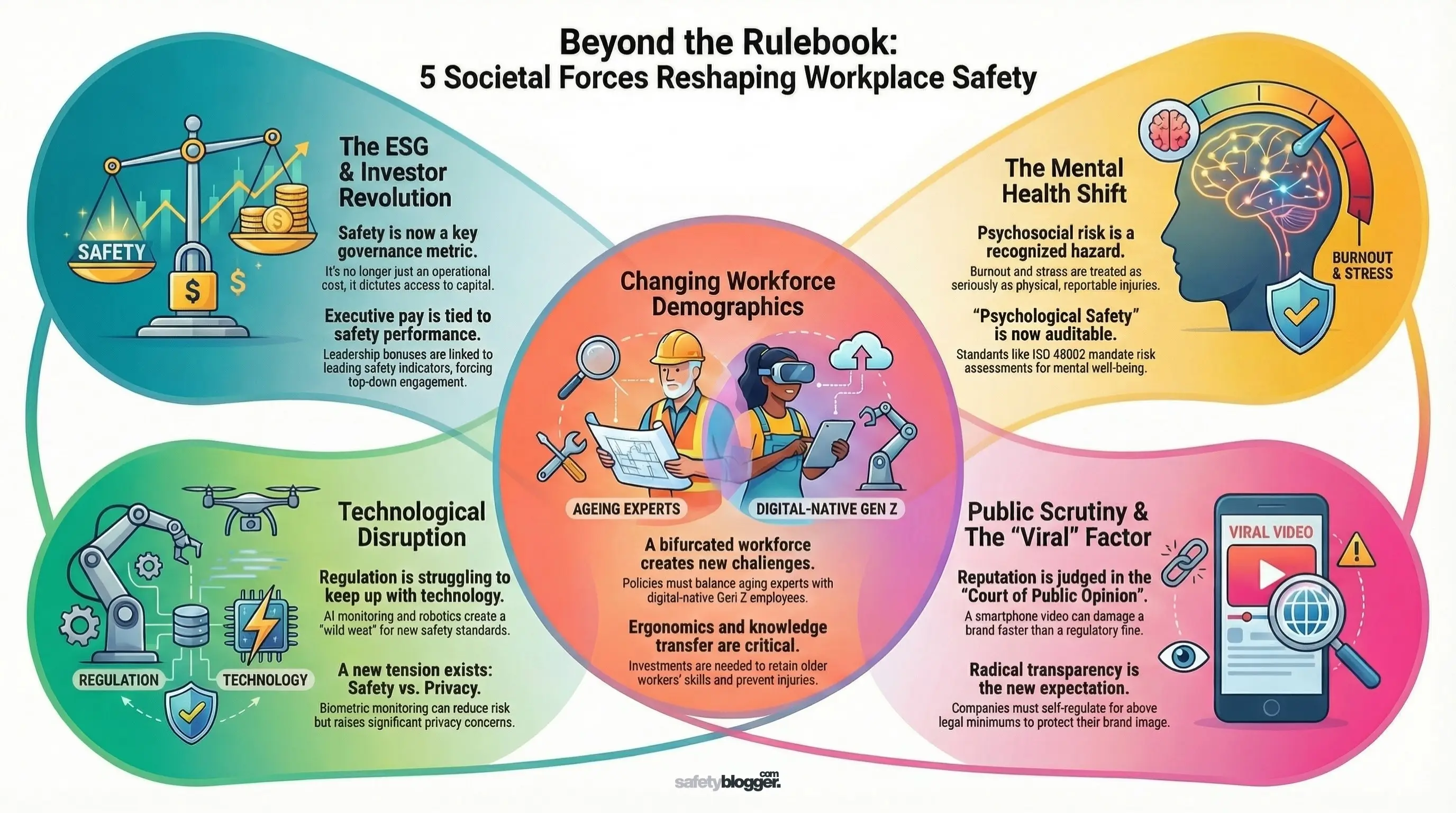
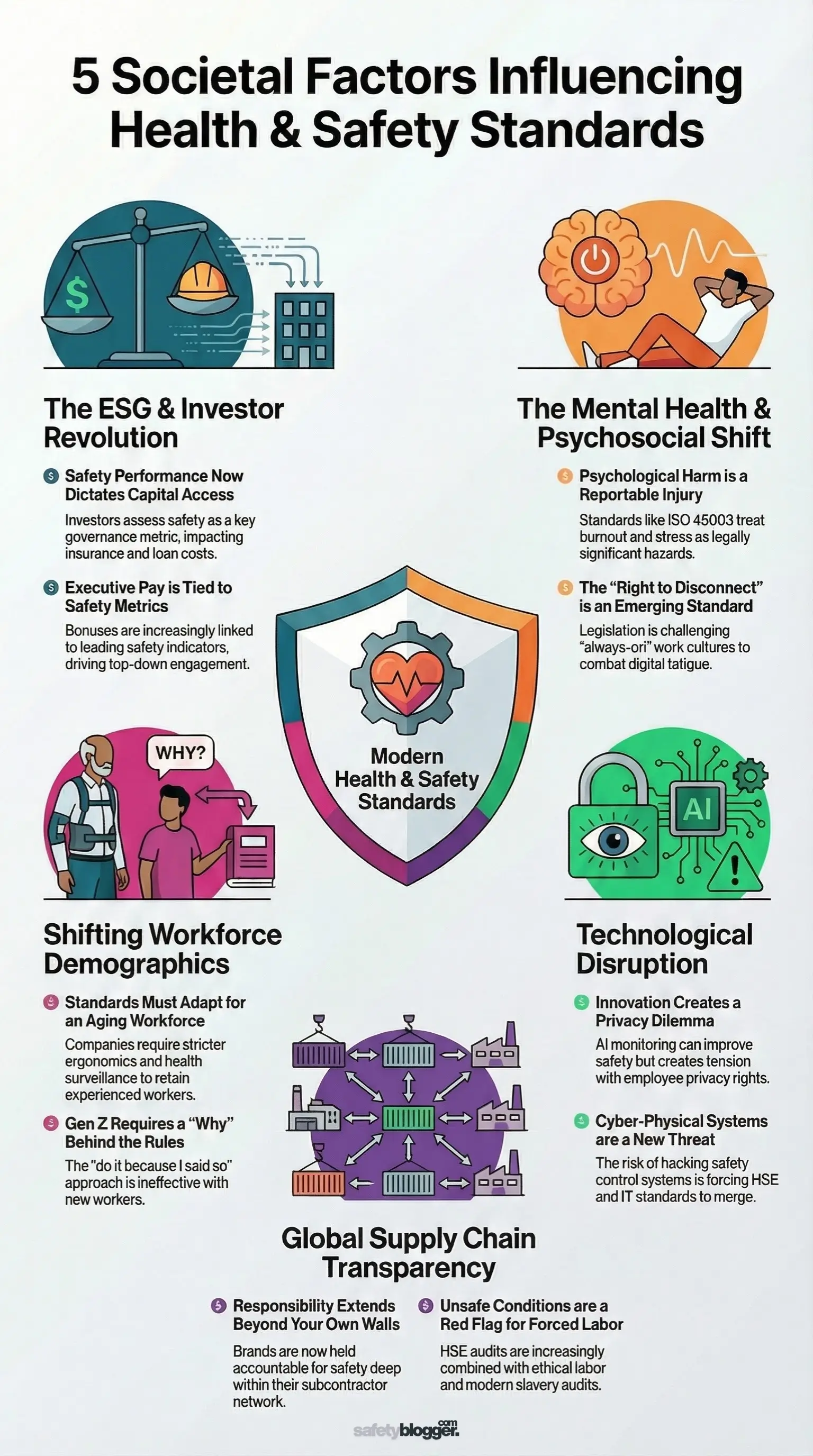
In the past, safety was an operational expense we tried to minimize; today, it is a governance metric that dictates capital access. Investors are no longer satisfied with lagging indicators like Lost Time Injury (LTI) rates; they are demanding proof of robust governance structures under the "G" in ESG (Environmental, Social, and Governance). I have seen audit scopes expand drastically to include board-level oversight of safety culture, moving HSE from the site office to the boardroom agenda.
Capital Cost: Poor safety records now directly increase insurance premiums and the cost of borrowing capital.
Transparency: Investors demand granular data on near-miss reporting and remedial actions, not just sanitized injury stats.
Executive Pay: We are increasingly seeing executive bonuses tied directly to leading safety indicators, forcing top-down engagement.
Pro Tip: When presenting to leadership, stop talking about "compliance costs." Frame your safety budget as "ESG risk assurance." It changes the conversation from spending to investing.
2. The Mental Health and Psychosocial Shift
Ten years ago, if a worker seemed stressed, we told them to "take a break." Today, under frameworks like ISO 45003, psychosocial risk is a hazard as legally significant as a chemical spill. Society no longer accepts that a paycheck justifies psychological harm, and this has forced regulators to treat burnout, harassment, and stress as reportable workplace injuries.
Regulatory Expansion: Standards are evolving to require "psychological safety" risk assessments alongside physical ones.
The Right to Disconnect: Legislation in Europe and trends globally are challenging the "always-on" culture, forcing HSE to monitor working hours and digital fatigue.
Stigma Reduction: Younger generations act as a forcing function, demanding mental health support that older generations suffered without.
3. Workforce Demographics: The "Graying" vs. Gen Z
We are managing a bifurcated workforce: older workers with immense experience but declining physical resilience, and younger workers who are digital natives but often lack hazard perception. I have had to approve ergonomic investments for aging operators that would have been laughed at a decade ago, simply because we cannot afford to lose their expertise to back injuries.
Aging Workforce: Mandates stricter ergonomics, shorter shifts for high-fatigue roles, and more frequent health surveillance (e.g., cardiac monitoring).
Knowledge Transfer: The retirement wave is a massive safety risk; standards now emphasize "organizational knowledge" retention (ISO 9001/45001).
Gen Z Expectations: New entrants demand a "Why?" for every rule. The "do it because I said so" command-and-control safety style is dead; it leads to turnover and non-compliance.
4. Technological Disruption and Digital Trust
Technology has moved faster than regulation, creating a "wild west" of safety standards. I have audited sites where AI cameras monitor PPE compliance, creating a massive tension between safety enforcement and privacy rights. Society demands we use technology to save lives, but also that we don't turn workplaces into panopticons.
AI and Automation: Robots remove humans from the line of fire (e.g., confined space drones), but introduce complex maintenance hazards.
Data Privacy: Biometric monitoring (smartwatches for fatigue) is technically possible but legally and socially explosive.
Cyber-Physical Risks: Hacking a safety control system is now a real threat; HSE and IT standards are merging (e.g., IEC 62443).
5. Global Supply Chain Transparency
You can no longer outsource your risk. Society now holds the primary brand responsible for the safety of the subcontractor's subcontractor three tiers down. I recall a major client firing a prime contractor not because their stats were bad, but because a sub-vendor in a developing nation was caught cutting corners on video.
Duty of Care Extension: "Out of sight, out of mind" is not a legal defense; audits now must penetrate deep into the supply chain.
Modern Slavery Links: HSE audits are increasingly paired with ethical labor audits; unsafe conditions are often a red flag for forced labor.
Harmonization: Companies are pushing ISO 45001 down the supply chain to create a unified safety language across borders.
6. Public Scrutiny and the "Viral" Factor
Social media has weaponized public perception. An unsafe act caught on a smartphone can destroy a company’s reputation faster than a regulator can issue a fine. This "judicial societal expectation" forces companies to self-regulate far above the legal minimums to avoid the court of public opinion.
Radical Transparency: Incidents are often reported on Twitter before the HSE manager gets the phone call.
Brand Protection: Safety policies are now reviewed by PR and Legal teams to ensure they align with public values, not just legal text.
Whistleblower Empowerment: Digital platforms give workers a voice to bypass internal reporting lines if they feel ignored, forcing internal systems to be more responsive.
7. Economic Volatility and "Lean" Operations
Economic pressure is the dark horse of safety standards. When margins get tight, the societal pressure to "keep the lights on" often clashes with safety protocols. However, the modern societal counter-weight is that "cutting safety is bad business." We are seeing a trend where lean manufacturing principles are being rigorously audited to ensure they don't strip away safety margins.
Doing More with Less: High-efficiency targets often lead to "hurry up" errors; safety standards are adapting to focus on "human factors" in high-pressure environments.
Gig Economy Safety: The rise of contract labor challenges traditional training models; standards are struggling to adapt to workers who are only on site for two days.
Resource Allocation: In downturns, I look for "smart" safety spending (tech/training) rather than just cutting the PPE budget.
Conclusion
The days of the HSE professional sitting in a silo, quoting section numbers from a dusty binder, are over. The factors influencing us today—from the mental health crisis to the relentless gaze of the smartphone camera—are societal, not technical. We are no longer just preventing accidents; we are managing the intersection of human rights, corporate ethics, and operational reality.
If you ignore these societal shifts, you aren't just risking a fine; you are risking your social license to operate. The most effective safety leaders I know are the ones who read the news as closely as they read the regulations.


Comments
Loading...