



During a recent ISO 45001 surveillance audit at a major petrochemical complex, I asked the site director how they planned to achieve their primary HSE objective: “Reduce accidents by the end of the year.” He pointed to a "Safety First" poster on the wall and mentioned they were reminding workers to be careful during toolbox talks. That was it—no baseline data, no specific reduction percentage, and no assigned resources. Unsurprisingly, their incident rates had plateaued for three years, and worker engagement was at an all-time low. This is the reality I see across global megaprojects and heavy industries: corporate safety goals are often written in boardrooms as wishful statements, completely disconnected from the operational reality of the shop floor.
When safety objectives are vague, accountability vanishes, hazard controls degrade, and eventually, someone gets hurt. In this article, I will break down how to set Health and Safety objectives and targets using the SMART framework—Specific, Measurable, Achievable, Relevant, and Time-bound. We will explore how to transition from reactive, lagging metrics like injury rates to proactive, leading indicators that drive genuine performance. This matters because setting the right targets is not just about satisfying auditors or winning contract bids; it is about creating a roadmap that actively prevents fatalities and occupational illnesses on your watch.
The Danger of Generic Safety Goals
I have reviewed hundreds of risk registers and corporate safety plans, and the most dangerous element is often a lack of clarity. When an objective cannot be measured, it cannot be managed.
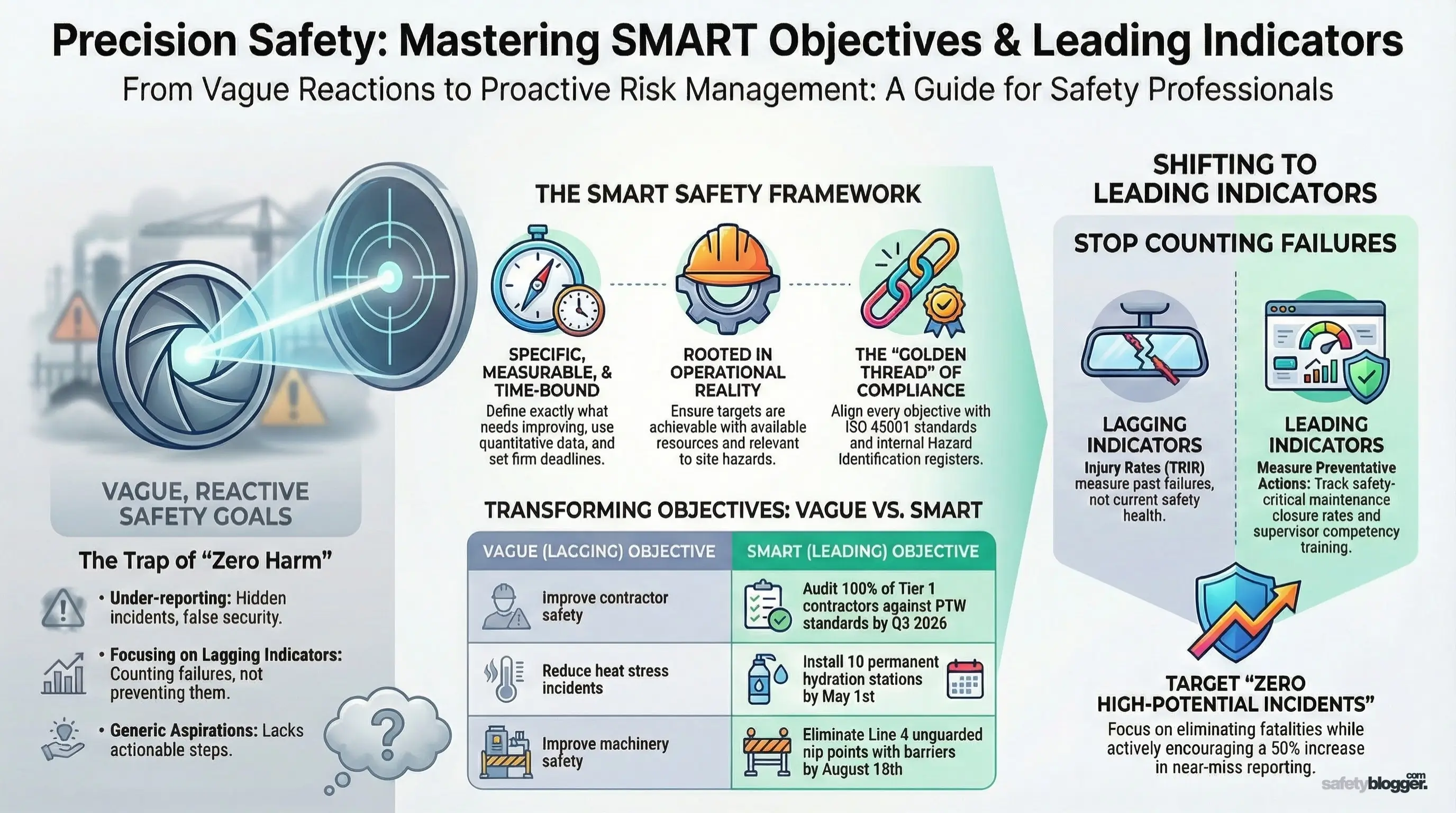
Vague goals create a false sense of security among management while leaving site supervisors confused about where to focus their daily efforts. If your only target is "Zero Harm," you are essentially telling your workforce that any incident is a failure, which inevitably drives the reporting of near-misses and minor injuries underground.
Symptoms of Poor Objective Setting
In the field, poor safety objectives manifest in very specific operational failures:
Over-reliance on lagging indicators like Total Recordable Incident Rate (TRIR) to measure success.
Lack of budget or resource allocation for critical safety improvements.
Supervisors cannot explain how their daily tasks contribute to the company’s safety goals.
The HSE department takes sole responsibility for safety targets, rather than operations management.
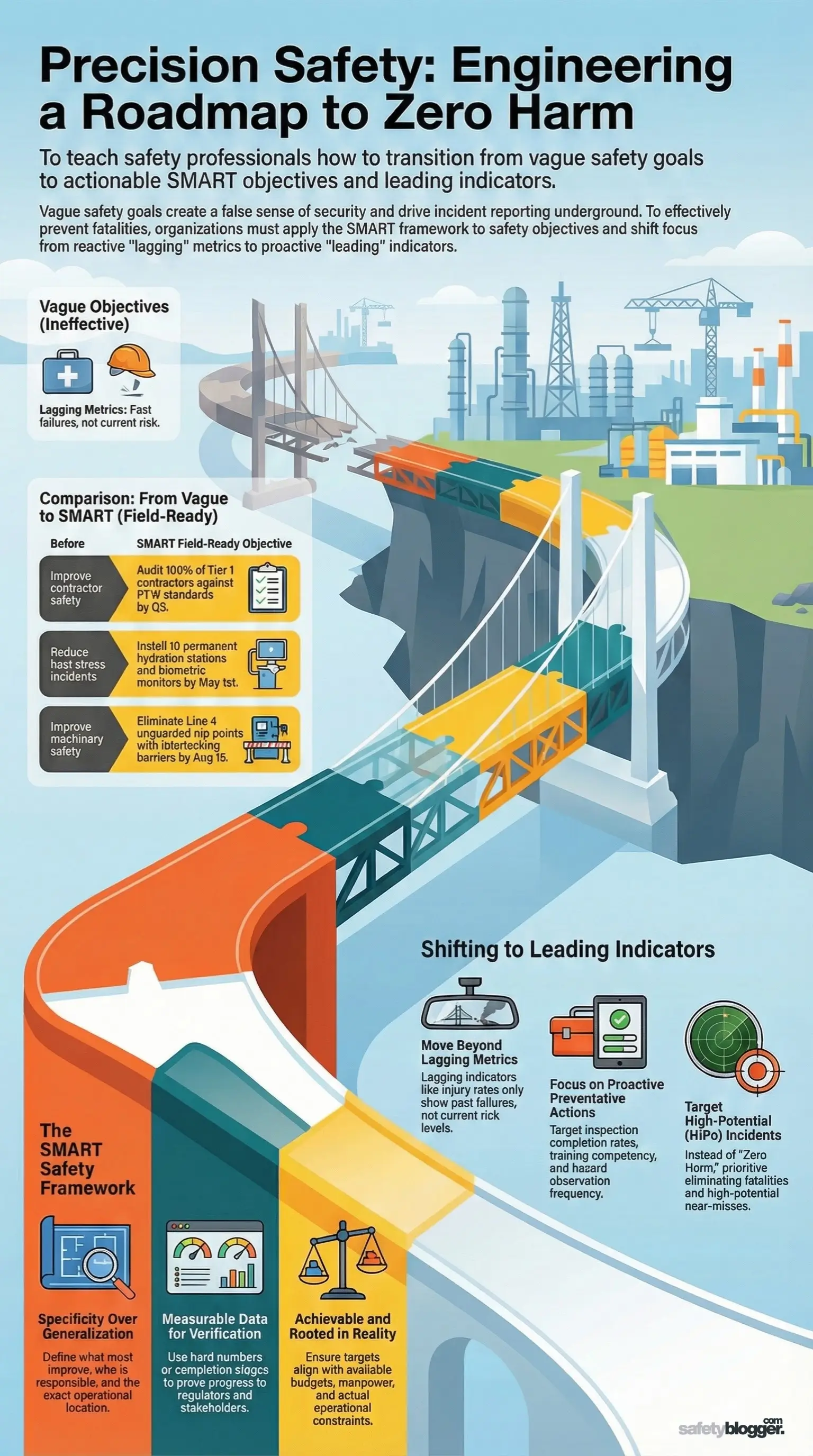
Pro Tip: Never adopt "Zero Harm" as an uncalibrated objective. Instead, target "Zero Fatalities" and "Zero High-Potential (HiPo) Incidents," coupled with an objective to increase near-miss reporting by 50%. You want to find the failures before they find your workers.
Applying SMART Principles to HSE Operations
Setting safety targets requires the same precision as engineering a scaffolding structure or calibrating a gas monitor. The SMART framework ensures your objectives hold weight in the field.
To make safety objectives effective, we must deconstruct them using practical criteria.
Specific
Generalizations kill accountability. An objective must clearly define what needs to be improved, who is responsible, and where the action will take place. Instead of "improve chemical safety," specify "eliminate manual decanting of corrosive chemicals in the processing area."
Measurable
If you cannot track it, you cannot verify it. You need quantitative data to prove progress to regulators, clients, and internal stakeholders. Use hard numbers, percentages, or completion stages.
Achievable
I have seen HSE Directors set targets to "retrain 5,000 workers in 30 days" just to appease a client after an incident. It is physically impossible without pencil-whipping the training matrix. Goals must stretch the organization but remain rooted in operational reality, considering available budgets, manpower, and operational constraints.
Relevant
Targets must align with your top site hazards. If you are managing a tunneling megaproject, a target to reduce paper waste in the site office, while environmentally positive, is irrelevant to your primary risk: structural collapse and confined space hazards. Focus on what kills or injures people in your specific industry.
Time-bound
A goal without a deadline is merely a suggestion. Define clear milestones—quarterly reviews, end-of-project closeouts, or fiscal year-end targets.
Comparison of Real-World HSE Objectives
Non-SMART (Vague) Objective | SMART Field-Ready Objective |
Improve contractor safety. | Audit 100% of Tier 1 contractors against the new Permit-to-Work standard by Q3 2026. |
Reduce heat stress incidents. | Install 10 permanent hydration stations and implement a bio-metric heat monitoring pilot for high-risk workers by May 1st. |
Get better at reporting hazards. | Increase worker-submitted proactive hazard observations by 20% compared to last year's baseline by December 31st. |
Improve machinery safety. | Eliminate all unguarded nip points on Line 4 conveyors by August 15th through the installation of interlocking barriers. |
Aligning Objectives with ISO 45001 and OSHA
In compliance-driven environments, your objectives must directly support your legal and international standard obligations. Clause 6.2 of ISO 45001 explicitly requires organizations to establish objectives that are consistent with the OH&S policy and take into account applicable legal requirements.
When I lead external audits, the first thing I look for is the "golden thread" connecting site hazards to management objectives.
Building Compliance-Driven Targets
Consultation and Participation: Objectives should not be drafted in a silo. Engage safety committees and floor workers. They know where the friction points are.
Legal Baselines: Target areas where OSHA citations or regulatory inspections have identified weaknesses in the past.
Risk Assessment Output: Objectives must directly address the highest-rated risks in your Hazard Identification and Risk Assessment (HIRA) registers.
OSHA 1910 Compliance Note: If your site operates under Process Safety Management (PSM), your objectives should heavily focus on mechanical integrity, process hazard analysis (PHA) completion, and managing change, rather than just behavioral safety.
Shifting from Lagging to Leading Indicators
The greatest shift in modern HSE management is moving away from counting the injured to counting the preventative actions. Lagging indicators tell you how many people you failed to protect. Leading indicators tell you how well you are managing risk today.
When setting SMART objectives, I strongly advise loading your strategy with leading indicators.
Examples of Leading Indicator Targets
Inspection Targets: Achieve 95% closure of safety critical maintenance work orders within 14 days.
Competency Targets: Train 100% of line supervisors in Incident Investigation Root Cause Analysis (RCA) by Q2.
Audit Targets: Conduct monthly deep-dive audits on high-risk activities (Lifting, Confined Space, Hot Work) with a minimum score target of 85%.
BBS Targets: Conduct 50 behavior-based safety conversations per month led by senior management.
Conclusion
Setting Health and Safety objectives using SMART principles is the difference between hoping for a safe year and engineering one. By transitioning from vague, reactive statements to Specific, Measurable, Achievable, Relevant, and Time-bound targets, organizations create a culture of accountability. The key is to align your objectives with your highest field risks, utilize leading indicators to drive proactive behavior, and ensure that every level of the organization understands their role in achieving the goal.
At the end of the day, safety metrics and audit scores are just numbers on a page. The true measure of our success as HSE professionals is whether our objectives actively remove hazards from the workplace, ensuring that the men and women who build, operate, and maintain our industries return home to their families exactly as they arrived.

Comments
Loading...