



I once stood in a sprawling steel fabrication yard when a Government Safety Inspector walked in through the main gate. The shift in atmosphere was instantaneous. The hum of conversation died, the foreman signaled frantically to the welders to put their visors down, and the Site Manager’s face drained of color. This figure—the Inspector—is not merely a visitor; they are the physical manifestation of the State’s police power over industry. They carry the authority to override security protocols, demand trade secrets, and legally paralyze a multimillion-dollar operation in minutes to save a single life.
In this treatise, I will dissect the statutory arsenal, operational realities, and jurisdictional conflicts that define the role of the Safety Inspector globally. Whether operating under OSHA, the UK’s HSE, or other international regulatory bodies, the fundamental dynamic remains the same. We will move beyond the theoretical text of regulations to examine what actually happens during a raid. For HSE professionals and site managers, understanding the inspector’s authority—from the "absolute right of entry" to the "power of prohibition"—is not just about compliance; it is about survival in a complex regulatory ecosystem.
The Statutory Arsenal: Powers and Authority
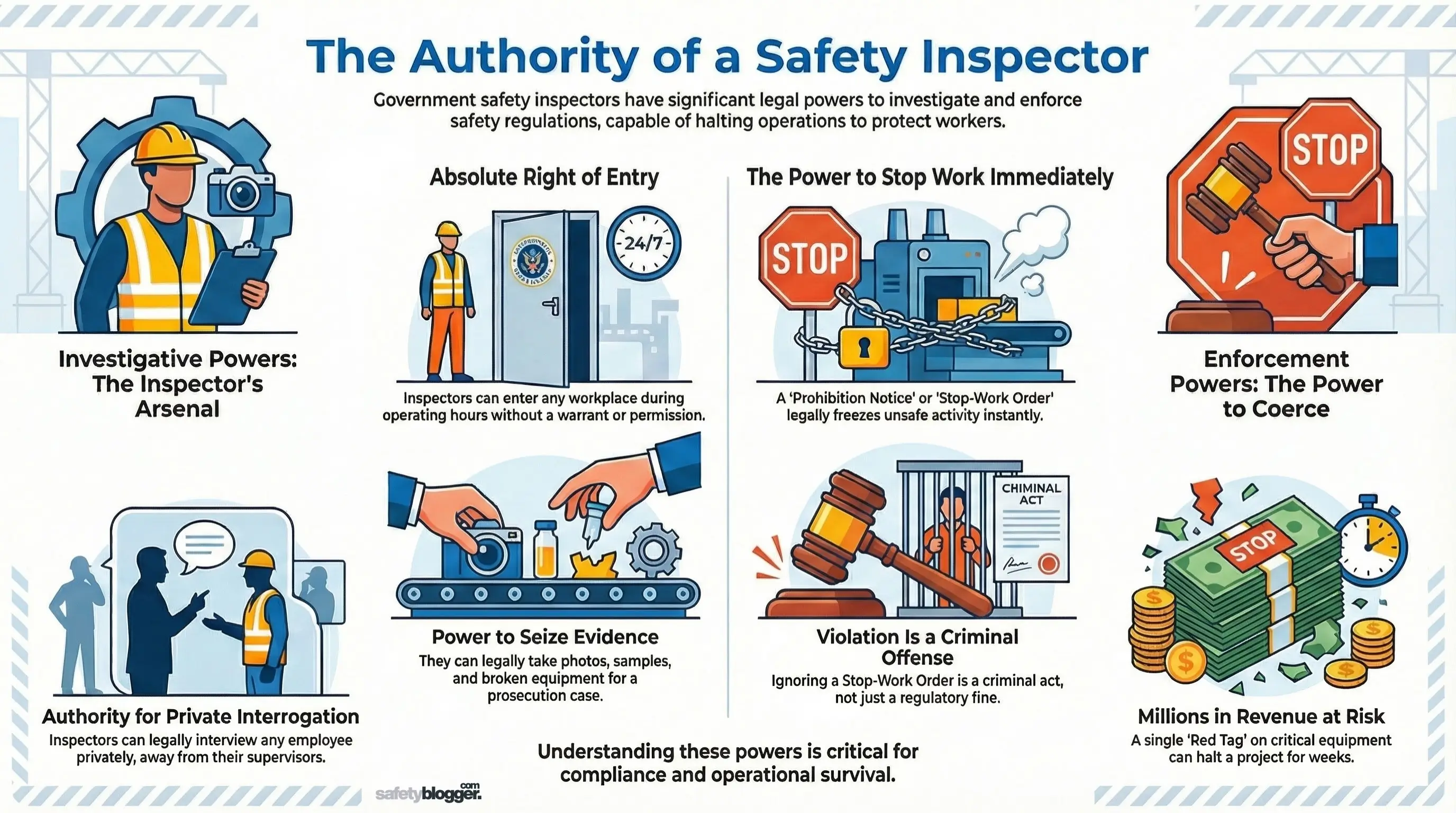
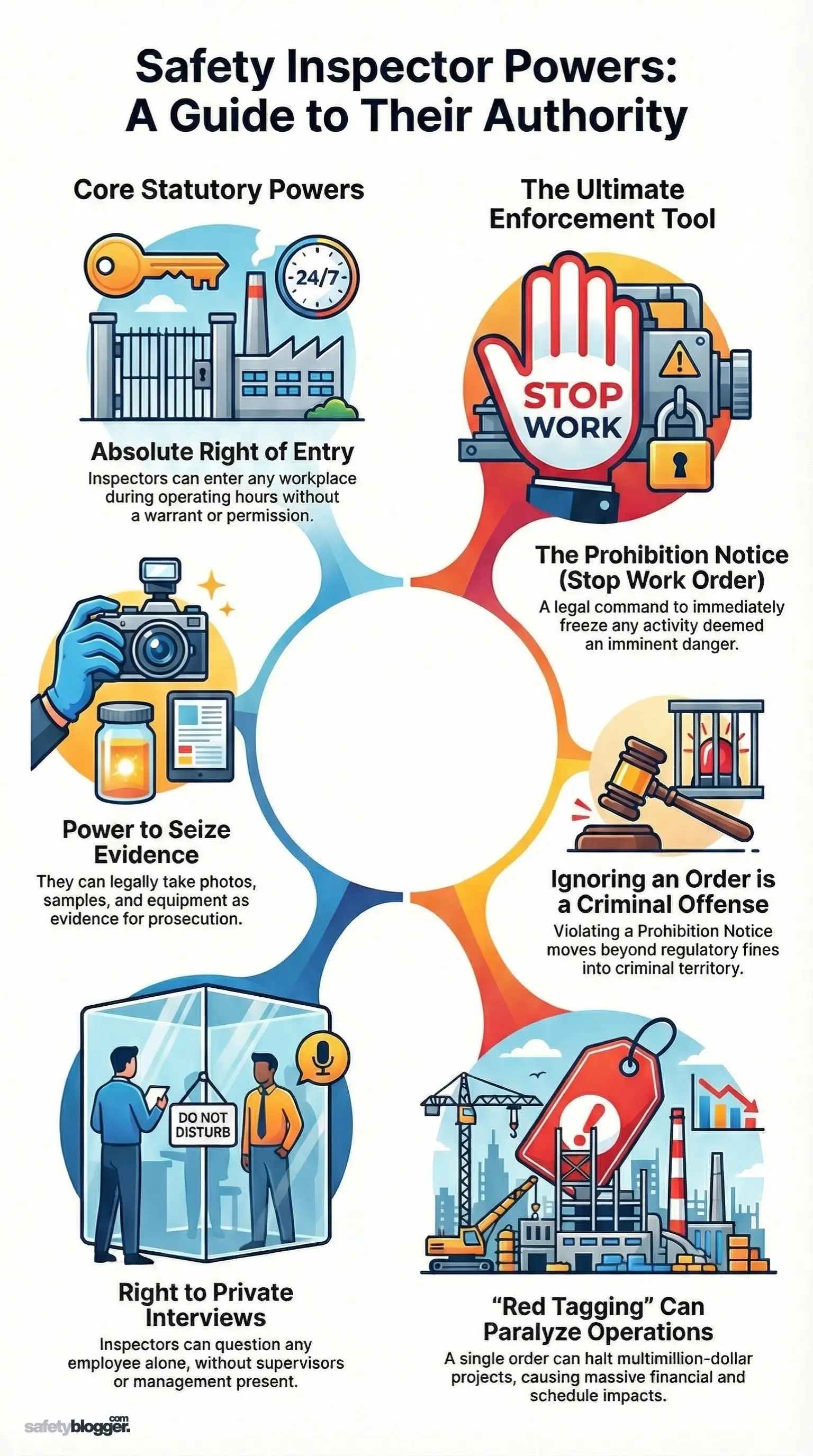
The efficacy of a Safety Inspector is defined entirely by the legal instruments they carry in their pocket. Over my career, I have seen inspectors utilize these powers to bypass site security teams and demand immediate access to proprietary processes. Their authority is generally derived from three pillars: Access, Seizure, and Interrogation.
The Absolute Right of Entry: In almost every jurisdiction, a Safety Inspector does not need a warrant or permission to enter a workplace during operating hours. If they suspect a dangerous condition or an imminent hazard, this power often extends to "any time," day or night. They are the only civilians who can walk onto a private industrial site unannounced and demand total access.
Power of Seizure and Preservation: They have the authority to disturb the scene of an accident or preserve it. I have seen inspectors tape off entire production lines, seizing broken gear parts, chemical samples, or surveillance footage as admissible evidence. They can take photographs and measurements that become the foundation of a prosecution case.
Power of Private Interrogation: This is often the most unnerving power for management. Inspectors can legally demand to interview any employee—privately. They can separate a frightened worker from their supervisor to get truthful statements regarding working hours, training gaps, or near-miss cover-ups.
The Power of Coercion: Prohibition and Stop-Work Orders
The most lethal weapon in the inspector's kit is the power to stop work immediately. While they issue "Improvement Notices" or "Citations" for minor non-compliances (like missing paperwork), the reality shifts when life is at risk.
This is often called a Prohibition Notice or a Stop Work Order. If an inspector sees an unshored trench that is about to collapse, or a crane operating near high-voltage lines, they can issue a legal order that freezes that activity instantly. This is not a request; it is a command. Breaking a Prohibition Notice is usually a criminal offense, not just a regulatory one. I have seen projects lose weeks of schedule and millions in revenue because a single inspector "Red Tagged" a critical piece of infrastructure that was deemed unsafe.
The Jurisdictional Labyrinth: Managing Overlap
One of the greatest frustrations I face as a Compliance Advisor is the crowded regulatory space where multiple agencies claim jurisdiction over the exact same square footage. The "Inspector" is rarely a monolith; they come from different tribes with different priorities.
Occupational Safety Authority: Focuses on worker welfare, machine guarding, fall protection, and process safety management (PSM).
Fire Marshals / Civil Defense: Focuses on structural fire safety, occupancy limits, sprinkler systems, and emergency egress.
Environmental Agencies: Focuses on emissions, waste disposal, and spill containment.
The Double Standard Dilemma
This overlap often traps facility owners in a "compliance limbo." I have audited chemical plants that were fully compliant with the Safety Inspector’s checklist regarding flammable storage cabinets, only to be fined by the Fire Marshal because the cabinets were not spaced according to specific building codes.
The Safety Inspector often navigates this by focusing on the worker's interaction with the hazard, while the Fire Marshal focuses on the public's risk. For the HSE Manager, this means preparing for multiple audits with potentially contradictory demands.
The Inspection Lifecycle: A Procedural Deep Dive
An inspection is rarely a random walk; it is a structured sequence of events that I have navigated hundreds of times. Understanding this lifecycle is critical for site management to maintain composure and demonstrate due diligence.
The Trigger: Inspections are often triggered by "lagging indicators"—severe injury reports, high worker compensation claims, or anonymous whistle-blower complaints.
The Opening Conference: The inspector presents credentials and explains the scope. This is the moment to establish a cooperative tone. They will often demand to check the OSHA logs (or equivalent injury registers) immediately.
The Walkaround: This is the physical audit. Inspectors look for "imminent dangers" first: fall hazards, unguarded nip points, and electrical risks.
The "Private" Interviews: As they walk, they will stop workers. “How long have you worked here?” “When was your last break?” “Did you receive training for this lockout procedure?”
The Closing Conference: The inspector summarizes findings. This is your only chance to clarify misunderstandings before they become written citations.
The "Padlocked Exit" Scenario
The scope of an inspection can be terrifyingly broad. One of the most haunting findings in industrial history—and one inspectors still check for obsessively—is the locked fire exit.
I once worked on a remediation case where an inspector found emergency exit doors padlocked from the outside to "prevent theft." This single violation shifted the inspection from a routine audit to a potential criminal negligence investigation. It illustrates that an inspector’s jurisdiction extends beyond the machine; it covers the fundamental morality of the workplace.
Operational Realities: The Gap Between Statute and Street
We must acknowledge the friction between the law as written and the law as practiced. The Safety Inspector operates in a constrained environment defined by resource deficits and human factors.
Resource Lack: In many regions, regulatory bodies are chronically underfunded. An inspector might be responsible for thousands of worksites, meaning they can only visit the "worst offenders." This creates a reactive culture where good companies rarely see an inspector until something goes wrong.
The "Tick-Box" Trap: Inexperienced inspectors may focus on easy-to-spot violations (like a missing poster or a frayed cord) while missing complex process safety hazards (like a degrading pressure relief valve).
The Adversarial Trap: Entering a factory to stop work is a confrontational act. I have seen inspectors threatened, intimidated, and stalled. The best inspectors master the art of de-escalation; the worst rely solely on the badge, leading to legal standoffs.
Government Inspector vs. ISO Auditor
It is vital to distinguish these two roles. I often have to explain to management that passing an ISO 45001 (Occupational Health and Safety) audit does not grant legal immunity.
The ISO Auditor: Hired by you. They look for system conformance and continuous improvement. They issue "Non-Conformance Reports" (NCRs). They are consultants.
The Government Inspector: Employed by the State. They look for legal compliance. They issue Citations, Fines, and Prohibition Orders. They are enforcement officers.
Confusing the two is a fatal error. You can have a perfect ISO certification and still be shut down by a Government Inspector for a specific regulatory breach.
Conclusion
The Safety Inspector is an unsung, often feared, yet indispensable agent of the industrial state. They are the friction point where the government’s duty to protect life meets the private sector’s drive for profit.
As HSE professionals, we must view the inspector not as an enemy, but as a rigorous stress-test of our own reality. If our safety culture is robust, the inspector’s visit is merely a verification. If our culture is hollow—if it exists only on paper—their visit is a reckoning. Ultimately, compliance is not about satisfying the inspector’s checklist; it is about the ethical imperative to ensure that the worker who punched in at the start of the shift punches out safely at the end.





Comments
Loading...