



I was leading a safety audit on a multibillion-dollar LNG pipeline project in the Middle East when work ground to a halt. We had three different prime contractors—one from South Korea, one from the UK, and a local joint venture—each operating under their own country’s safety definitions. Scaffolding deemed "safe" by the local contractor was immediately red-tagged by the British engineers, leading to a massive conflict and a near-miss where a worker fell through a poorly secured grating. It was a chaotic ecosystem of conflicting rules, and the only way to regain control was to immediately strip away the national biases and enforce a single, unifying framework: the project’s adoption of ISO 45001 and the International Finance Corporation (IFC) EHS Guidelines.
International health and safety standards matter because they are the absolute architectural blueprint for saving lives in complex, borderless industries. Without them, safety becomes subjective, reliant on local regulations that are often inadequate, outdated, or poorly enforced. In this article, I will unpack the critical roles these international frameworks play on the ground—not as bureaucratic paperwork, but as the primary drivers of consistency, legal protection, and proactive risk management. Whether you are operating on a high-governance mega-project or trying to bring a local manufacturing plant up to global benchmarks, understanding the role of these standards is the difference between hoping no one gets hurt and engineering a system that prevents it.
Establishing a Unified Language for Safety
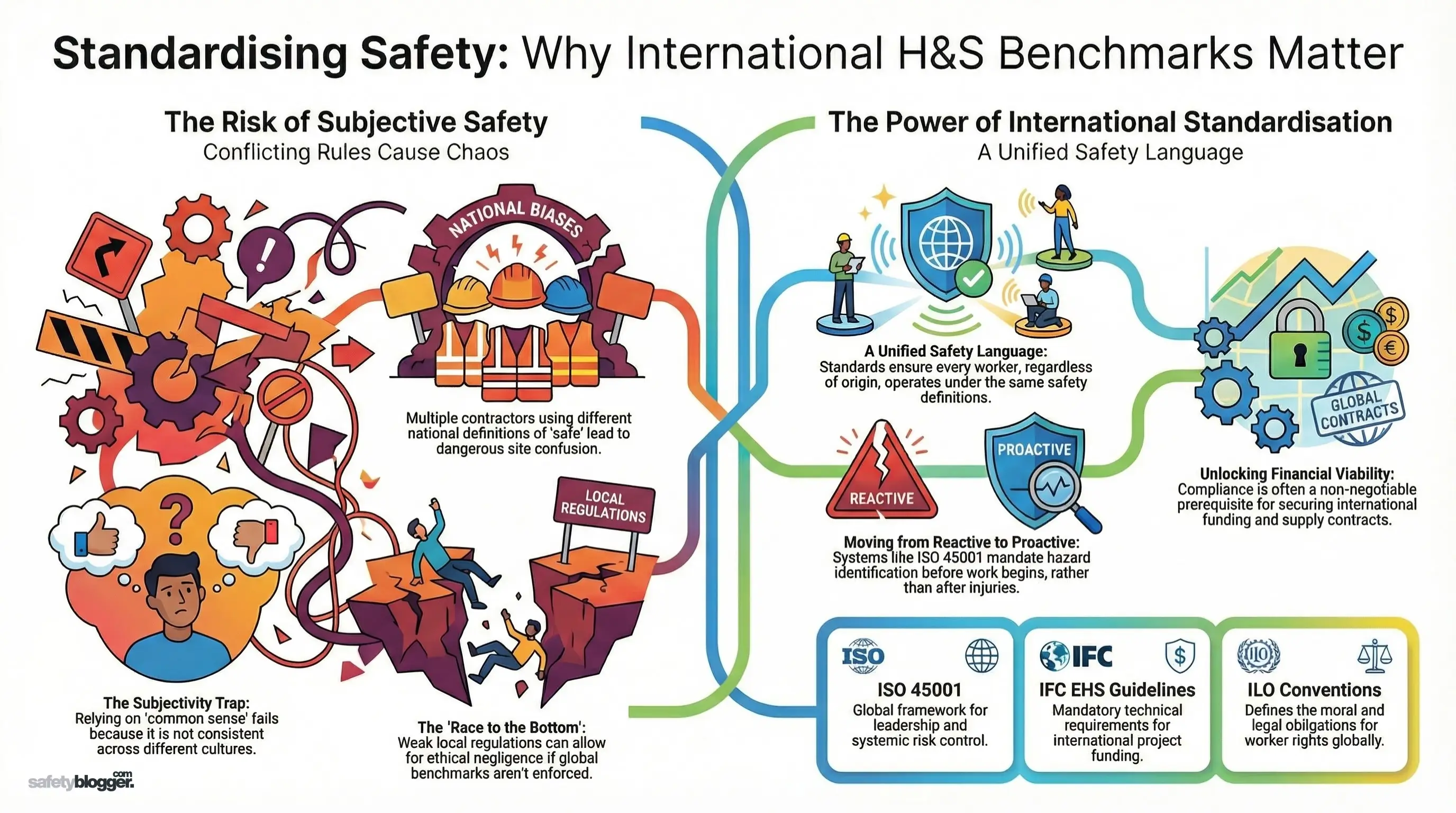
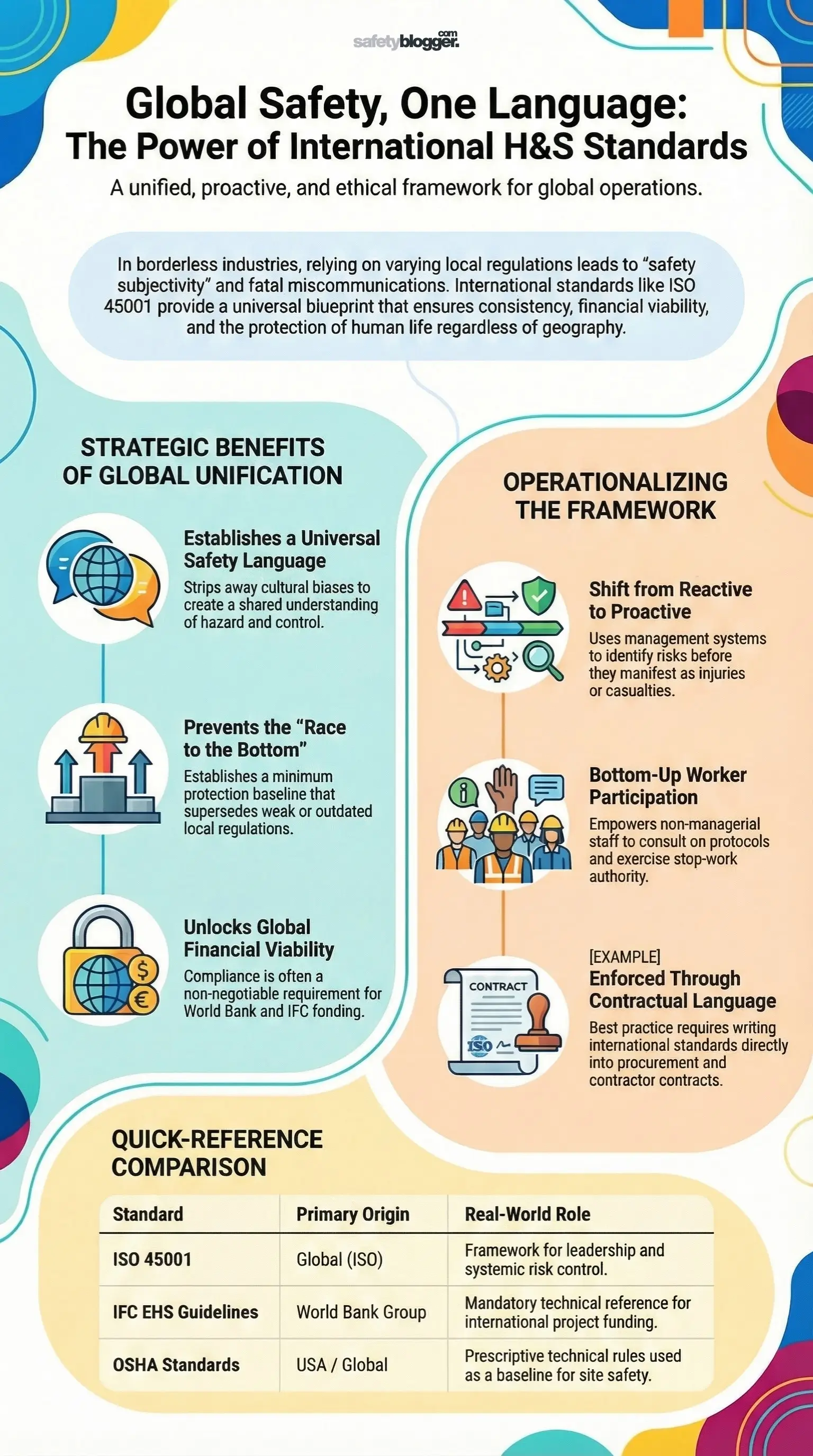
When you have a diverse workforce from ten different countries, safety cannot be lost in translation. International standards serve as the ultimate equalizer, stripping away cultural biases and creating a universal understanding of hazard, risk, and control.
On global EPC (Engineering, Procurement, and Construction) projects, standardizing expectations is the first line of defense against fatal miscommunications. A Confined Space Entry procedure under OSHA 1910.146 might differ slightly from a standard in a developing nation, but applying an international standard ensures that everyone—from the project director to the scaffold rigger—operates under the same definition of "safe." This unification prevents the deadly assumption that "common sense" is the same everywhere.
Eliminates conflicting procedures: A single standard replaces dozens of fragmented local rules.
Standardizes training: Competency requirements are benchmarked globally.
Streamlines communication: Near-misses, audits, and hazards are reported using the same criteria globally.
Field Pro Tip: Never assume a contractor’s "compliance with local laws" is enough on high-risk sites. Always write adherence to specific international standards (e.g., ISO 45001) directly into the contract procurement language.
Preventing the Global "Race to the Bottom"
The primary moral role of international standards is to guarantee that human life is valued equally, regardless of geographic location. They establish a minimum baseline protection that supersedes weak local regulations.
I have inspected mineral processing plants in developing nations where local regulations allowed workers to handle toxic reagents with nothing but cotton gloves and a dust mask. If we only followed local law, we would be legally compliant but ethically negligent. By enforcing international benchmarks—like the ILO Conventions or WHO exposure limits—we force operations to rise to a globally acceptable level of human protection. International standards prevent corporations from exploiting the lax safety laws of host countries to cut operational costs.
Shifting Operations from Reactive to Proactive
Historically, safety was judged by lagging indicators—how many people were injured last month. The modern role of standards, spearheaded by frameworks like ISO 45001, is to force organizations to look forward, identifying risks before they manifest as casualties.
This role is accomplished through the requirement of a formal Occupational Health and Safety Management System (OHSMS). Standards do not just tell you to wear a harness; they demand you assess why the work at height is necessary in the first place, apply the Hierarchy of Controls to see if the hazard can be eliminated, and monitor the effectiveness of your controls. It transforms safety from a policing function on the shop floor to a strategic business process in the boardroom.
Context of the Organization: Requires management to understand internal and external factors affecting safety.
Hazard Identification: Moves beyond spot-checks to systematic risk profiling.
Continual Improvement: Mandates that the system evolves and improves over time through internal audits and management reviews.
Facilitating Global Trade and Financial Viability
In today's interconnected global economy, health and safety is a prerequisite for doing business. International standards play a massive role in unlocking funding, passing due diligence, and entering global supply chains.
If you are seeking funding from the World Bank or the IFC for an infrastructure project, compliance with the IFC Environmental, Health, and Safety (EHS) Guidelines is non-negotiable. Similarly, major multinational clients (like Apple, Shell, or Toyota) audit their suppliers against ISO standards. If a steel plant cannot demonstrate alignment with international safety and environmental standards, they are locked out of the global market.
Comparison of Major International Standards and Their Roles
Standard / Framework | Primary Origin | Real-World Role & Application |
ISO 45001 | Global (ISO) | Provides the framework for a management system. Focuses on leadership, worker participation, and systemic risk control. |
IFC EHS Guidelines | World Bank Group | Mandatory technical reference for international funding. Sets specific limits on emissions, noise, and occupational hazards. |
OSHA Standards (1910/1926) | USA (Adopted globally) | Highly prescriptive technical rules (e.g., exact scaffold dimensions, electrical clearance) used as a baseline globally. |
ILO Conventions | UN Agency | Sets fundamental labor rights, defining the moral and legal obligations of nations regarding worker safety. |
Enabling Worker Consultation and Participation
One of the most critical evolutions in the role of international standards is the shift of focus from top-down management to bottom-up engagement. You cannot manage safety effectively from a desk.
International standards legally and procedurally require that non-managerial workers are consulted in the development of safety protocols. During certification audits, auditors don't just check the paperwork; they interview the welders, riggers, and operators. If the standards have not been communicated effectively, or if workers fear retaliation for reporting hazards, the system fails. This role empowers workers, giving them a voice and the authority to stop unsafe work, which is the ultimate defense against operational disasters.
Conclusion
Throughout my career auditing and managing sites across different continents, I have seen operations fail catastrophically not because people wanted to get hurt, but because there was no standardized system to prevent it. International health and safety standards provide that system. Their role is to turn good intentions into verifiable, measurable, and consistent actions.
We must remember that compliance with an international standard is not the ultimate goal—it is the baseline. A certificate on the wall does not stop a falling load or detect a gas leak. The true value of these standards is realized only when their principles are embraced by leadership, integrated into daily operations, and utilized to protect the most valuable asset on any job site: human life. Safety is a moral imperative, and these standards are the tools we use to honor it.




Comments
Loading...