

I slammed my hand on the emergency stop button of the 50-ton mobile crane just as the rigger began the lift. Looking down from the scaffold deck on a congested petrochemical turnaround project, I saw a crew of instrumentation technicians from a completely different contractor walk directly into our drop zone, totally unaware of the three tons of steel about to hover above them. Their company had issued them a work permit for cable pulling, while my company had a permit for heavy lifting in the exact same grid, and neither safety office knew the other was there. This is the terrifying reality of a shared workplace where coordination fails and safety is kept in silos.
Siloed safety on multi-employer worksites is a leading cause of industrial fatalities, because a hazard created by one organization easily becomes a death sentence for another. When multiple organizations share a site—whether in construction, a chemical park, or an industrial port—they share a legal and moral obligation to cooperate, coordinate, and communicate. This article breaks down how to manage simultaneous operations, clarify overlapping legal duties, and practically align different safety cultures to protect every single worker on the ground.
The Core Duty of Cooperation and Coordination
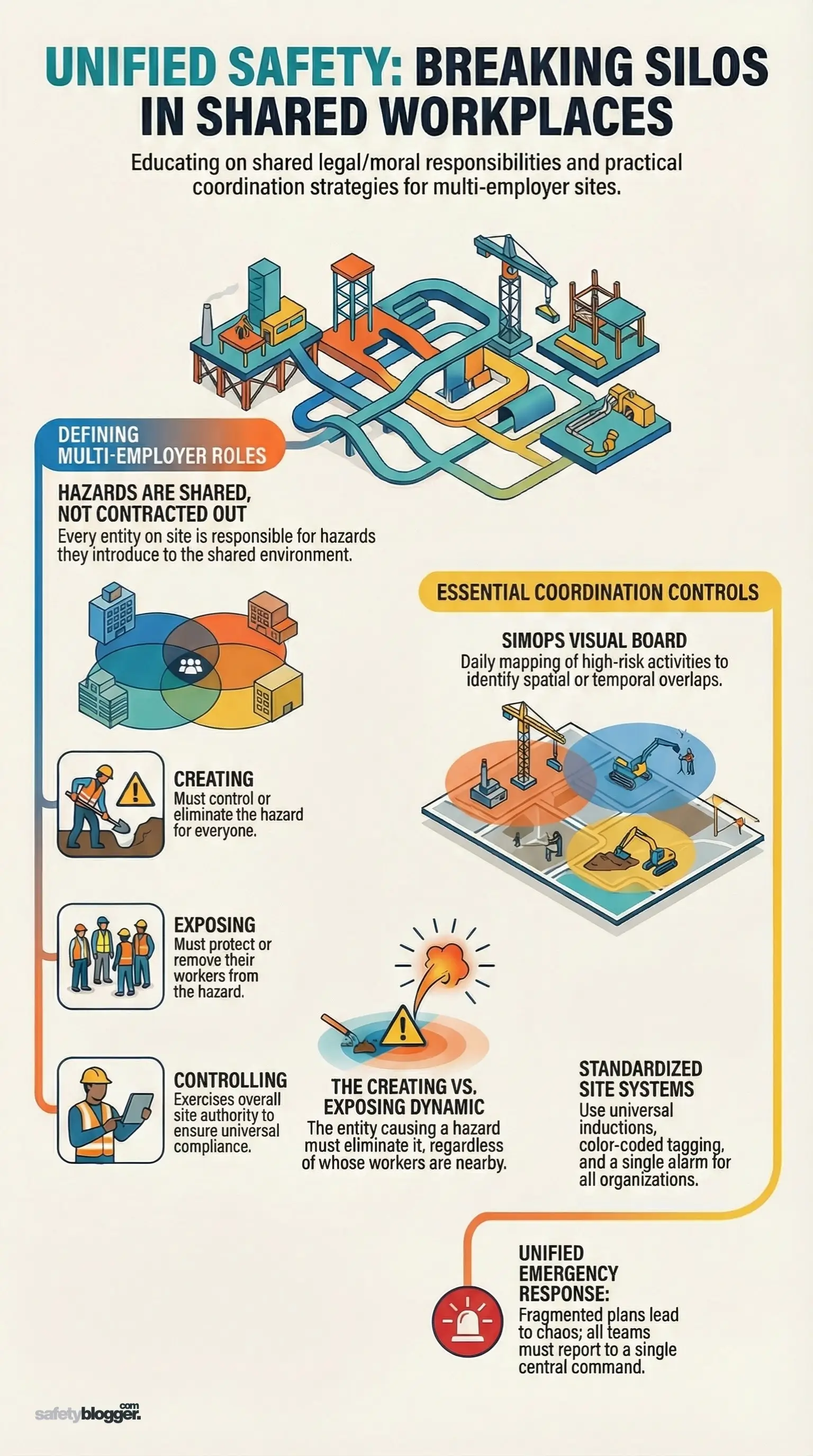
When multiple organizations operate in the same physical space, safety cannot be managed in isolation. Every entity on site must actively communicate their daily scope of work and the hazards they are introducing to the shared environment.
This requires moving past the mindset of "I only look after my own people." If your blasting crew kicks up silica dust, you are responsible for the respiratory protection of the adjacent civil contractor's workers. Field failures in shared workspaces almost always stem from a lack of transparency.
Common coordination failures I see during site audits include:
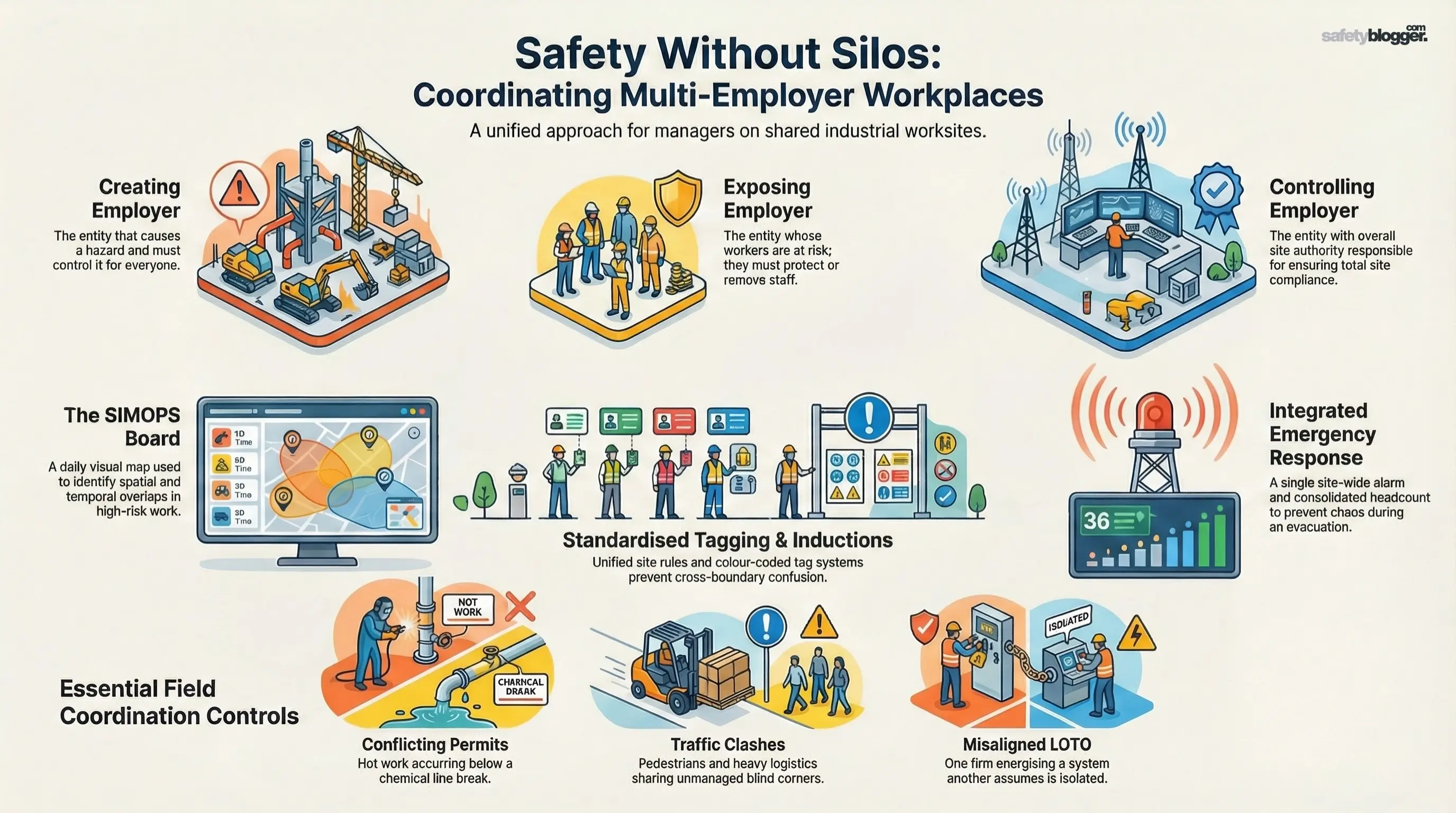
Conflicting Work Permits: Hot work happening below a different company's chemical line break.
Traffic Management Clashes: Logistics companies and pedestrian workers using the same blind corners without a unified site traffic plan.
Misaligned Lockout/Tagout (LOTO): One company energizing a system that another company assumes is isolated.
Shared Hazards, Ignored Controls: Edge protection removed by scaffolders but not communicated to the roofing crew.
"A hazard created on a shared site is shared by everyone. You cannot contract out your moral responsibility for human life."
Understanding the "Multi-Employer" Responsibility
Under global standards like the OSHA Multi-Employer Citation Policy, UK CDM Regulations, and ISO 45001, culpability on a shared site is divided based on your role, not just who signed a worker's paycheck. You must understand where your organization fits into the site hierarchy.
To manage risk effectively, we categorize employers based on their relationship to the hazard. It is entirely possible for one organization to fit into multiple categories simultaneously.
Employer Role | Responsibility on a Shared Site | Field Example |
Creating Employer | The entity that causes the hazard. Must control or eliminate the risk for everyone. | A painting contractor leaving toxic fumes in a confined space. |
Exposing Employer | The entity whose own workers are exposed to the hazard. Must protect them or remove them. | An electrical contractor whose workers are breathing the painter's fumes. |
Correcting Employer | The entity responsible for fixing the hazard (e.g., maintenance). | The site maintenance team fixing the ventilation to clear the fumes. |
Controlling Employer | The entity with overall site authority (Principal Contractor/Client). | The Project Management team ensuring all parties comply with site rules. |
Practical Strategies for Workplace Coordination
Coordination cannot be a monthly management meeting; it must be a daily operational reality. The most effective shared workplaces utilize a "Permit to Work" center where all daily activities are plotted on a massive site map to visually identify clashes.
As a Contractor HSE Manager, I insist on standardizing certain processes across the entire site, regardless of how many subcontractors are present. You cannot have five different definitions of "safe working at height" on the same plot of land.
Essential Field Coordination Controls:
The SIMOPS Board: A daily visual management board where all high-risk activities (lifting, radiography, hot work, pressure testing) are plotted to identify temporal or spatial overlaps.
Joint Hazard ID Walkarounds: Safety officers from different companies conducting joint area inspections to look for cross-boundary hazards.
Unified Inductions: A single, authoritative site induction for all entrants, ensuring everyone knows the universal site rules, alarms, and emergency exits.
Standardized Tagging Systems: Using one universally agreed color-code system for scaffold tags and electrical inspections so any worker can read any tag.
Managing Simultaneous Operations (SIMOPS)
When high-risk operations must occur close to each other, a specific SIMOPS matrix must be developed. For example, if heavy lifting is occurring near live process lines, representatives from the crane company, the plant operations team, and the maintenance contractor must sign off on a joint risk assessment.
Unified Emergency Response
In the event of a fire, explosion, or toxic release, the crisis does not recognize contractual boundaries. Emergency response in a shared workplace must be fully integrated, managed by the Controlling Employer, and practiced by every organization.
A fragmented emergency plan leads to chaos, unaccounted personnel, and fatalities. All organizations must report to the same central command during an evacuation.
Critical Emergency Integration Steps:
One Alarm System: A unified site-wide alarm that is audible in all contractor cabins and working areas.
Consolidated Headcount: Subcontractors must immediately report their headcount to the central site controller at the muster point.
Shared Rescue Resources: Pre-agreed sharing of advanced first aid, rescue-from-height teams, and emergency vehicles.
Joint Drills: Conducting full-scale evacuation drills that test the communication bridges between different companies.
Conclusion
Working on a multi-employer site requires a high degree of maturity, trust, and continuous communication. The paperwork—contracts, scopes of work, and organizational charts—may separate us, but the physical reality of the worksite binds us together.
The ultimate measure of safety in a shared workplace is whether a supervisor from Company A feels empowered to stop an unsafe act by a worker from Company B. Safety is a collective moral responsibility. When we step onto a shared site, the protection of human life must immediately override our individual company logos and operational silos.


Comments
Loading...