


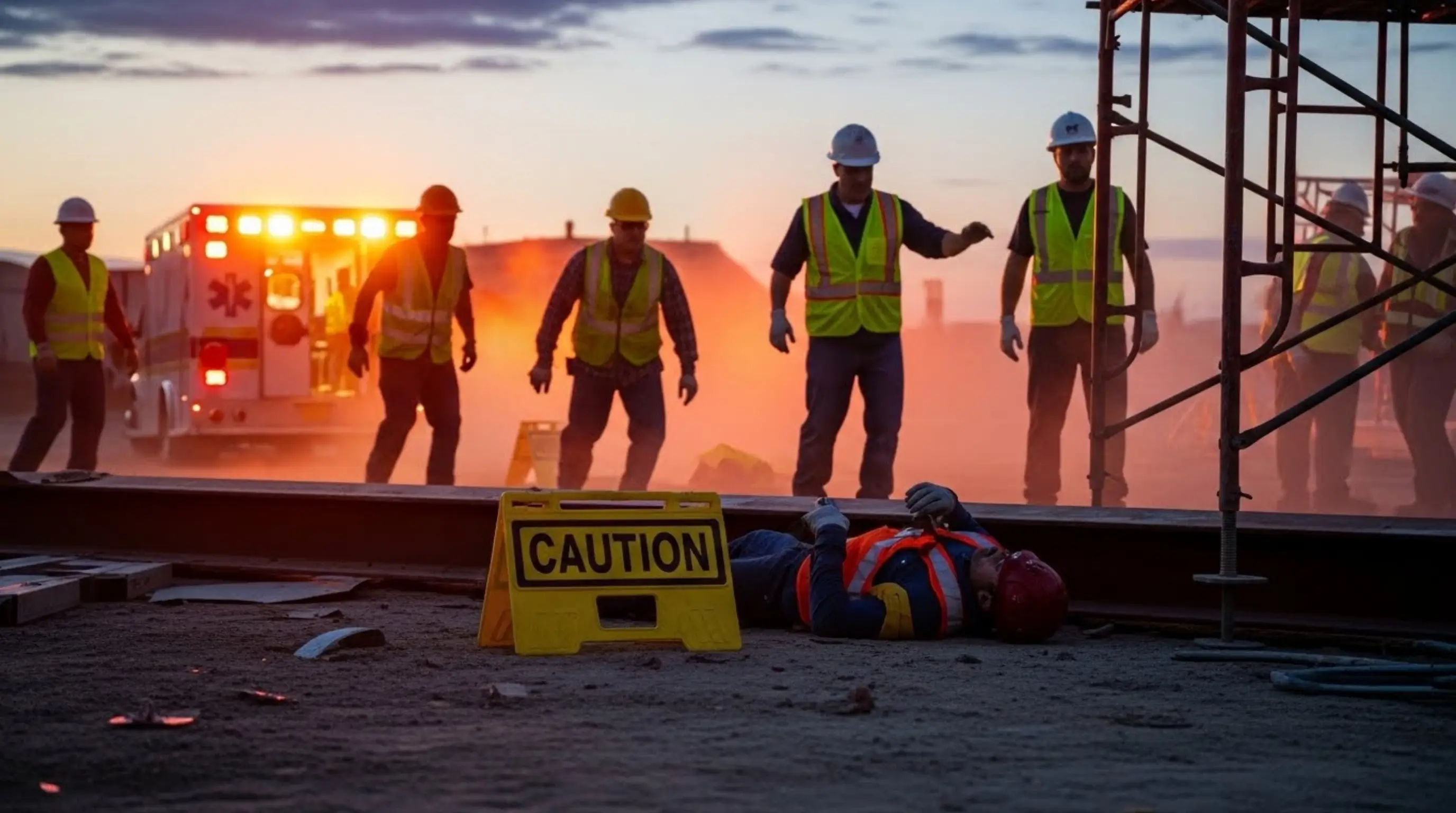
I vividly remember sitting across from a Project Director during a tense budget meeting for a massive offshore expansion project. He looked at the HSE line item, sighed, and asked, "Badr, do we really need this level of spending on training and surveillance? We haven't had an accident in six months." It was a classic moment that every safety professional faces eventually—the need to justify safety not just as a rulebook exercise, but as a fundamental pillar of business survival. I didn't quote a regulation immediately; instead, I asked him if he was prepared to look a widow in the eye, stand before a judge, or explain a 15% dip in quarterly profits to shareholders due to a single site shutdown.
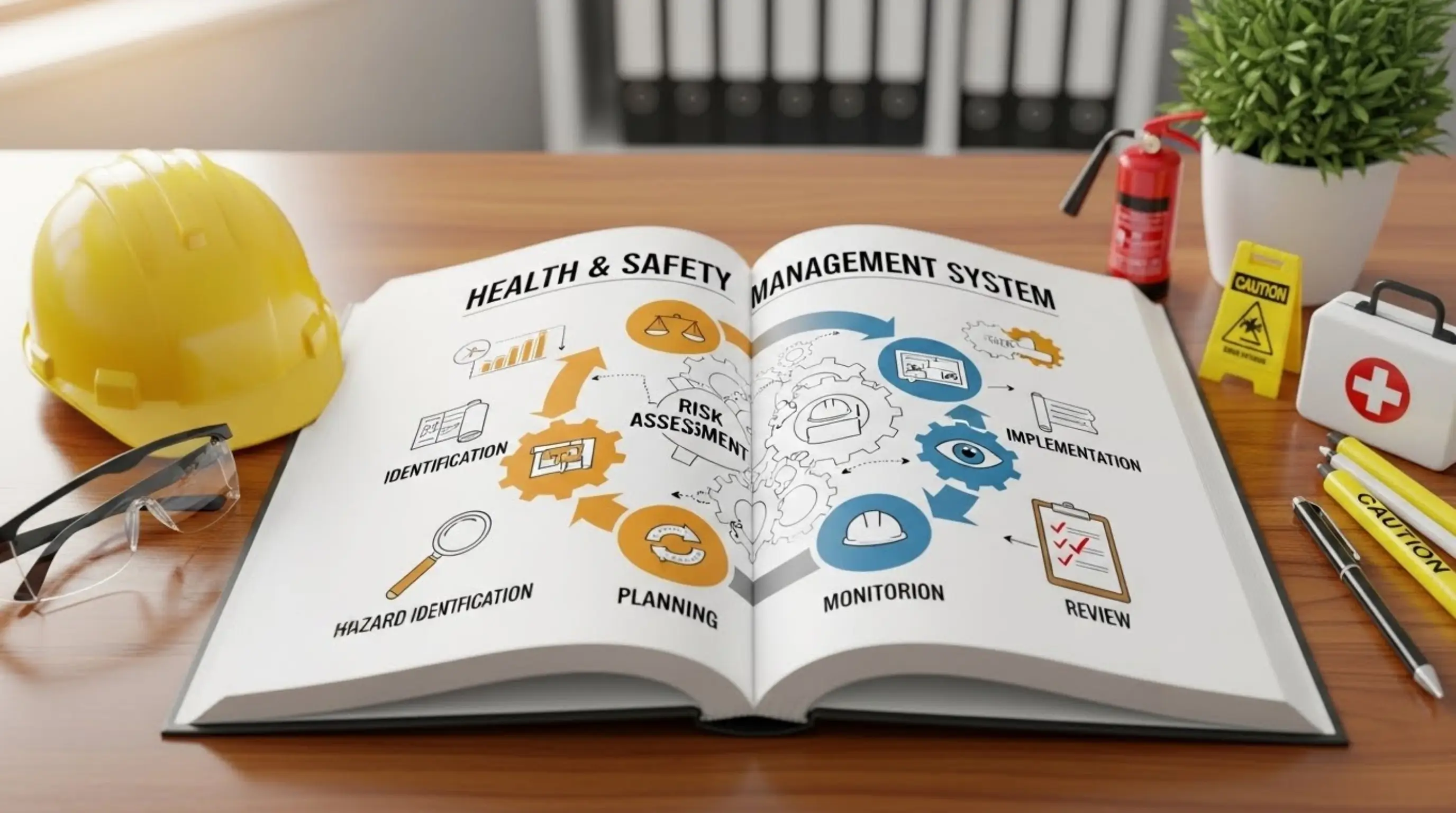
Managing Health and Safety (H&S) is often misconstrued as a bureaucratic burden, but in reality, it is the bedrock of a sustainable organization. Whether you are a site supervisor, a corporate executive, or an HSE student, understanding the "Why" is just as critical as understanding the "How." In this article, I will break down the three non-negotiable arguments for managing safety: the Moral obligation to protect human life, the Legal duty to comply with the law, and the Financial necessity of preserving the bottom line.
1. The Moral Reason: The Ethical Duty of Care
At its core, health and safety is about people, not paperwork. Before we discuss laws or profits, we must acknowledge that every worker is a human being with a family, aspirations, and a right to life.
Societal Expectations and Human Impact
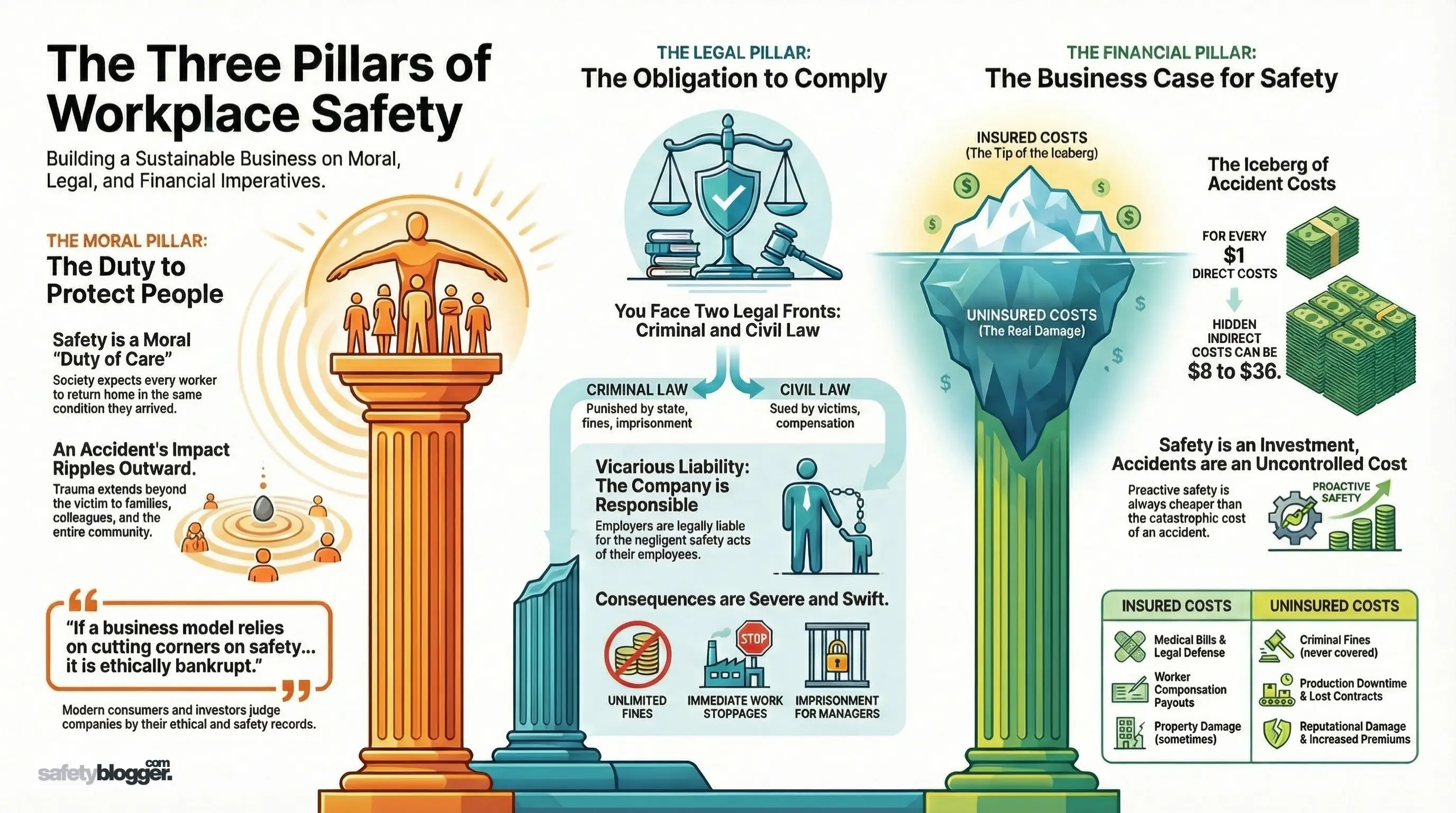
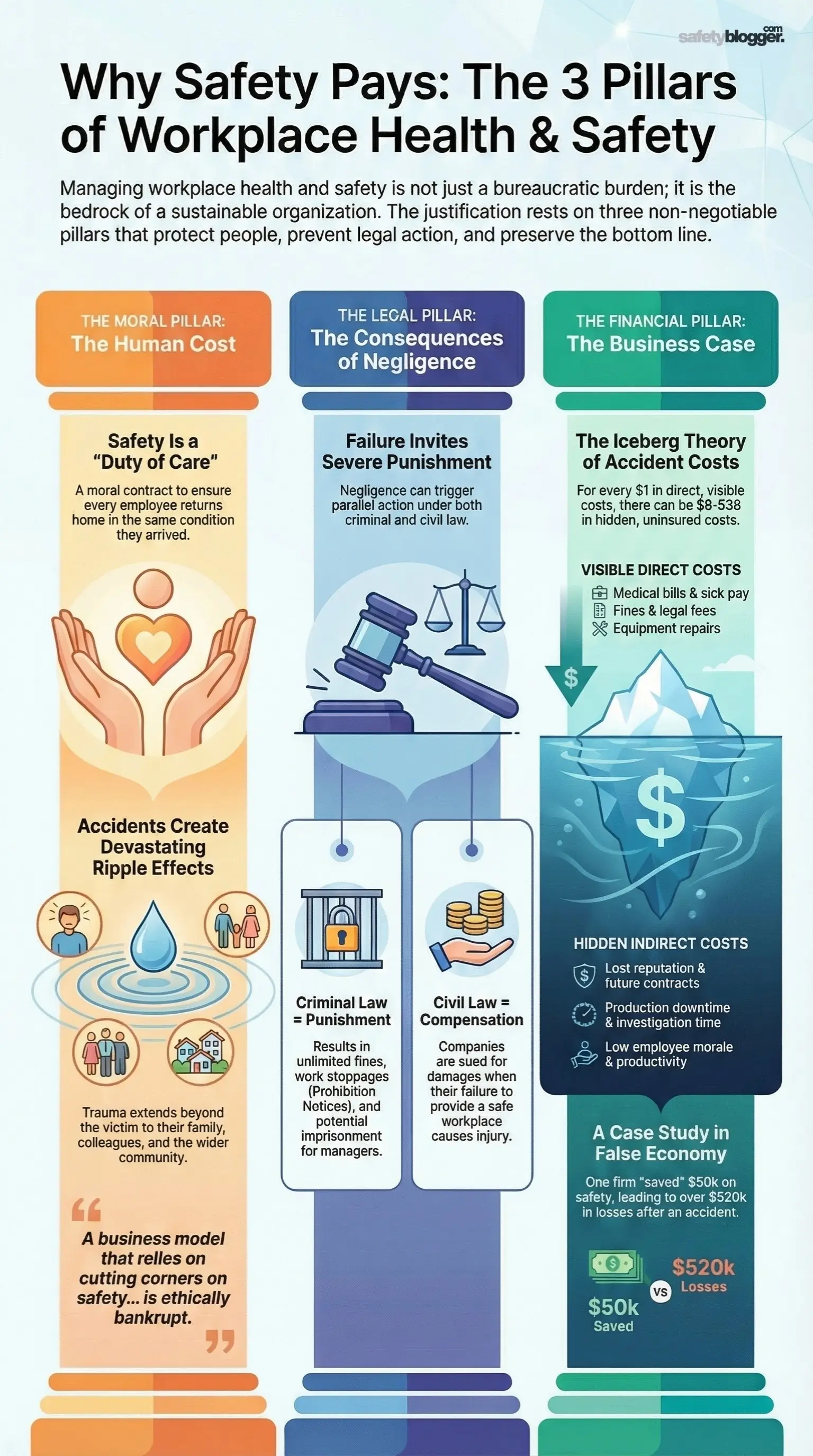
Society has evolved, and the days when industrial progress was accepted as a valid excuse for human casualties are long gone. Today, there is a universal societal expectation that an employee should return home in the same physical and mental condition in which they arrived at work. As an auditor, I often remind management teams that they hold a "Duty of Care." This isn't just a legal term; it is a moral contract. When we fail this contract, the ripple effects are devastating.
I have seen firsthand that a workplace fatality does not end when the ambulance leaves the site. The trauma extends to:
The Victim's Family: Loss of a primary earner, emotional devastation, and altered futures.
Colleagues: Witnessing an accident often leads to PTSD, guilt, and a permanent drop in morale.1
The Community: A company that kills or injures its people loses its social license to operate.
Pain and Suffering vs. Statistics
We can calculate the cost of a damaged forklift, but we cannot put a price on the pain of a burn victim or the grief of a child losing a parent. In the safety world, we often get bogged down in TRIR (Total Recordable Incident Rate) and LTIR (Lost Time Injury Rate). However, statistics are dehumanizing.
Corporate Social Responsibility (CSR) plays a huge role here. Modern consumers and investors judge companies by their ethical profile. A poor safety record tarnishes a brand's reputation, proving that they value profit over human life.2 If a business model relies on cutting corners on safety to be profitable, it is ethically bankrupt.
Pro Tip: When I conduct training, I never start with charts. I start with case studies of real people. If you want to drive the moral argument home to your workforce, stop talking about "incidents" and start talking about "injuries and lives."
2. The Legal Reason: Compliance and Consequences
While the moral argument appeals to the heart, the legal argument appeals to the instinct for self-preservation. Governments worldwide—whether under OSHA in the USA, the Health and Safety at Work Act (HASAWA) in the UK, or international frameworks like ILO C155—have established rigid frameworks to punish negligence.
Preventative vs. Punitive Legal Frameworks
Most international jurisdictions operate under a two-tiered legal system regarding safety: Criminal Law and Civil Law. It is vital to understand that these run in parallel. You can be fined by the state and sued by the victim simultaneously.
Criminal Law: This concerns the state punishing the organization or individual for breaking the law (e.g., violating a specific standard). The outcome is punishment, not compensation.
Civil Law: This concerns the victim suing for damages. The goal here is to put the victim back in the position they were in before the accident (financially).
The employer has a clear statutory duty to provide a safe plant, safe systems of work, adequate training, and competent supervision. Failing this triggers legal action.
Criminal Law: Punishment and Enforcement
In my years working across different regulatory zones, I have seen enforcement become increasingly aggressive. Regulatory bodies do not always wait for an accident to happen. If an inspector walks onto your site and sees an imminent danger—like an unsupported trench or unguarded machinery—they can shut you down immediately.3
The consequences of failing criminal law compliance include:
Enforcement Notices: Prohibition Notices stop work immediately, while Improvement Notices require fixes within a set time.4
Unlimited Fines: Courts in many regions now peg fines to company turnover, meaning large corporations can face penalties in the millions.
Imprisonment: Directors and managers can face jail time if their negligence is proven to have caused harm, potentially leading to corporate manslaughter charges.
Strict Liability: In many jurisdictions, certain safety offenses are "strict liability," meaning the prosecution does not need to prove you intended to break the law—only that you failed to comply.5
Civil Law: Compensation and Negligence
Civil claims are where the financial bleeding often begins for companies that ignore safety. For a worker to succeed in a civil claim, they generally must prove three things (the Trinity of Negligence):
Duty of Care: The employer owed them a duty (almost always true in employment).
Breach of Duty: The employer failed to provide reasonable safety measures.
Causation: That specific breach caused the injury.
Vicarious Liability is a concept every manager must know. It means the employer is liable for the negligent acts of their employees. If one of your forklift drivers hits a pedestrian because they were rushing, you (the company) are likely liable.
3. The Financial Reason: The Business Case for Safety
If the moral and legal arguments don't convince a board of directors, the financial argument always will. Safety is an investment; accidents are an uncontrolled cost.
Direct Costs (The Visible Costs)
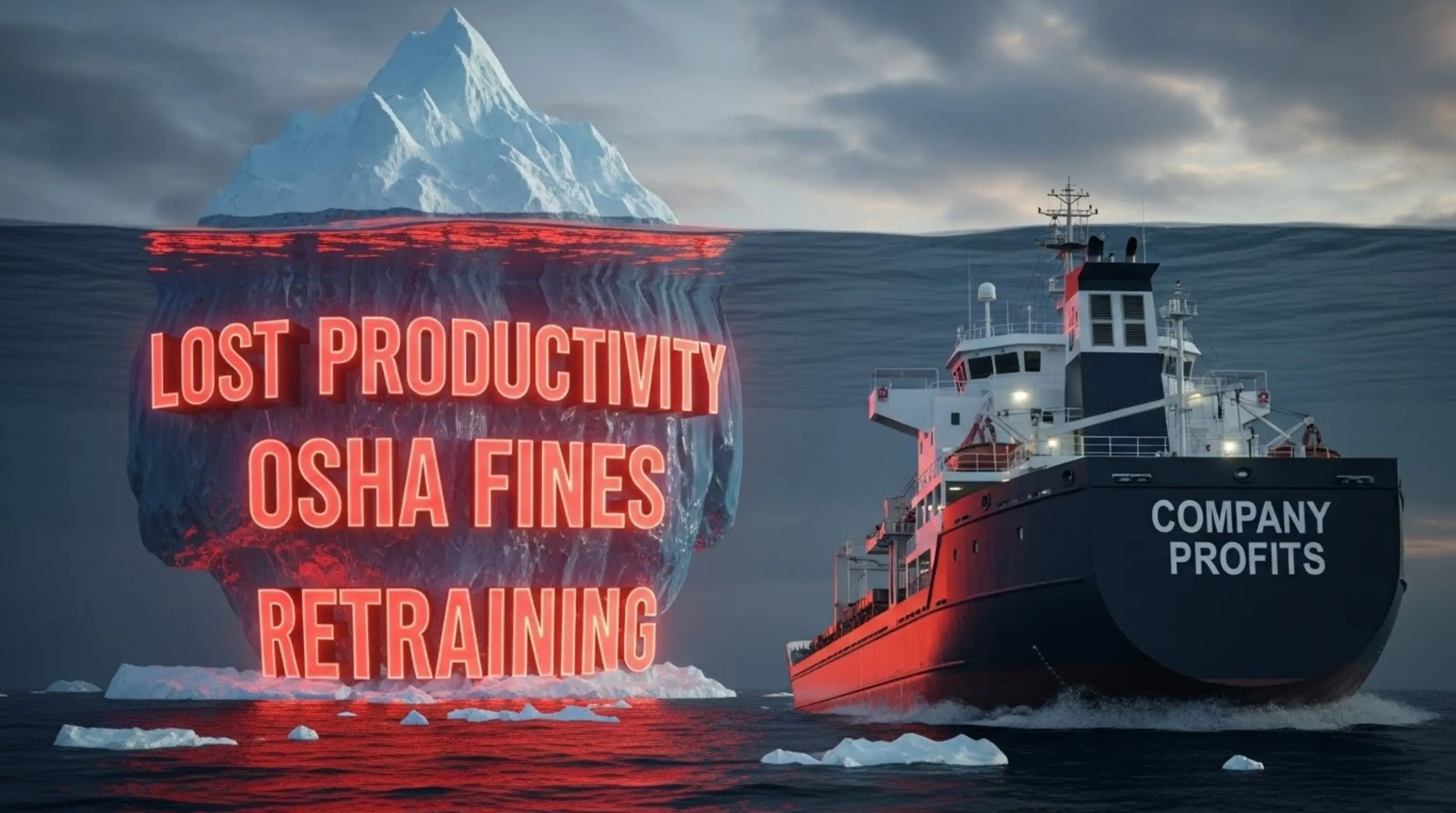
These are the costs that show up immediately on the balance sheet. They are easy to quantify and are usually the "tip of the iceberg." When I audit incident reports, these are the figures finance departments usually account for.
Examples of direct costs include:
First aid and medical treatment.
Sick pay for the injured worker.
Repairs to damaged equipment or plant.
Fines and legal fees.
Indirect Costs (The Hidden Costs)
This is where the real damage happens. In safety economics, we use the Iceberg Theory. For every $1 of direct costs (what you see above the water), there are often $8 to $36 of indirect costs lurking below the surface. These are uninsured and come straight out of the company's profit margin.
Consider the chaos following a major accident:
Operational Disruption: The site is shut down for investigation. Deadlines are missed.
Investigation Time: Senior management, safety officers, and supervisors spend hundreds of hours investigating rather than working.
Reputational Damage: News travels fast. Clients may cancel contracts, and you may be barred from bidding on future tenders.
Morale: Productivity plummets when workers are fearful or demoralized by a colleague's injury.6
Insured vs. Uninsured Costs
Many executives falsely believe, "We have insurance, so we are covered." This is a dangerous misconception.
Insured Costs | Uninsured Costs (The "Real" Killers) |
Compensation to the injured worker | Criminal fines (Insurance never covers illegal acts) |
Damage to property (sometimes) | Production delays and downtime |
Medical costs | Loss of business reputation and goodwill |
Legal defense costs | Increased future insurance premiums |
Accident investigation time |
Audit Insight: I once audited a manufacturing firm that "saved" $50,000 by delaying machine guarding upgrades. Three months later, an amputation incident cost them $120,000 in fines and an estimated $400,000 in lost contracts and downtime. Safety is always cheaper than an accident.
Conclusion: Integrating the Three Reasons
Managing health and safety is not about ticking boxes to satisfy an auditor like me. It is a three-pronged imperative. The Moral reason drives us to protect our fellow human beings from harm. The Legal reason keeps us out of prison and keeps our operations running. The Financial reason ensures that our business remains profitable and sustainable by avoiding the catastrophic costs of negligence.
We must move away from a reactive "compliance-based" culture—where we do it because we have to—toward a proactive "culture-based" safety, where we do it because it benefits everyone. As leaders, we have a duty to integrate these three pillars into our daily decision-making.



Comments
Loading...