



I still remember a heated debriefing session following a serious near-miss involving a forklift in a busy warehouse. The Operations Manager sat across from me, arms crossed, and said, "Badr, isn't safety your job? That's why we hired you." It is a sentiment I have heard on construction sites, oil rigs, and manufacturing floors for over a decade. It is also fundamentally wrong. As an auditor and HSE Director, I have seen careers ended and companies fined heavily because managers believed safety was a side department rather than a core operational function.
The reality of modern safety management—whether under OSHA regulations or the ISO 45001 framework—is that safety is a line management responsibility. The HSE professional is the advisor; the manager is the owner of the risk. If you have the authority to hire, fire, schedule work, and allocate budget, you have the ultimate duty of care for the people under your command. This article breaks down the twelve non-negotiable health and safety responsibilities every manager must master to protect their team and ensure legal compliance.
Setting the Tone and Policy
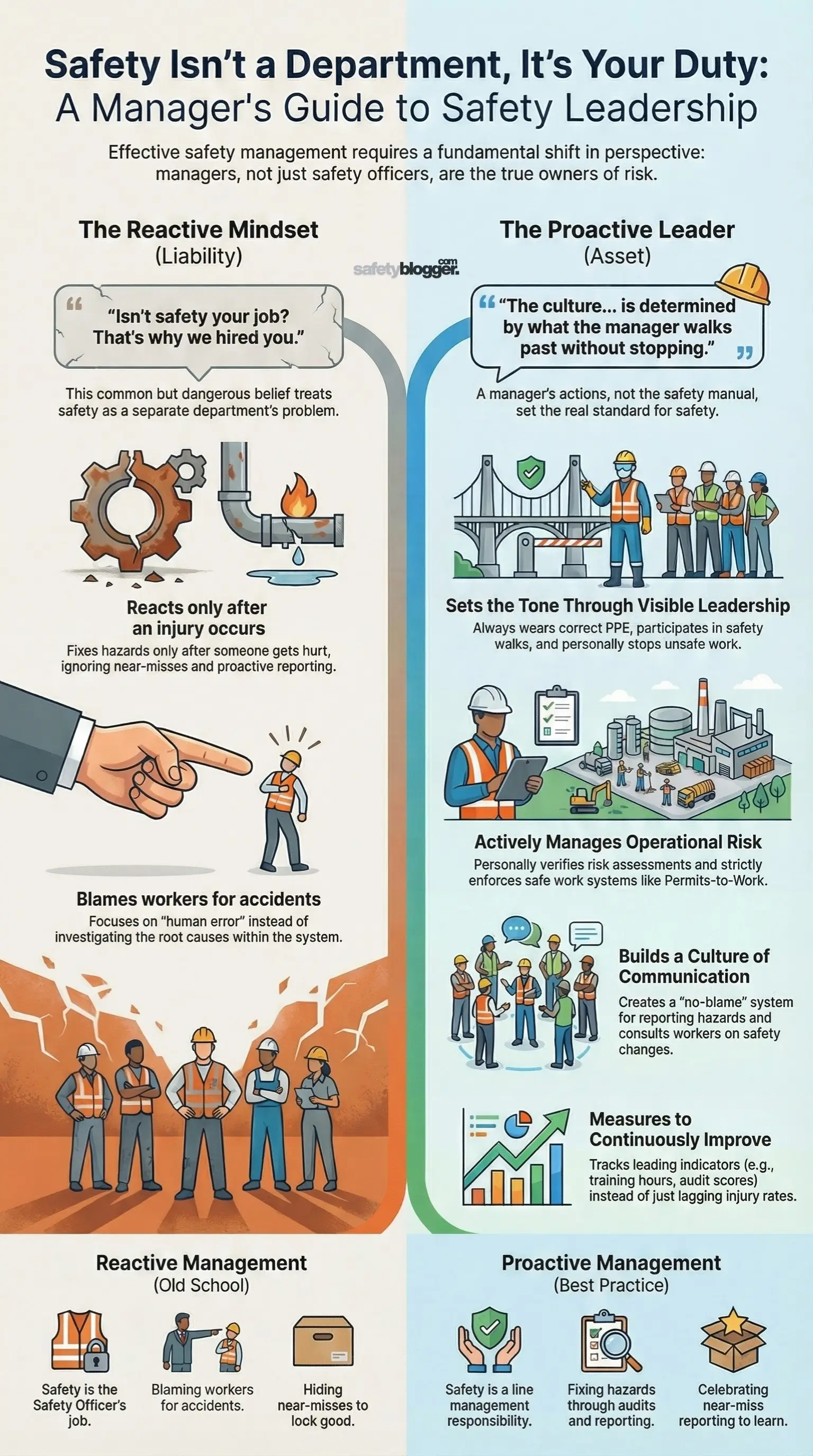
The culture of a worksite is not determined by the safety manual gathering dust on a shelf; it is determined by what the manager walks past without stopping.
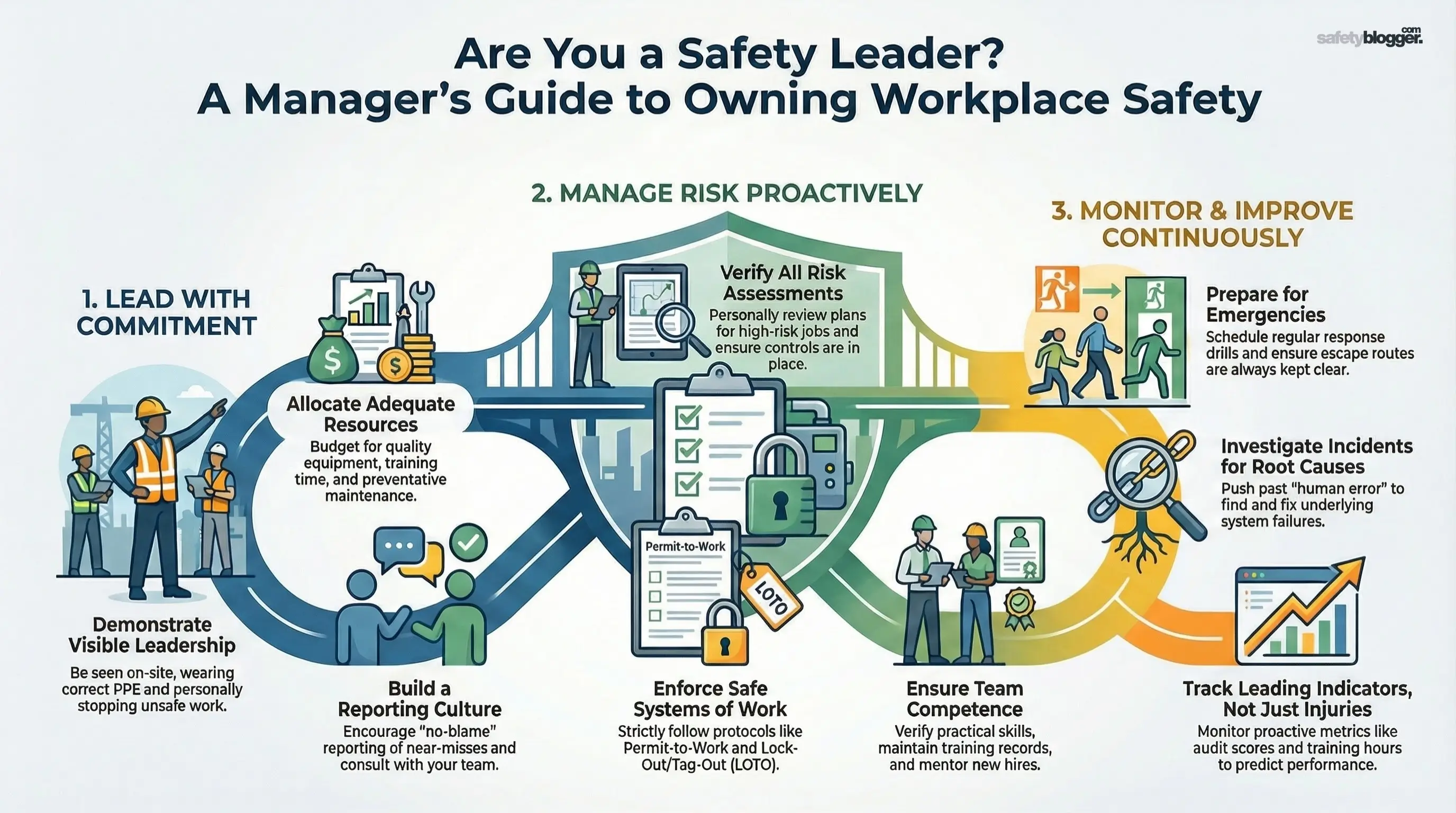
1. Demonstrating Visible Safety Leadership
You cannot lead from behind a desk. In my experience, the safest sites are those where the Project Manager or Plant Manager is seen wearing PPE correctly and following the same rules as the apprentices. If you bypass a barricade or ignore a "No Mobile Phones" sign, you have just told your entire workforce that safety is optional.
Participate in field walks: Conduct at least one dedicated safety walkthrough per week, engaging with workers rather than just inspecting equipment.
Adhere to all site rules: Always wear the required Personal Protective Equipment (PPE) without exception to set the standard.
Stop unsafe work: Personally intervene if you see a violation, showing that safety takes precedence over schedule.
Open safety meetings: Chair the monthly safety committee meeting yourself, rather than delegating it to the HSE officer.
2. Establishing Clear HSE Policies and Objectives
Under ISO 45001 Clause 5 (Leadership), top management is accountable for the effectiveness of the OH&S management system. You must ensure that safety policies are not just corporate jargon but are translated into clear, actionable objectives for your specific department.
Set SMART safety goals: Define specific targets, such as "100% attendance at toolbox talks" or "Zero overdue hazard reports."
Cascade responsibilities: Clearly define who is responsible for specific safety tasks in job descriptions (e.g., who checks the fire extinguishers?).
Sign the policy: Endorse the site safety policy with your signature to demonstrate executive commitment.
Review periodically: Re-evaluate safety objectives quarterly to ensure they align with current operational risks.
3. Allocation of Adequate Resources
I have audited countless projects where the safety plan was perfect, but the budget was nonexistent. A manager's primary duty is to provide the necessary tools, budget, and manpower to do the job safely. If you demand safety but cut the budget for training, you are legally negligent.
Budget for quality PPE: Ensure funds are available for high-quality gear that fits well, rather than buying the cheapest option.
Allocate time for safety: Build safety training, drills, and meetings into the production schedule so they aren't seen as "downtime."
Fund maintenance: Approve budget requests for preventive maintenance on guards, sensors, and emergency systems immediately.
Staff appropriately: Ensure there are enough qualified personnel to perform tasks without rushing or cutting corners.
Risk Management and Operational Control
This is where the rubber meets the road. Managers must actively engage in identifying what can hurt their people and putting barriers in place.
4. Facilitating Risk Assessments (HIRA)
You do not need to write every Risk Assessment yourself, but you must ensure they happen before work starts. I often see managers signing off on Method Statements they haven't read. Your responsibility is to verify that the hazards identified match the reality of the work environment.
Review RAMS/JSA: Personally review and sign off on Risk Assessments and Method Statements for critical activities.
Involve the workforce: Ensure the team doing the work is involved in identifying the hazards, as they know the real conditions best.
Update on change: Trigger a review of risk assessments whenever there is a change in equipment, personnel, or site conditions (Management of Change).
Verify controls: Physically check that the control measures listed on paper (e.g., barriers, ventilation) are actually in place on site.
5. Implementing Safe Systems of Work (SSOW)
Once risks are identified, you must enforce the Safe Systems of Work. This means ensuring that Permit-to-Work (PTW) protocols are strictly followed for high-risk activities like confined space entry or hot work.
Enforce Permit-to-Work: Ensure no high-risk work begins without a valid, authorized permit.
Monitor Lock-Out/Tag-Out (LOTO): Verify that energy isolation procedures are strictly followed during maintenance.
Supervise critical lifts: Ensure a lift plan is in place and a competent rigger/signaler is present for crane operations.
Control shift handovers: Mandate formal handover processes to ensure safety information is passed between shifts.
6. Managing Contractor and Visitor Safety
On complex EPC projects, contractors often make up the bulk of the workforce. You are responsible for vetting these contractors and treating them as part of your own team regarding safety standards.
Conduct pre-qualification: Review a contractor's safety statistics and history before awarding a contract.
Ensure site induction: Verify that every contractor and visitor receives a site-specific safety induction before entering operational areas.
Establish bridging documents: Clearly define how your safety management system interfaces with the contractor's system.
Audit performance: regularly inspect contractor work areas and penalize or stop work for non-compliance.
7. Emergency Planning and Response
It is not enough to have a fire extinguisher on the wall. Managers must ensure that their teams know exactly what to do when things go wrong. I have led drills where evacuation took twice as long as acceptable because the manager had blocked emergency exits with inventory.
Appoint emergency personnel: Designate and train fire wardens, first aiders, and spill response team members.
Schedule drills: Plan and execute regular evacuation, fire, and medical emergency drills to test readiness.
Maintain clear egress: Enforce a zero-tolerance policy on blocking emergency exits, aisles, or fire fighting equipment.
Review response plans: Debrief after every drill to identify gaps and update emergency procedures accordingly.
Competence, Communication, and Culture
A safe plant is a competent plant. Machinery fails, but human error is often driven by a lack of knowledge or a culture of silence.
8. Ensuring Competence and Training
You must verify that every person operating equipment or performing a task is competent to do so. This goes beyond checking a license; it means assessing actual skill (Verification of Competency - VOC).
Identify training needs: Conduct a Training Needs Analysis (TNA) for all roles to identify gaps in certifications or skills.
Maintain training matrices: Keep an up-to-date record of all employee qualifications and expiry dates.
Provide refresher training: Schedule regular refreshers for critical skills like forklift driving, first aid, and working at height.
Mentor new hires: Assign experienced mentors to supervise new or young workers during their probation period.
9. Consulting and Communicating with Workers
Worker participation is the heartbeat of safety. Your responsibility is to create an environment where workers feel safe reporting hazards. If a subordinate reports a near-miss and you berate them for delaying production, you kill the safety culture instantly.
Hold Toolbox Talks: Ensure daily pre-start briefings cover specific hazards relevant to that day's tasks.
Encourage reporting: Create a "no-blame" system for reporting near-misses and hazards.
Feedback loops: Always inform workers of the action taken regarding a safety issue they raised (close the loop).
Consult on changes: Ask for worker input before introducing new PPE or changing work procedures.
10. Managing Fatigue and Health
Occupational health is often the "silent killer." As a manager, you are responsible for monitoring work hours to prevent fatigue, which is a leading cause of heavy equipment accidents, and managing long-term exposure risks.
Monitor working hours: Enforce limits on overtime and ensure adequate rest breaks between shifts.
Conduct health surveillance: Arrange for periodic medical checks (audiometry, spirometry) for workers exposed to noise or dust.
Manage environmental factors: Provide hydration stations in hot weather and appropriate heating/shelter in cold conditions.
Rotate tasks: Implement job rotation to reduce repetitive strain injuries and mental fatigue.
Reactive Management (Old School) | Proactive Management (Best Practice) |
Blaming workers for accidents ("Clumsy") | Investigating root causes (System failure) |
Safety is the Safety Officer's job | Safety is a line management responsibility |
Fixing hazards only after an injury | Fixing hazards through audits and reporting |
Hiding near-misses to look good | Celebrating near-miss reporting to learn |
Monitoring and Continuous Improvement
The job isn't done when the plan is written. You must check that the plan is working through verification and investigation.
11. Investigating Incidents and Near-Misses
When an incident occurs, your role is not to find a scapegoat but to find the root cause. I have investigated many accidents where the immediate cause was "operator error," but the root cause was a manager ignoring a known mechanical fault.
Secure the scene: Ensure the incident scene is preserved immediately to prevent evidence tampering.
Lead the investigation: Participate in the investigation team for high-potential incidents rather than delegating it entirely.
Find root causes: Push beyond "human error" to identify systemic failures using tools like "5 Whys" or Fishbone diagrams.
Share lessons learned: Communicate the findings and required changes to all teams to prevent recurrence.
12. Monitoring Performance and Auditing
Finally, you must measure safety performance just as you measure production output. Do not rely solely on "Lagging Indicators" (injury rates). Focus on "Leading Indicators" that predict future performance.
Track leading indicators: Monitor metrics like the number of safety observations, training hours, and audit scores.
Conduct internal audits: Schedule regular self-assessments of your department's compliance with safety procedures.
Review corrective actions: Ensure that action items from audits and investigations are closed out by their due dates.
Report honestly: Provide accurate safety data to upper management, even if the news is bad, to ensure resources are allocated where needed.
Conclusion
Over my career, I have learned that the difference between a safe site and a dangerous one almost always comes down to the quality of its management. Safety professionals can advise, audit, and train, but we cannot dictate the daily culture—that power belongs to the manager.
By embracing these twelve responsibilities, you move beyond simple compliance. You build a resilient operation where efficiency and safety support each other. Ultimately, your most important responsibility is ensuring that every person who clocks in under your supervision clocks out in the same condition, ready to go home to their family. That is a burden of trust you must carry with pride.





Comments
Loading...