


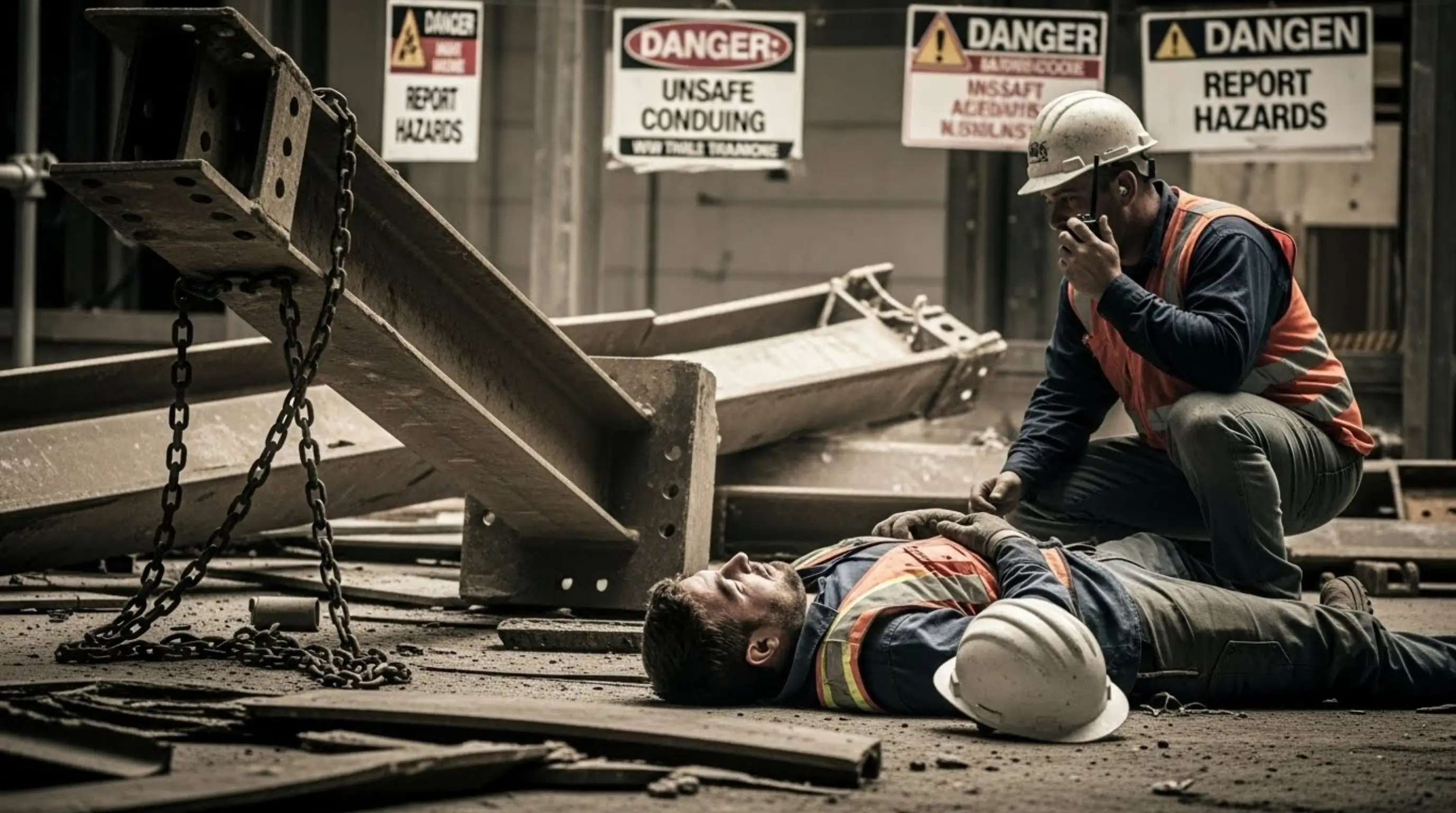
I have stood in the silence of a factory floor immediately after a fatality, where the air is heavy with shock and the machinery has finally been silenced. In those critical moments—what we call the "Golden Hour" of an investigation—the difference between a tragic "accident" and criminal negligence is usually right there in plain sight, waiting to be documented. I have seen managers frantically backdating training logs and supervisors wiping grease off bypassed safety sensors. The reality of high-risk industries is that true "Acts of God" are incredibly rare; almost every major incident I have investigated in the last decade was preceded by a chain of ignored warnings, budget cuts on maintenance, or a culture that prioritized speed over safety.
This article is not legal advice, but a field guide from an operational perspective on how negligence is established through forensic fact-finding. I will break down the four pillars of negligence—Duty, Breach, Causation, and Damages—and explain how we translate them from legal concepts into tangible, onsite evidence. Whether you are a safety manager trying to prevent liability or an auditor understanding where systems fail, you need to understand that negligence is proven not by what people say in depositions, but by the physical and documentary trail they leave behind.
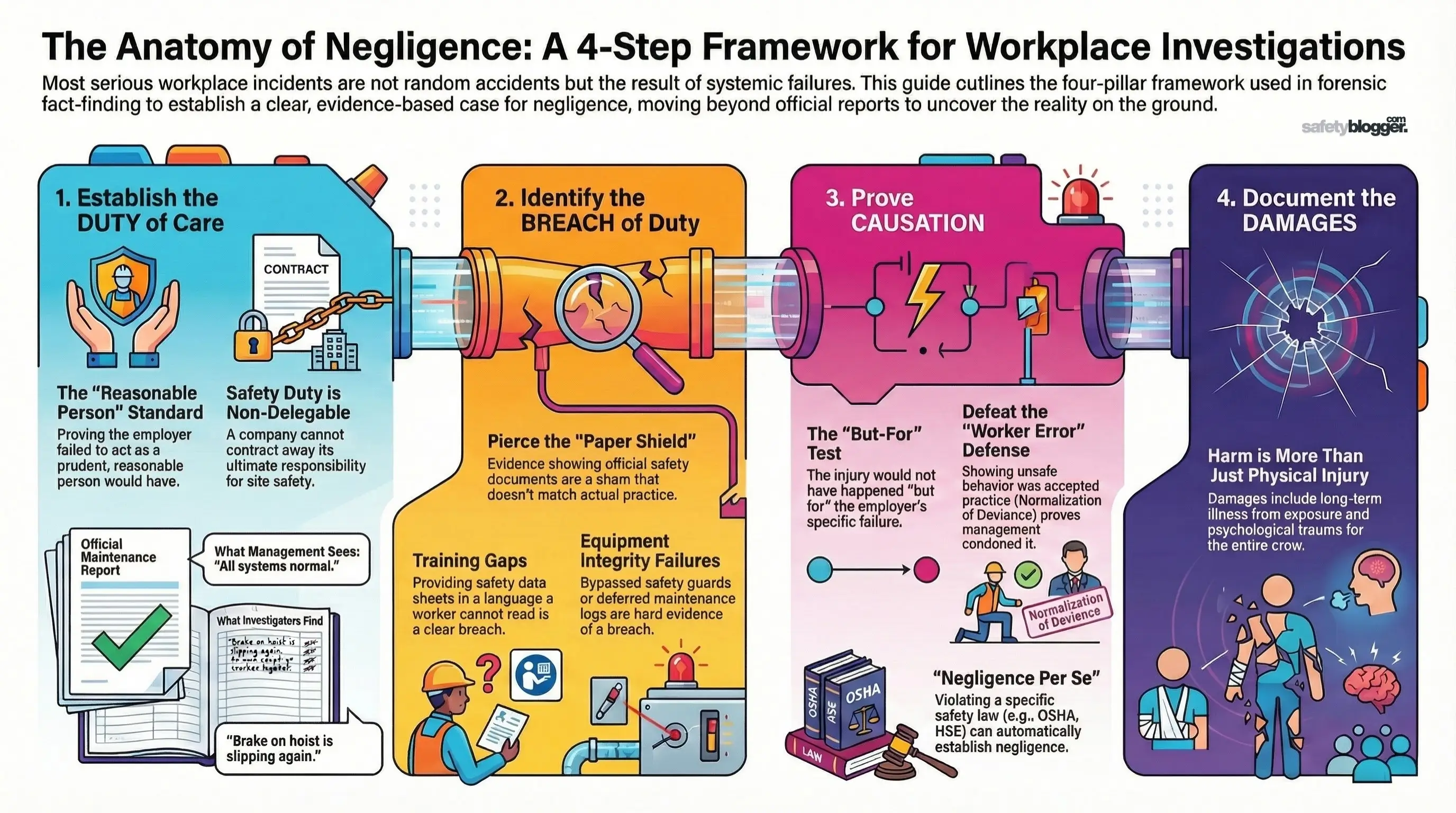
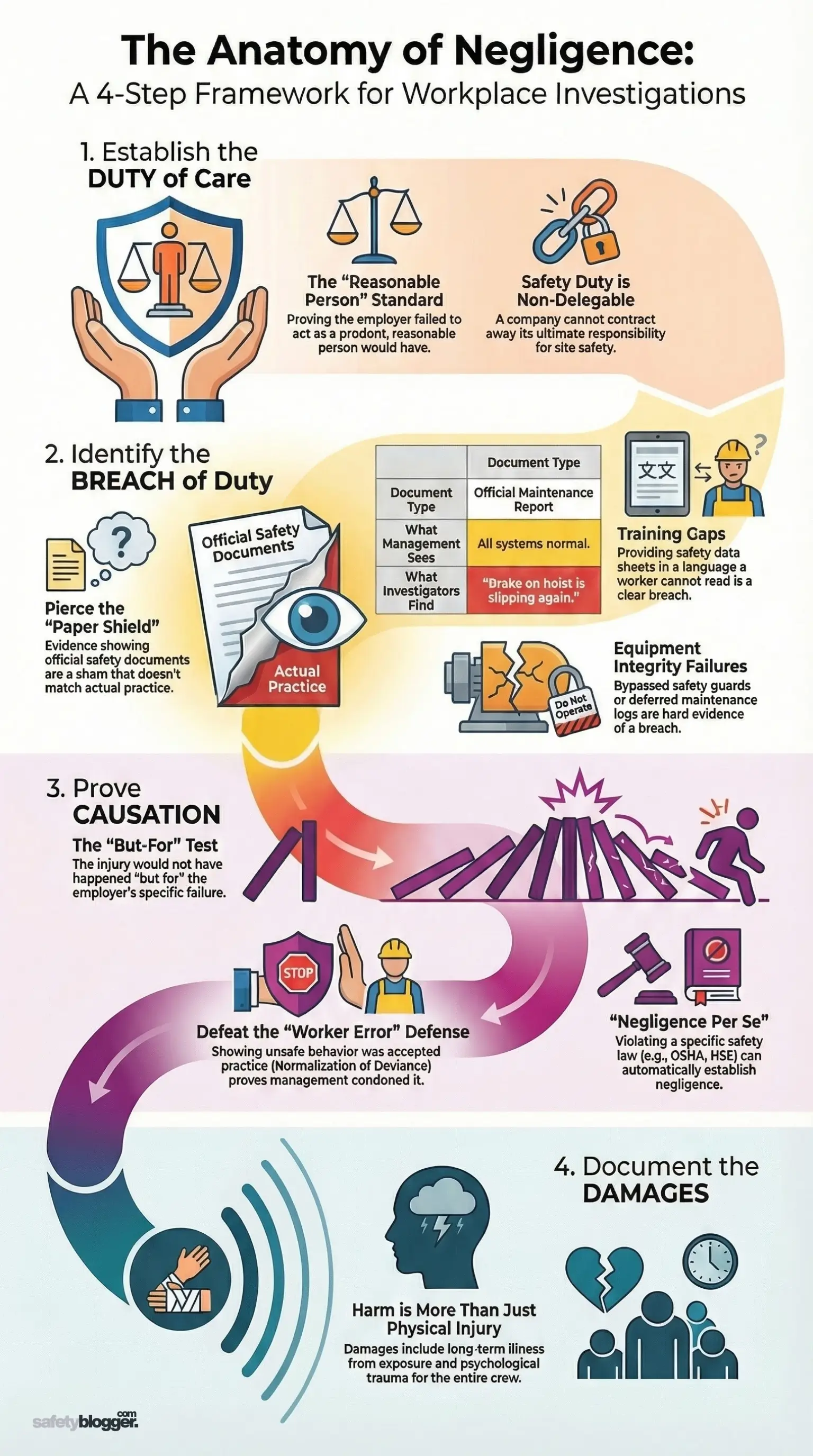
Establishing the Duty of Care
Before you can prove someone failed, you must prove they had a responsibility to act. In my experience, this is the easiest part to establish but the hardest to define in scope. In global heavy industries, the "Duty of Care" is non-negotiable, yet I constantly see organizations trying to outsource this duty to subcontractors.
The "Reasonable Person" Standard
The law and safety standards ask: "What would a prudent, reasonable employer have done in this situation?" When I build a case file, I look for the gap between the company's actions and the industry baseline. If an oil rig operator ignores a corrosion alert that a "reasonable" operator would have fixed, that is the foundation of negligence. We use ISO 45001 and manufacturer guidelines as the yardstick. If the crane manual says "inspect daily" and the site team inspected "weekly," the duty has been breached.
The Non-Delegable Nature of Safety
I have seen countless general contractors try to blame a third-party vendor for an accident on their site. However, under most global frameworks (like the UK’s HSE or US OSHA principles), the primary controller of the site retains the ultimate duty of care. You cannot contract away your liability. If I find that a site manager failed to vet the safety credentials of a subcontractor who then caused an explosion, the site manager is negligent for negligent hiring or supervision.
Identifying the Breach: The "Paper Shield" vs. Reality
This is where the battle is usually won or lost. Employers often hide behind what I call a "Paper Shield"—a mountain of signed forms that claim safety was a priority. My job is to prove that the paper does not match the practice. A breach occurs when the standard of care is not met.
The Training Gap
Paperwork often claims a worker was "competent," but reality proves otherwise.
Generic Sign-offs: I look for induction forms signed by 20 workers with the exact same pen and handwriting style. This proves the training was faked.
Language Barriers: I once investigated a chemical burn case where the Safety Data Sheet (SDS) was in English, but the injured worker only read Spanish. Providing instructions in a language the worker cannot understand is a clear breach of duty.
Competency vs. Attendance: Did the worker actually demonstrate they could do the job, or did they just sit in a room for an hour?
Maintenance and Equipment Integrity
Machines rarely fail without warning. When I inspect a failed piece of equipment, I look for:
Deferred Maintenance: Maintenance logs that show "parts on order" for months while the machine kept running.
Bypassed Guards: Physical evidence that interlocks or light curtains were tampered with to speed up production.
Lack of Lockout/Tagout (LOTO): Evidence that energy sources were not isolated during repair work.
Field Note: I always pull the "Shift Handover Logs." Formal reports are sanitized for management, but the shift logs written by operators often contain raw, honest complaints like "Brake on hoist is slipping again." That entry proves the employer had prior knowledge of the hazard and did nothing.
Proving Causation: The "But-For" Test
It is not enough to show that the employer was sloppy; you must prove that their sloppiness directly caused the injury. This is often where employers try to blame the worker (contributory negligence).
Breaking the Chain of Events
To prove negligence, I use the "But-For" test: But for the employer's failure to install a guardrail, would the fall have happened? If the answer is no, causation is established.
Direct Link: The missing guardrail directly led to the fall.
Proximate Cause: Was the injury a foreseeable result of the breach? If you leave live wires exposed, an electrocution is foreseeable.
Defeating the "Worker Error" Defense
Employers love to claim the worker was "unsafe." I counter this by looking at "custom and practice." If a worker was not wearing a harness, but I find photos of other workers and supervisors also not wearing harnesses in the preceding weeks, the defense falls apart. It proves that unsafe behavior was condoned by management. This is known as the "Normalization of Deviance."
The Role of Regulatory Non-Compliance
While negligence is a common law concept, violating a statutory regulation is often considered "negligence per se." This means if you broke the law, you are automatically negligent.
The Hierarchy of Controls Violation
I check if the employer followed the hierarchy of controls. Did they rely on PPE (the weakest control) when they could have engineered out the hazard?
Elimination/Substitution: Could the toxic chemical have been replaced?
Engineering Controls: Was ventilation adequate?
Administrative Controls: Were rotations used to limit exposure?
If an employer skips the top of the hierarchy to save money and relies solely on a hard hat, they have failed to reduce risk as low as reasonably practicable (ALARP).
Audit Trails and Previous Citations
A history of non-compliance is damning.
Internal Audits: I demand to see the Corrective Action Requests (CARs) from previous internal audits. If a hazard was identified six months ago and marked "open" or "pending budget," that is evidence of willful negligence.
Regulator citations: Past fines for similar issues establish a pattern of behavior.
Damages: Quantifying the Impact
Finally, negligence requires that actual harm occurred. While this is often obvious in injury cases, from an HSE perspective, we must document the full extent of the impact to ensure the "cost" of negligence is fully understood.
Beyond Medical Bills
Long-term Health: In cases of chemical exposure or noise, the damage is latent. We use industrial hygiene monitoring data to prove that exposure levels exceeded the Threshold Limit Value (TLV), causing irreversible harm.
Psychological Trauma: Witnessing a traumatic event causes PTSD. I often document the mental state of the surviving crew, as their psychological injury is a direct result of the employer's negligence.
Conclusion
Proving negligence is rarely about finding a "smoking gun." It is about assembling a puzzle of missing logs, ignored emails, bypassed safeguards, and cultural apathy. As an HSE professional, my goal in these investigations is never to simply assign blame, but to expose the systemic failures that allowed the negligence to thrive.
The most dangerous phrase in any industry is "we have always done it this way." When that mindset leads to an injury, it is not an accident—it is a choice. For those of us in the field, our documentation, our audits, and our refusal to look the other way are the only things standing between a worker and a preventable tragedy.





Comments
Loading...