


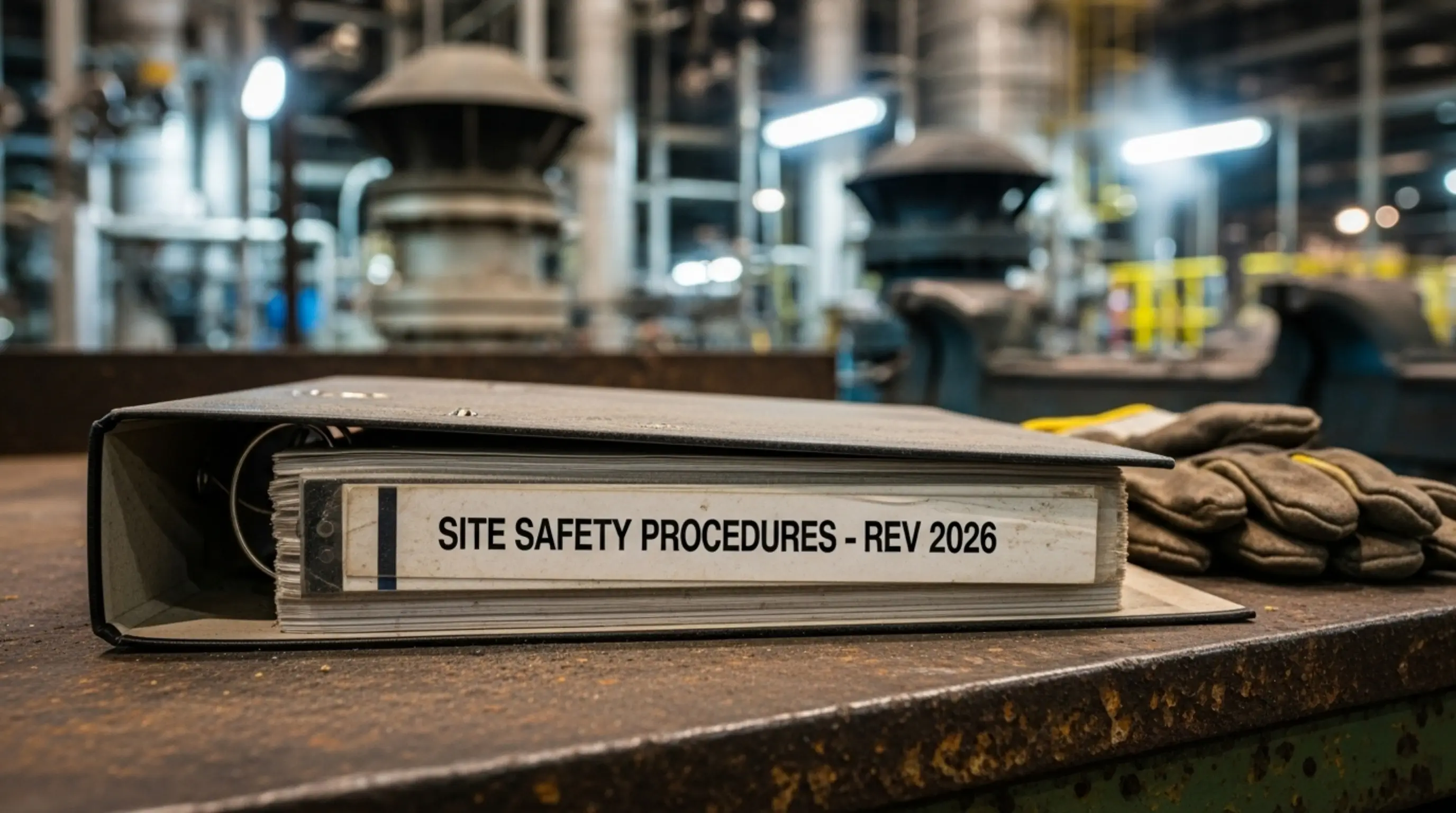
During a recertification audit at a mid-sized petrochemical facility last year, I discovered a confined space entry procedure that had not been revised since 2018. The document was neatly formatted and signed by a plant manager who had retired three years prior, but it completely omitted the new nitrogen purging system installed just six months ago. When I interviewed the night-shift supervisors, they admitted they were following an informal "mental checklist" because the official procedure was dangerously obsolete, creating a systemic gap that was just waiting to facilitate a major incident.
A static safety management system is a deteriorating safety management system. In this article, I will unpack why treating health and safety policies as living documents is critical for hazard control, regulatory compliance, and organizational resilience. We will explore the specific operational triggers that demand immediate procedural reviews, how to align with ISO 45001 continuous improvement mandates, and the life-saving impact of keeping the gap between paper and practice as narrow as possible.
The Hidden Hazard of Administrative Decay
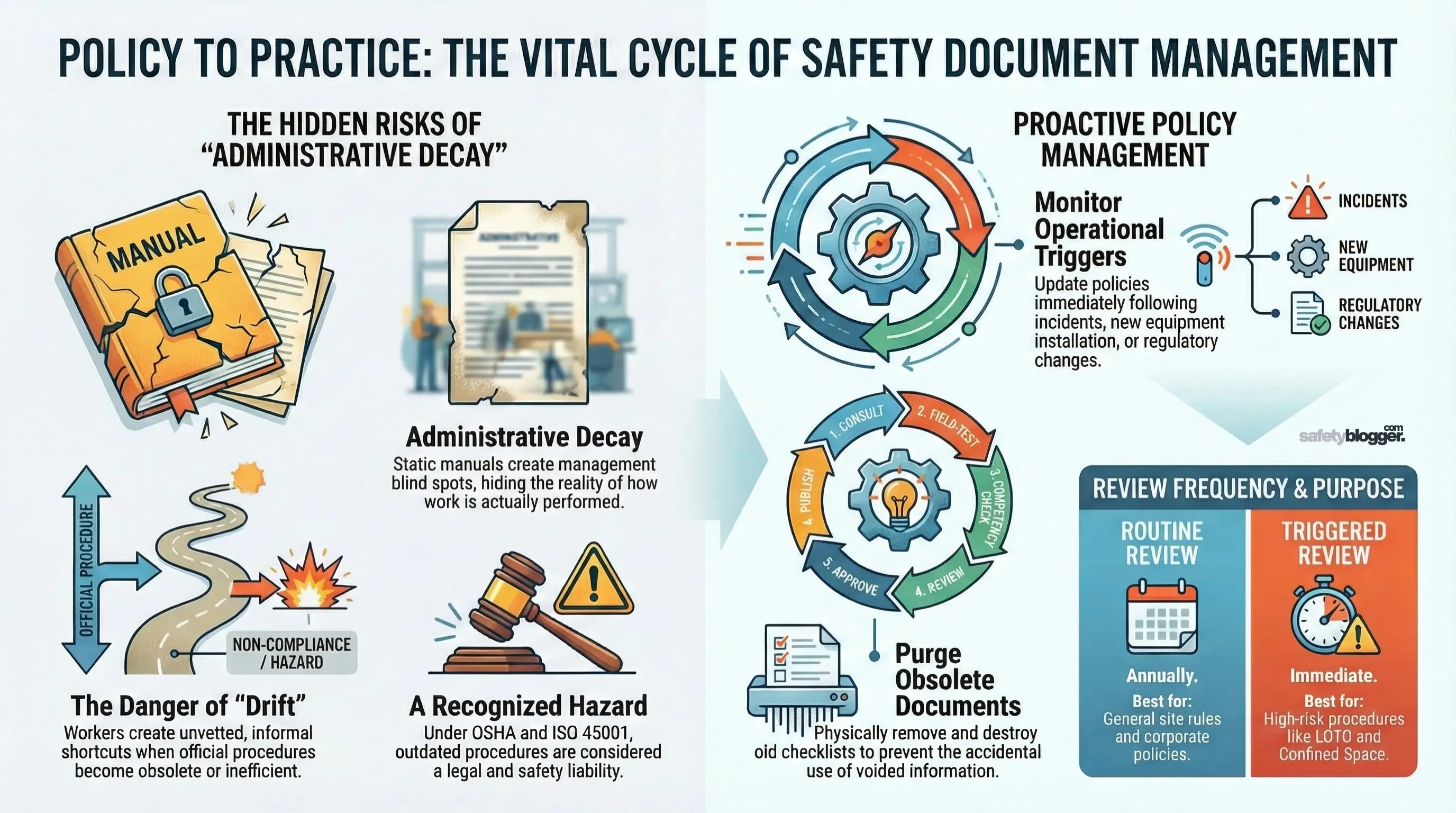
Policies and procedures are the backbone of any safety management system, but they are highly susceptible to administrative decay. When operational realities shift faster than the documentation, the workforce loses faith in the safety system.
On a dynamic job site—whether it is a fast-paced construction mega-project or a chemical processing plant—the introduction of new machinery, altered shift patterns, or even contractor turnover changes the risk profile. When I see safety manuals collecting dust on a shelf, I know instantly that the real work is happening through unwritten, unvetted shortcuts. This divergence between what is written and what is practiced creates a dangerous blind spot for management.
The Drift into Failure
Safety professionals refer to this phenomenon as "drift." It occurs when workers adapt to inefficient or outdated procedures by creating their own workarounds. If the written policy states a lockout-tagout (LOTO) procedure takes 45 minutes using old isolation points, but maintenance has found a way to do it in 15 minutes using newer valves, the official policy becomes irrelevant. My job as an auditor is to find this drift and correct the documentation before the shortcut leads to a fatality.
Triggers for Immediate Policy Review
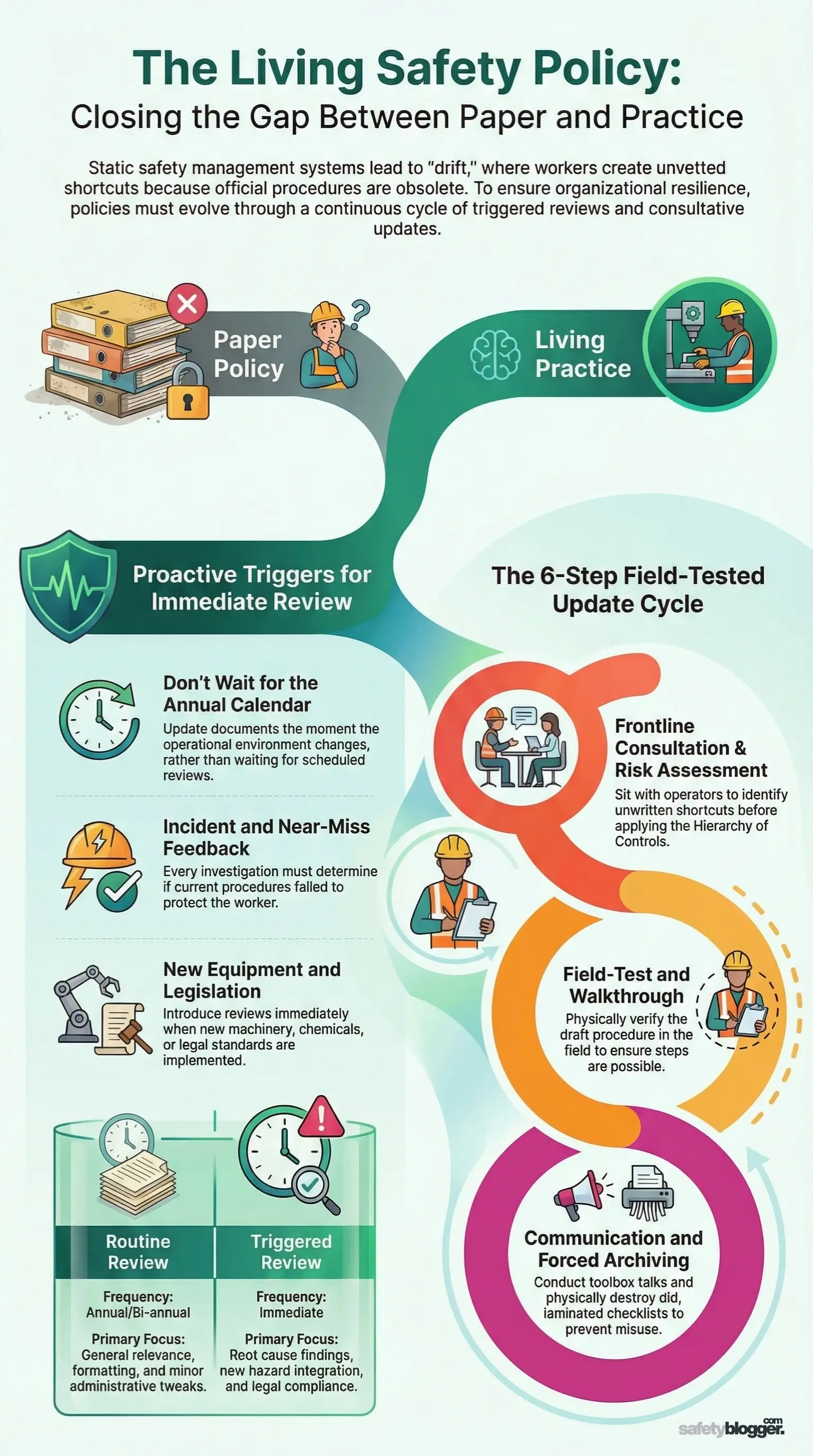
While an annual review is the baseline standard for most organizations, waiting for a calendar date to update a procedure is a reactive strategy. Proactive safety requires us to update documents the moment the operational environment changes.
Through my years of auditing and investigating incidents, I have found that policies must be reviewed immediately following specific operational triggers. Ignoring these triggers often leads to repeat incidents and legal non-compliance.
Here are the primary triggers that demand an immediate review of your HSE policies and procedures:
Following an Incident or Near-Miss: Every investigation should end with the question, "Did our current procedure contribute to this?" If the procedure failed to protect the worker, it must change.
Introduction of New Plant, Equipment, or Chemicals: A new chemical requires a new COSHH/HAZCOM assessment, which directly alters safe work procedures.
Changes to Legislation or Industry Standards: If OSHA updates a standard (like the recent emphasis on heat illness), your internal policies must reflect the new legal baseline.
Feedback from the Frontline Workforce: If workers report that a procedure is confusing, contradictory, or impossible to execute safely, the document is flawed.
Results from Safety Audits and Inspections: Non-conformities identified during ISO 45001 audits directly point to procedural gaps that need closing.
Review Matrix: Routine vs. Triggered Updates
Review Type | Frequency | Primary Focus | Best Used For |
Routine Review | Annually or Bi-annually | General relevance, contact updates, formatting, minor operational tweaks. | Corporate safety policy, general site rules, administrative forms. |
Triggered Review | Immediate / Event-driven | Root cause analysis findings, new hazard integration, legal compliance checks. | High-risk procedures (LOTO, Confined Space), emergency response plans. |
Aligning with Regulatory and Management System Requirements
Regulatory bodies and international standards do not view policy reviews as optional administrative tasks; they view them as legally binding obligations. Failing to maintain current procedures is a common citation during regulatory inspections and a primary reason for ISO non-conformances.
Under ISO 45001:2018 (Clause 7.5.3), documented information must be controlled, which includes ensuring it remains suitable and adequate for use. Furthermore, OSHA’s General Duty Clause implies that an employer must provide a workplace free from recognized hazards—and an outdated procedure that misdirects workers is, in itself, a recognized hazard. When I conduct external audits, I do not just check if a policy exists; I check its version history and interview workers to test its current applicability.
"A management system is not a stack of documents; it is a dynamic cycle. If your policies are not evolving through the Plan-Do-Check-Act (PDCA) cycle, your system is failing the fundamental test of continual improvement."
A Field-Tested Methodology for Procedural Updates
Reviewing a procedure is not a desk-job exercise for the HSE Manager to do in isolation. When policies are rewritten without consulting the end-users, they become bureaucratic obstacles rather than safety tools.
Over the years, I have developed a rigid, consultative approach to updating policies that ensures the final document is both compliant and practically usable on the shop floor.
Step 1: Frontline Consultation: Before deleting a single word, I sit down with the operators and supervisors who do the job. I ask them what works, what doesn't, and what hazards the old document missed.
Step 2: Risk Re-Assessment: I apply the Hierarchy of Controls to the updated process. Can we eliminate the hazard entirely this time?
Step 3: Draft and Field-Test: I take the draft procedure into the field and do a walkthrough. If a step is physically impossible, we revise it.
Step 4: Approval and Communication: Once approved, the update is rolled out. Simply emailing a PDF is not communication; toolbox talks and formal briefings are required.
Step 5: Training and Competency Check: Workers must be trained on the changes, and their understanding must be verified.
Step 6: Archiving: The old procedure is explicitly voided and archived to prevent the dangerous use of outdated documents.
Pro Tip: Never underestimate the danger of unretrieved old procedures. I once investigated a chemical spill where a night shift operator used a laminated response checklist from five years ago that was still pinned to the control room wall. Always physically remove and destroy obsolete documents from the field.
Conclusion
The regular review and updating of health and safety policies and procedures is not an administrative burden; it is a critical diagnostic check of your entire safety management system. Outdated procedures normalize risk, legally expose the organization, and most importantly, leave workers unprotected against the realities of a changing work environment.
At the end of the day, a procedure is a promise. It is a promise from management to the workforce that if they follow these steps, they will go home safely. When we allow those documents to become obsolete, we break that promise. Compliance metrics and audit scores are important, but they mean nothing compared to the human lives that depend on accurate, relevant, and robust safety standards.

Comments
Loading...