



The radio crackled with a code we hadn't used in two years. I was in the middle of a hot work audit at a coastal petrochemical terminal when the gatehouse guard's voice broke through the static: "We have an unannounced visit from the federal environmental regulator. They are asking for the plant director and the permit logs." The atmosphere on the site changed instantly. Tools went down, supervisors started frantically checking their paperwork, and a heavy silence fell over the control room. As the Lead Compliance Advisor, I met the inspectors at the gate. They didn't want coffee, and they didn't want a site tour; they wanted our emission monitoring records for the last 90 days, and they wanted to walk the tank farm immediately.
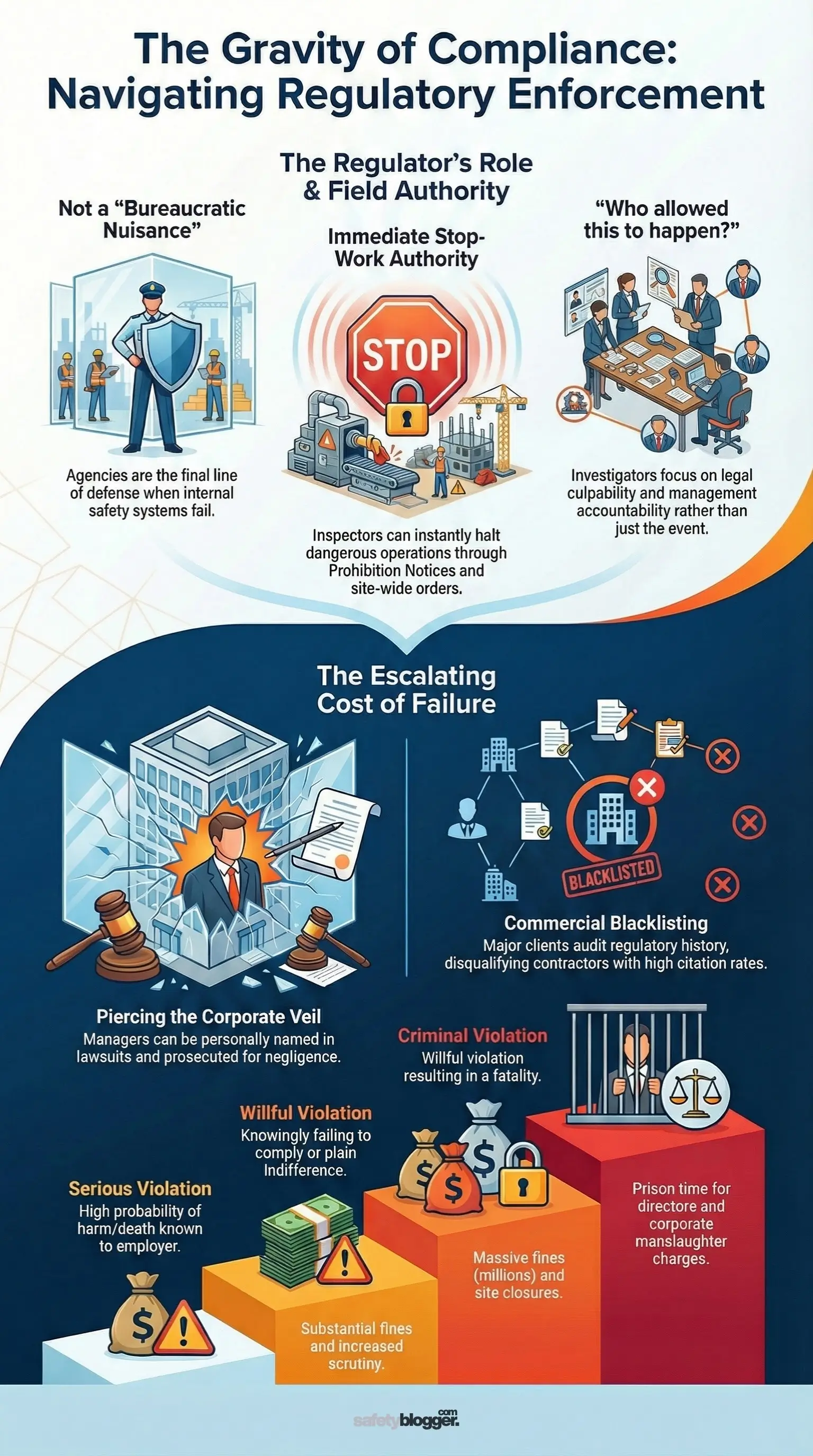
This is the reality of regulatory enforcement. Enforcement agencies are not bureaucratic nuisances; they are the final line of defense for the public and the workforce. When internal safety systems fail, the regulator steps in, and the consequences are unforgiving. This article details the actual role of enforcement agencies on high-risk sites, how they operate, and the cascading, often destructive consequences that non-compliance brings to an organization, its leadership, and its future.
The Role and Reach of Enforcement Agencies
Enforcement agencies exist to ensure that statutory duties of care are being met. Whether it is OSHA (US), the HSE (UK), the EPA, or specialized bodies like the Federal Railroad Administration (FRA), their mandate is the same: protect human life and the environment through the strict application of the law.
They are not there to help you write a risk assessment. They are there to verify that your risk assessment is accurate and actively protecting workers.
Primary Functions in the Field
Routine and Targeted Inspections: Unannounced visits based on high-hazard industry targeting (e.g., combustible dust, scaffolding, trenching).
Incident Investigation: Deploying to the site immediately following a fatality, catastrophe, or major spill to determine root causes and legal culpability.
Compliance Verification: Reviewing training records, maintenance logs, and industrial hygiene data.
Issuing Citations and Orders: Halting dangerous operations instantly (Stop Work Orders) and issuing citations for identified hazards.
"A regulatory inspector’s first question isn't 'what happened?' It is 'who allowed this to happen?'"
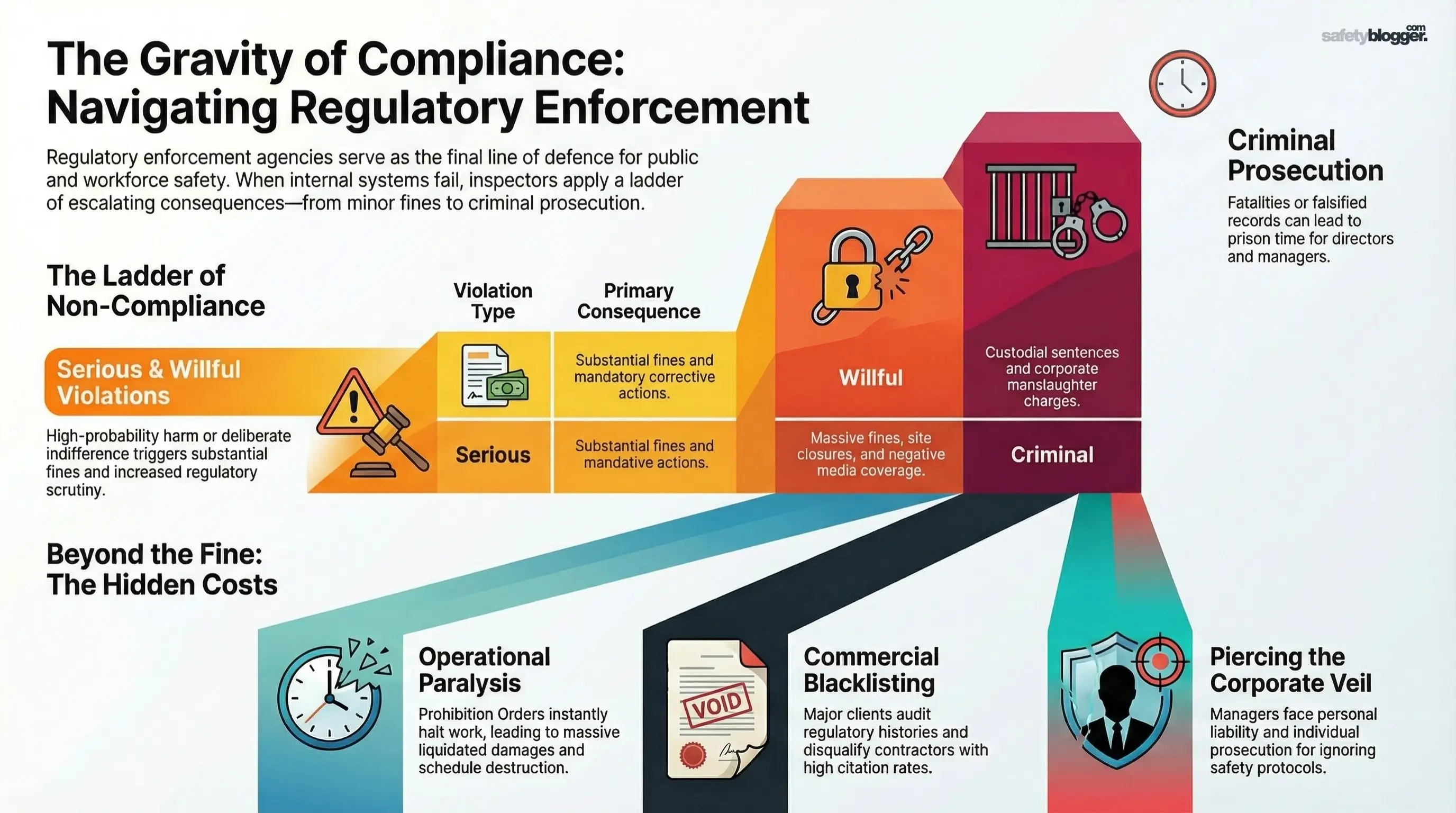
The Escalating Ladder of Non-Compliance
During my time managing compliance for a multinational EPC contractor, I watched a minor scaffolding violation snowball into a multi-million dollar disaster because site management tried to downplay the issue. Non-compliance is rarely a single static event; it is an escalation of consequences.
Enforcement agencies classify violations based on the employer's intent and the probability of harm. The penalties scale aggressively:
Violation Type | Definition | Real-World Consequence |
Other-than-Serious | Violations directly related to job safety but unlikely to cause death. | Minor fines, administrative warnings, abatement orders. |
Serious | High probability that death or serious physical harm could result, and the employer knew (or should have known). | Substantial fines, increased regulatory scrutiny, mandatory corrective actions. |
Willful | The employer knowingly failed to comply with a legal requirement or acted with plain indifference to worker safety. | Massive fines (often reaching millions), site closures, media press releases. |
Criminal | Willful violations resulting in a fatality, or falsifying official records to mislead an agency. | Prison time for directors/managers, permanent site closure, corporate manslaughter charges. |
The Real Field Costs: Beyond the Fine
Fines are often just a line item on a corporate balance sheet. The true consequences of non-compliance hit the operation in ways that money alone cannot fix.
Operational Paralysis: When a regulator issues a Prohibition Notice or Stop Work Order, your project dies that day. Cranes stop lifting, concrete stops pouring. The schedule is destroyed, leading to massive liquidated damages from the client.
Commercial Blacklisting: Major clients (like ExxonMobil, Rio Tinto, or government entities) audit your regulatory history before awarding contracts. If your Total Recordable Incident Rate (TRIR) is artificially low, but your regulatory citation history is high, you will be disqualified from bidding. No client wants a contractor that attracts federal attention.
Personal Liability for Managers: This is the reality that shakes supervisors the most. In many jurisdictions, the "corporate veil" is pierced during severe safety failures. If an agency determines you were negligent, you cannot hide behind your company. I have seen project managers personally named in lawsuits and prosecuted for ignoring confined space entry rules that led to a fatality.
Pro Tip for Field Leaders: If an inspector identifies an imminent danger on your site during a walkthrough, do not wait for the citation. Shut the operation down immediately, in front of the inspector, and fix it. Good faith abatement goes a long way.
The Anatomy of a Successful Investigation
When the inspector arrives, your response sets the tone for the entire investigation. Hostility breeds suspicion. Panic indicates a lack of control.
Through dozens of audits and post-incident investigations, the rules of engagement are clear:
Designate a Competent Host: The inspector should be escorted by someone who knows the site hazards intimately—typically the HSE Manager.
Control the Scope: Walk the inspector directly to the area of concern. Do not take the "scenic route" through the plant where they might spot unrelated hazards.
Never Guess, Never Lie: If an inspector asks for a training record you cannot immediately find, say: "I will retrieve that from our HR database and provide it to you." Do not say, "I'm sure we did it."
Duplicate Their Efforts: Take the same photos the inspector takes. Sample the same air or soil they sample. This allows your internal legal and technical teams to prepare a parallel defense.
Conclusion
The arrival of an enforcement agency at your gate is the ultimate stress test of your organization's integrity. While the consequences of non-compliance—from crippling fines to prison sentences—are severe, they are fundamentally avoidable. Regulatory standards are not arbitrary hurdles; they are the minimum legal requirement for keeping human beings alive in hazardous environments.
As HSE professionals and operational leaders, our goal is not to "pass the inspection." Our goal is to run a site so effectively that when the regulator does arrive, our worst fear is a paperwork delay, not a fatality. Protect your people, and the compliance will take care of itself.




Comments
Loading...