



I once suspended all operations at a heavy fabrication yard in the Middle East after discovering welders working in a confined space with toxic fumes and no active extraction. The Project Manager argued that the workers were wearing standard dust masks, but as a Lead Auditor, I knew that under the foundational principles of international safety law, providing cheap, ineffective PPE while ignoring the deadly process hazard was a gross violation. The employer’s primary duty is to make the work safe, not to outfit workers for a hazardous environment that could have been engineered correctly in the first place.
This brings us to the absolute bedrock of global occupational health and safety: the International Labour Organization’s (ILO) Convention C155 (Article 16) and Recommendation R164 (Paragraph 10). These are not mere guidelines or HR policies; they are the international legal frameworks that define what an employer must do to protect human life. Whether you are running a chemical plant in Pakistan or a construction mega-project in the EU, understanding these responsibilities is the difference between a compliant, safe workplace and systemic negligence that ends in fatality.
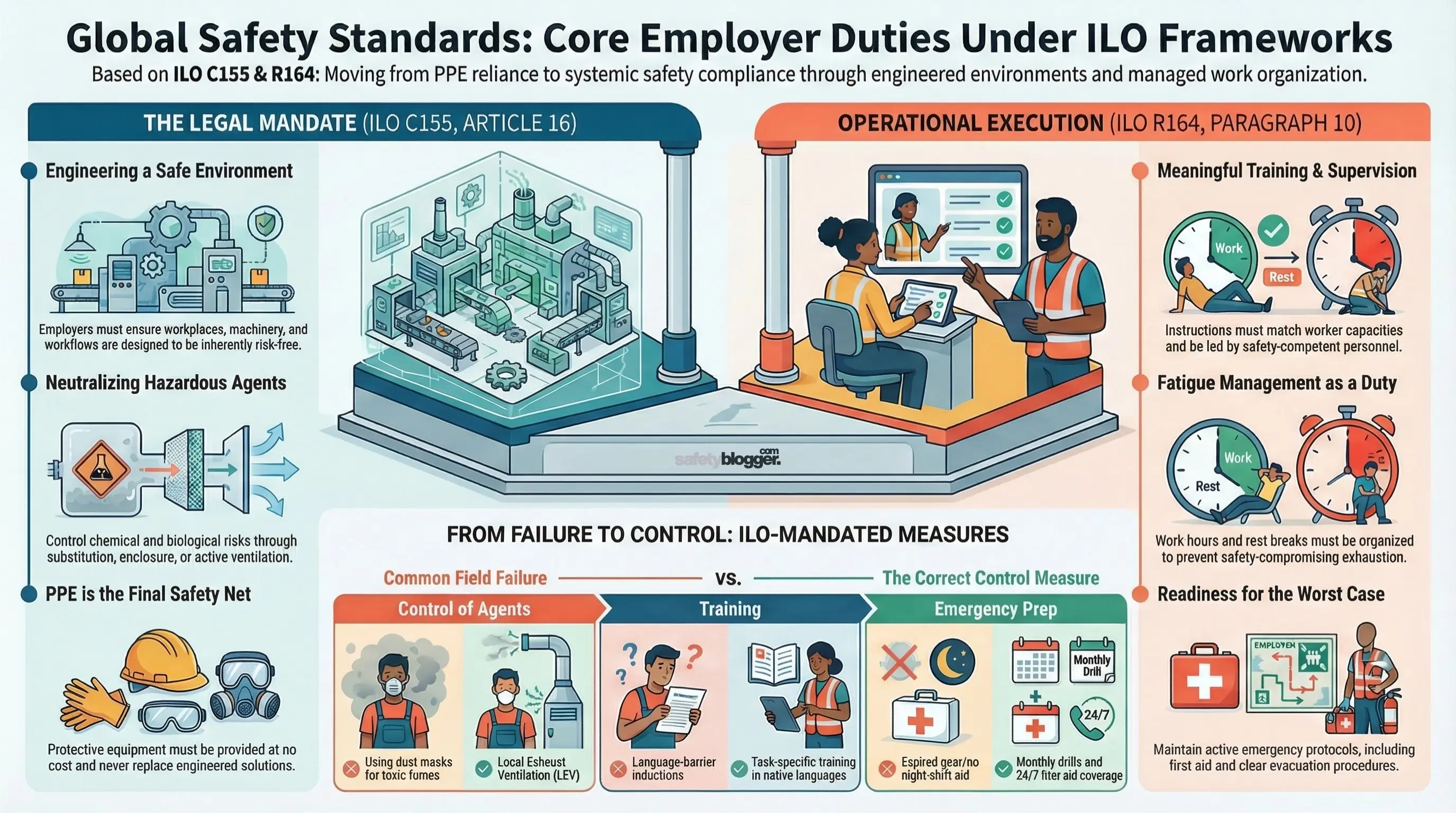
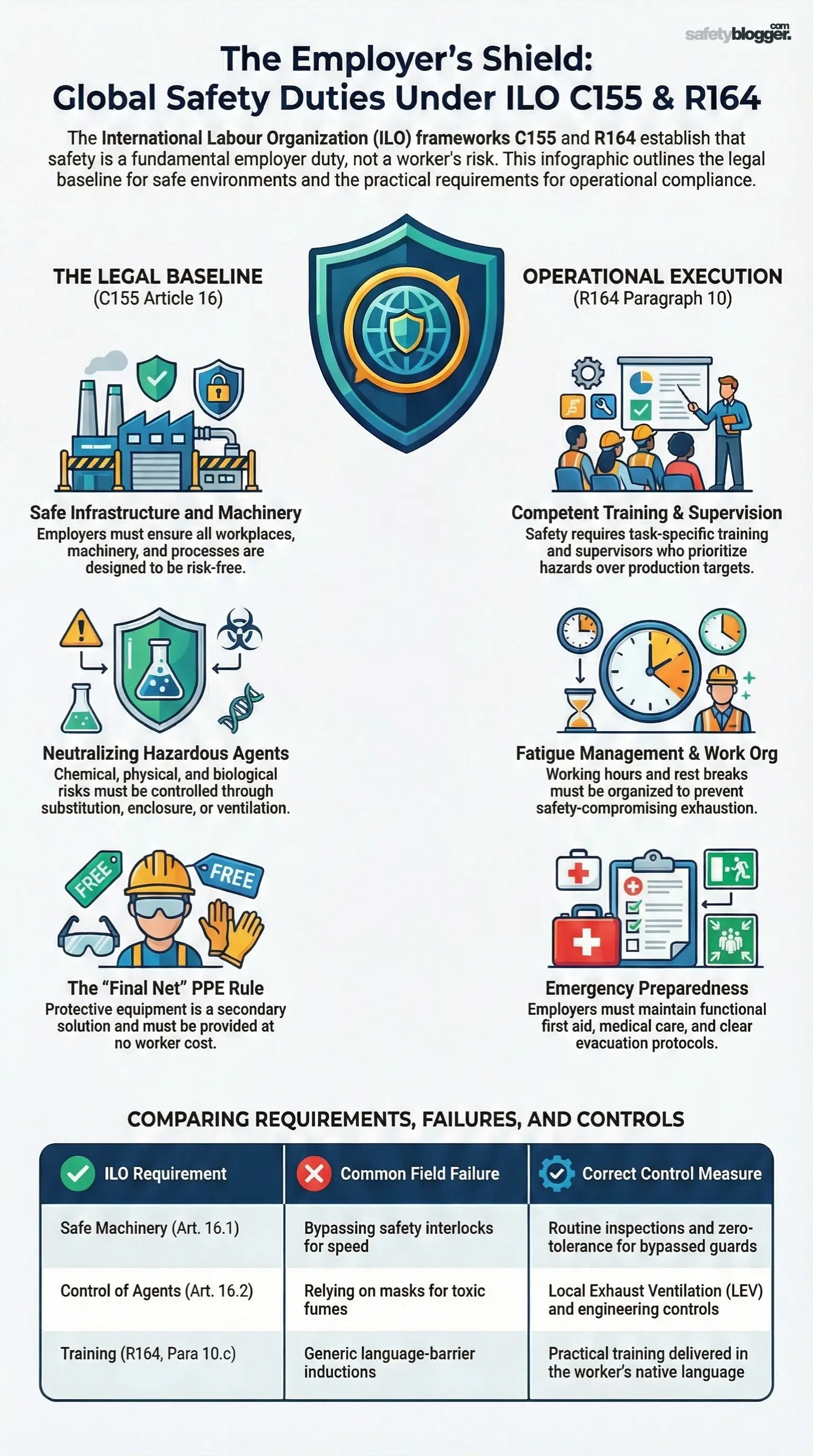
The Absolute Duties Under C155 Article 16
Article 16 of the ILO Convention C155 sets the baseline. It strips away excuses and places the burden of safety squarely on the employer’s shoulders. As an HSE Director, I use this standard to evaluate whether management truly understands their role.
First, the convention demands that employers ensure workplaces, machinery, equipment, and processes are safe and without risk to health. This is a massive, overarching duty. It means before a worker even steps onto a job site, the employer must have conducted the risk assessments, inspected the heavy plant machinery, and designed safe workflows. You cannot blame "worker behavior" for an accident if the machine lacked guards or the scaffold was fundamentally unstable.
Second, it addresses chemical, physical, and biological agents. Employers must ensure these agents are without risk to health when the appropriate measures of protection are taken. In my years inspecting petrochemical facilities, this is where most failures occur. Employers often accept hazardous ambient levels of benzene or silica, assuming it's "part of the job." Article 16 demands substitution, enclosure, or active ventilation to neutralize these agents.
Finally, the article mandates the provision of adequate protective clothing and protective equipment to prevent risks of accidents or adverse health effects. Crucially, this must be provided at no cost to the worker. It is the final safety net, not the primary solution.
Translating Theory to the Field: R164 Recommendation 10
While C155 provides the legal mandate, Recommendation R164 (Paragraph 10) provides the operational "how-to." It expands on the duties of the employer, turning legal clauses into practical field requirements.
As an auditor, when I assess compliance with R164, I am looking for the integration of safety into the company's DNA. Here is how R164 demands employers execute their responsibilities:
Training and Instruction: Employers must provide instructions and training, taking account of the functions and capacities of different categories of workers. Pencil-whipping a 10-minute induction video does not count.
Competent Supervision: Work must be supervised by competent personnel. A supervisor must understand the specific hazards of the job, not just the production targets.
Organization of Work: The way work is structured—including working hours and rest breaks—must not adversely affect occupational safety and health. Fatigue management is a legal duty, not a perk.
Emergency Preparedness: Employers must prepare for the worst. This includes first aid, medical care, and clear evacuation protocols.
Pro Tip: When auditing for R164 compliance, I always interview the workers on the floor, not the managers. If a crane operator cannot explain the emergency shutdown procedure, the employer has failed their R164 obligation, regardless of how good their paperwork looks.
Common Field Failures in Employer Responsibilities
In my decade of site inspections, I rarely see employers outright refusing to practice safety. Instead, I see a dangerous dilution of C155 and R164 responsibilities through negligence and cost-cutting.
The "PPE as a Panacea" Trap
The most frequent violation of Article 16 is using Personal Protective Equipment as the first line of defense. I have seen construction sites rely entirely on fall arrest harnesses without ever considering edge protection or scaffolding. This violates the legal demand to make the workplace safe.
Shifting the Financial Burden
R164 clearly states that OSH measures should not involve any expenditure for the workers. Yet, I frequently encounter contractor arrangements where laborers are forced to buy their own steel-toed boots or pay for their own medical surveillance tests. This is a direct regulatory failure.
Ignoring Fatigue and Mental Load
Paragraph 10(e) of R164 explicitly mentions the organization of work and working hours. In high-pressure shutdowns, I often see employers pushing workers through 16-hour shifts. When a tired worker makes a fatal mistake, the root cause is the employer's failure to organize work safely, not the worker's momentary lapse.
Table: Employer Responsibilities vs. Site Realities
ILO Requirement (C155/R164) | Common Field Failure | The Correct Control Measure |
Safe Machinery (Art. 16.1) | Bypassing safety interlocks to speed up production. | Routine PM inspections and a "Zero Tolerance" policy on bypassed guards. |
Control of Agents (Art. 16.2) | Handing out dust masks for high-concentration silica tasks. | Local Exhaust Ventilation (LEV) and wet-cutting methods. |
Training (R164, Para 10.c) | Generic, language-barrier inductions. | Task-specific, practical training delivered in the worker's native language. |
Emergency Prep (R164, Para 10.f) | Expired fire extinguishers and no trained first aiders on night shifts. | Monthly drills and mandatory first-aid coverage for all operational shifts. |
Conclusion
The responsibilities outlined in ILO C155 Article 16 and R164 Recommendation 10 are not abstract concepts for lawyers; they are the fundamental shield protecting the lives of workers on the ground. From heavy industrial plants to small-scale construction, the employer holds the ultimate duty of care.
Real safety leadership means accepting that hazards are the employer’s problem to solve, not the worker’s risk to bear. It requires building operations where safety is engineered into the process, competence is rigorously trained, and emergencies are prepared for. In the end, regulatory compliance is just the baseline. The true measure of an organization is its unwavering commitment to the principle that human life is always worth more than operational convenience or profit margins.





Comments
Loading...