


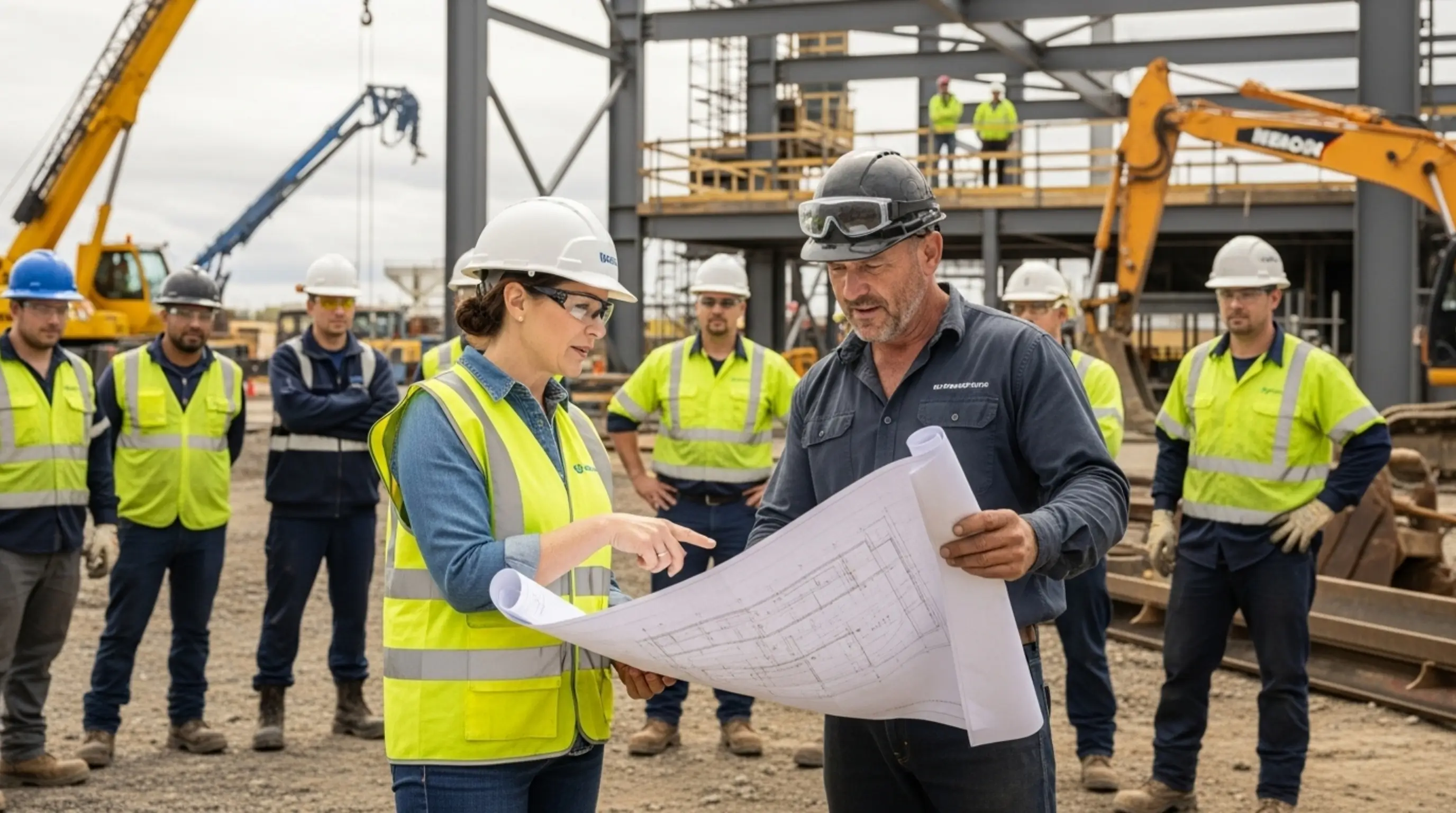
During a major refinery turnaround in the Middle East, I had to shut down an entire unit when a subcontractor’s excavation crew struck an unmarked, live chemical pipeline. The client’s operations team had provided outdated underground utility maps to the principal contractor, who then passed the work to a tier-two subcontractor without conducting a fresh line-locating scan. When the incident investigation concluded, we found three different, conflicting permit-to-work systems in use on the same site. The client blamed the main contractor for lack of supervision, the main contractor blamed the subcontractor for incompetence, and the subcontractor blamed the client for faulty drawings. No one was hurt that day, but the breakdown in coordination was a systemic failure waiting to claim a life.
Managing the interface between clients, principal contractors, and sub-contractors is one of the most complex challenges in occupational safety. The danger does not usually stem from a lack of safety systems, but from the gaps between them. In multi-employer environments, responsibility diffuses, communication fragments, and hazard perception differs drastically between permanent operations staff and transient construction crews. This article covers the practical realities of coordinating contracted work, moving beyond simple contractual compliance to build a cohesive, field-tested safety culture that protects every worker on site, regardless of whose logo is on their hard hat.
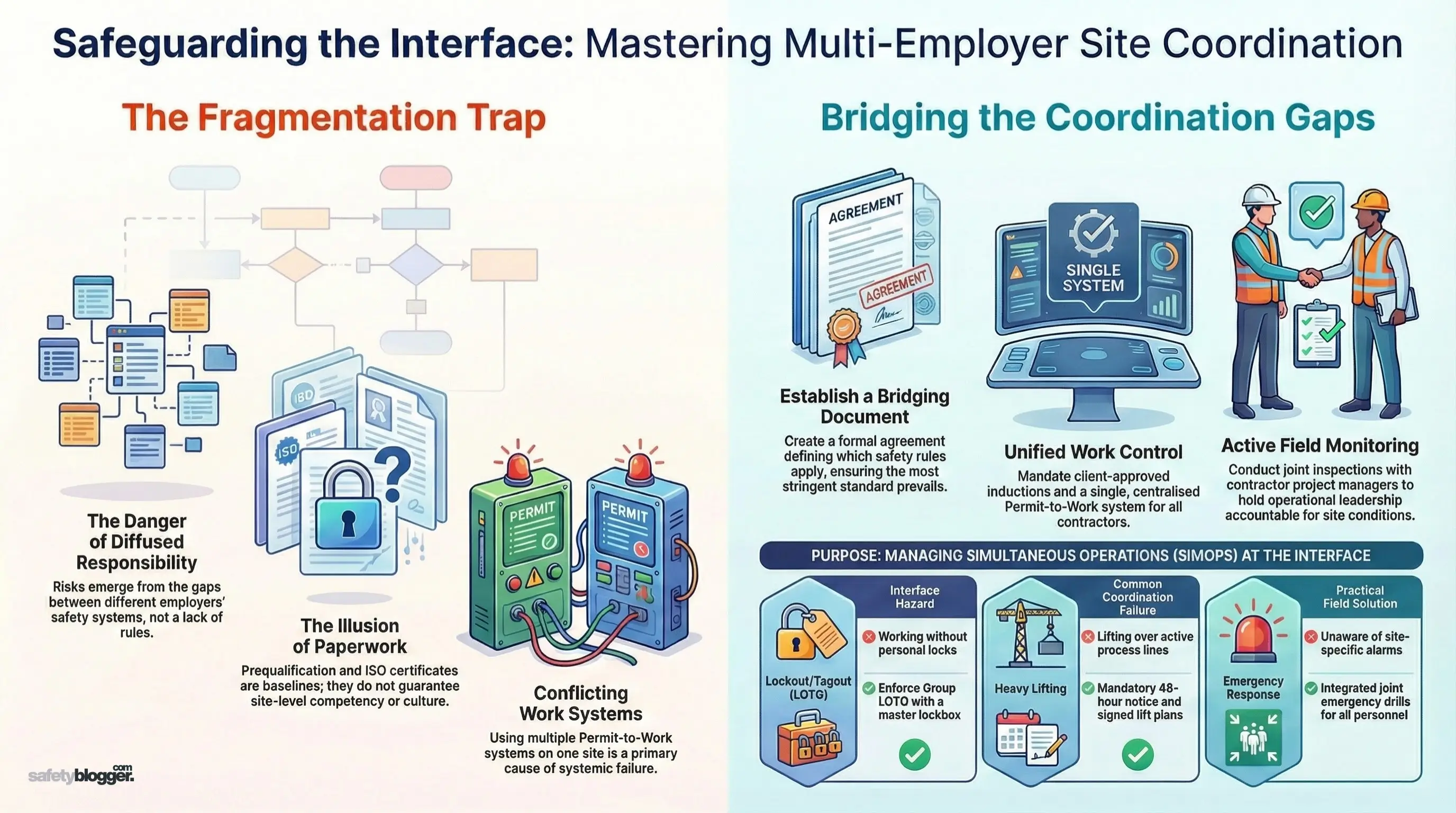
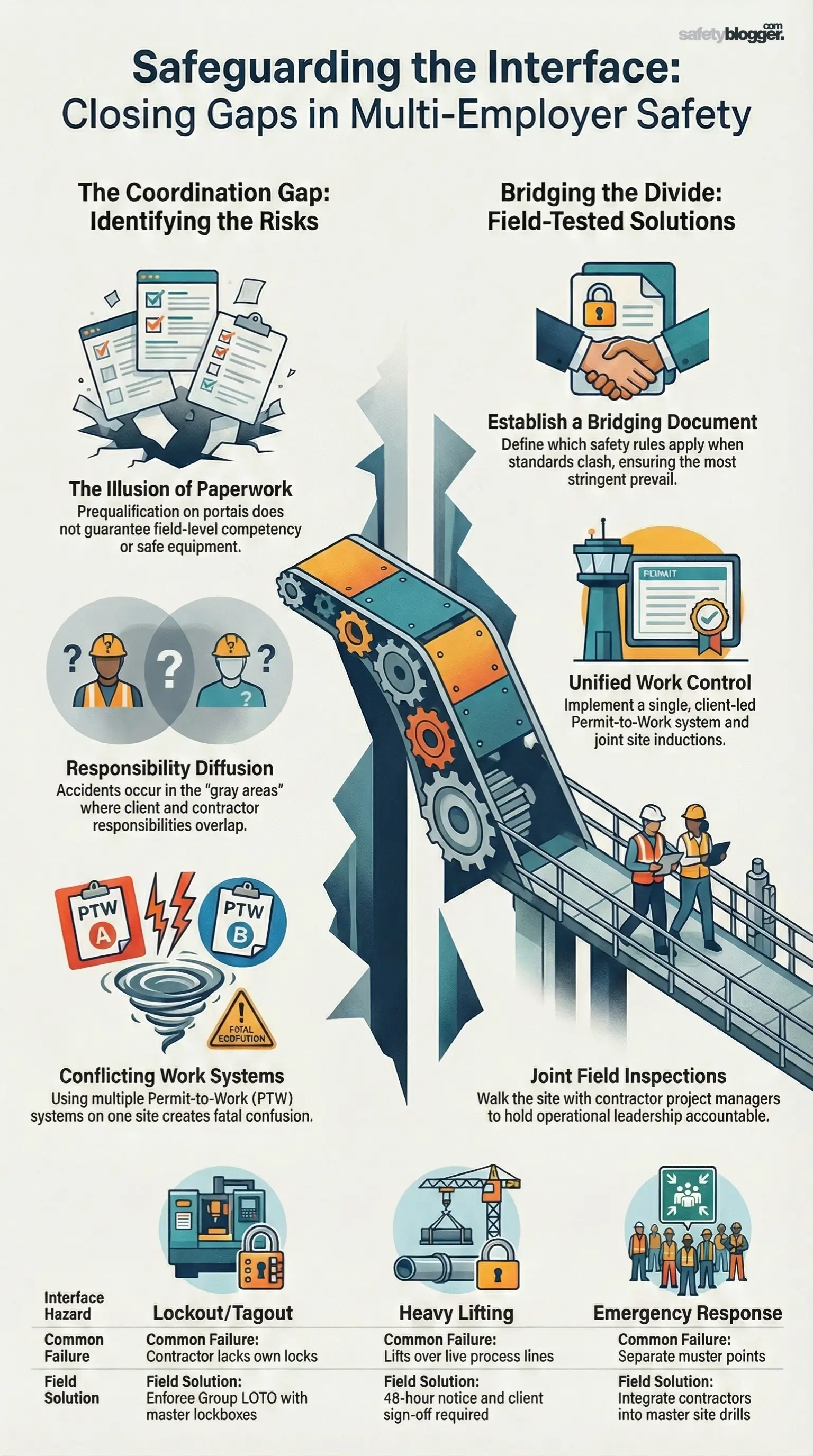
The Illusion of Paperwork: Prequalification vs. Reality
Prequalification is often treated as the ultimate safety filter, but in my experience, a perfect safety manual on a procurement portal does not guarantee a safe crew on site. Prequalification is merely the baseline.
Relying solely on trailing indicators like TRIR or ISO 45001 certificates is a dangerous trap. I have audited contractors with flawless safety records who showed up on day one with expired lifting gear and untrained supervisors. Effective management starts by auditing the reality, not just the paperwork.
Audit field capability: Before the contract is signed, visit the contractor’s existing job sites to witness their actual safety culture and equipment standards.
Define scope boundaries: Ambiguity in the Scope of Work (SOW) leads to safety gaps. Clearly define who supplies the PPE, who handles hazardous waste disposal, and who provides emergency medical response.
Assess supervisor competency: A contractor’s safety is only as good as their front-line supervisors. Interview them to ensure they understand the specific high-risk hazards of your site.
Field Note: If a contractor submits a generic Job Hazard Analysis (JHA) that doesn't mention the specific constraints of your facility, reject it immediately. A copy-paste safety plan is the first warning sign of contractor negligence.
Bridging the Gaps: Communication and Chain of Command
When you have a client, a principal Engineering, Procurement, and Construction (EPC) contractor, and multiple sub-contractors, information silos are inevitable. Without a unified chain of command, critical safety information gets lost in translation.
To prevent this, we must establish a clear "Bridging Document." This is the operational agreement that defines whose safety rules apply when standards clash. As a rule, the most stringent standard must always prevail.
Standardizing the Work Control System
Unified Inductions: Do not let contractors run their own site inductions. Ensure every worker goes through a standardized, client-approved orientation that covers site-specific emergency protocols.
Single Permit-to-Work (PTW) System: Operating multiple PTW systems on one site is a recipe for disaster. Contractors must be trained to use the overarching site PTW system, ensuring all isolations and clearances are managed centrally.
Joint Toolbox Talks: Do not allow contractors to hold isolated safety meetings. Client representatives and main contractor safety leads should regularly attend and co-host subcontractor toolbox talks to ensure alignment.
Managing High-Risk Interfaces and SIMOPS
The most critical hazards in contracted work occur at the "interfaces"—where the client’s existing operations overlap with the contractor’s construction activities. This is known as Simultaneous Operations (SIMOPS).
In an active petrochemical plant, a contractor performing hot work (welding) near a client's live gas processing unit creates an interface risk that requires absolute coordination. Misalignment here is usually fatal.
Field Controls for Complex Interfaces
Interface Hazard | Common Coordination Failure | Practical Field Solution |
Lockout/Tagout (LOTO) | Contractor works on machinery isolated by client ops without placing their own locks. | Enforce Group LOTO. The contractor lead must place a lock on the master lockbox. |
SIMOPS (Heavy Lifting) | Crane operations over active client process lines or pedestrian walkways. | Mandatory 48-hour advanced notice for lifts; client ops must sign off on the lift plan. |
Emergency Response | Contractors use their own muster points, unaware of the plant's toxic gas alarm meaning. | Integrate contractor drills into the master site drill. Joint emergency exercises are non-negotiable. |
Active Field Monitoring and Enforcement
You cannot outsource safety liability. Legally and morally, the client and principal contractor hold the ultimate duty of care. Managing contractors requires persistent, active field presence.
I make it a point to perform joint inspections. Walking the site with the contractor’s project manager—not just their safety officer—changes the dynamic. It holds operational leadership accountable for the conditions on the ground.
Correcting Non-Compliance
Empower Stop Work Authority (SWA): SWA must be absolute and universal. A tier-three sub-contractor laborer must feel empowered to stop the client’s site manager if they see an unsafe act.
Implement a Consequence Matrix: Contractual penalties for safety violations must be clear. This ranges from warnings for minor infractions to the immediate removal of personnel and contract termination for life-critical rule violations.
Track Leading Indicators: Monitor the contractor’s near-miss reporting rates, the quality of their hazard observations, and their housekeeping standards.
Pro Tip: Embed a client HSE representative directly into the contractor’s daily planning meetings. Catching a poor lifting plan at 7:00 AM in the trailer is infinitely better than stopping the lift at 10:00 AM on the site.
Conclusion
Managing clients, contractors, and contracted work is an exercise in leadership, communication, and boundary management. The most sophisticated contracts and rigorous pre-qualification checklists are useless if the different entities on site operate as separate tribes.
Through years of investigating incidents on mega-projects, the lesson is clear: accidents happen in the gray areas of responsibility. Eradicating those gray areas requires active supervision, transparent communication, and a unified safety culture. At the end of the day, safety is not about shifting liability to the lowest bidder; it is about protecting human life through relentless, coordinated vigilance.






Comments
Loading...