



During a third-party compliance audit for a mega-infrastructure project in Southeast Asia, I found myself in a standoff with the project director. He was furious that a group of local steel fixers had stopped work under a suspended load due to high wind speeds, costing the project thousands in delays. When he threatened to fire the crew for insubordination, I pulled the contract specifications, which bound the joint venture to international labor standards. I pointed directly to Article 19 of ILO Convention C155, which protects workers from undue consequences when they remove themselves from imminent danger.
Understanding the International Labour Organization (ILO) Convention C155 and its accompanying Recommendation R164 is not an academic exercise for lawyers; it is the absolute bedrock of field safety. In regions with fragmented or developing local safety laws, these international standards become the governing law on major sites. They shift safety from a reactive, paper-pushing exercise to a proactive, consultative process. If you do not understand the framework of C155 and R164, you cannot effectively audit, manage, or defend the basic rights of your workforce in a high-risk environment.
What is ILO Convention C155? The Foundation of OHS Governance
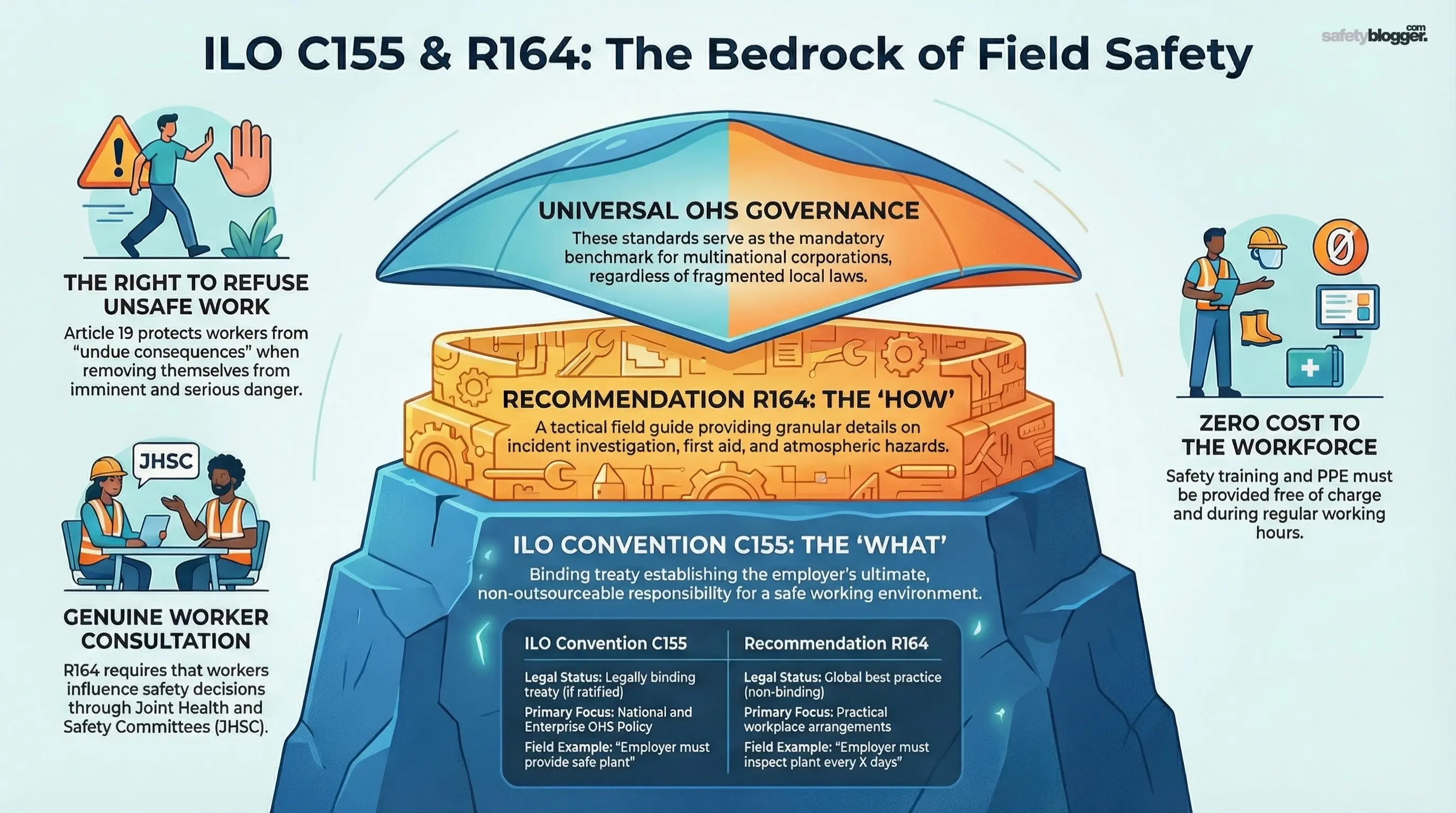
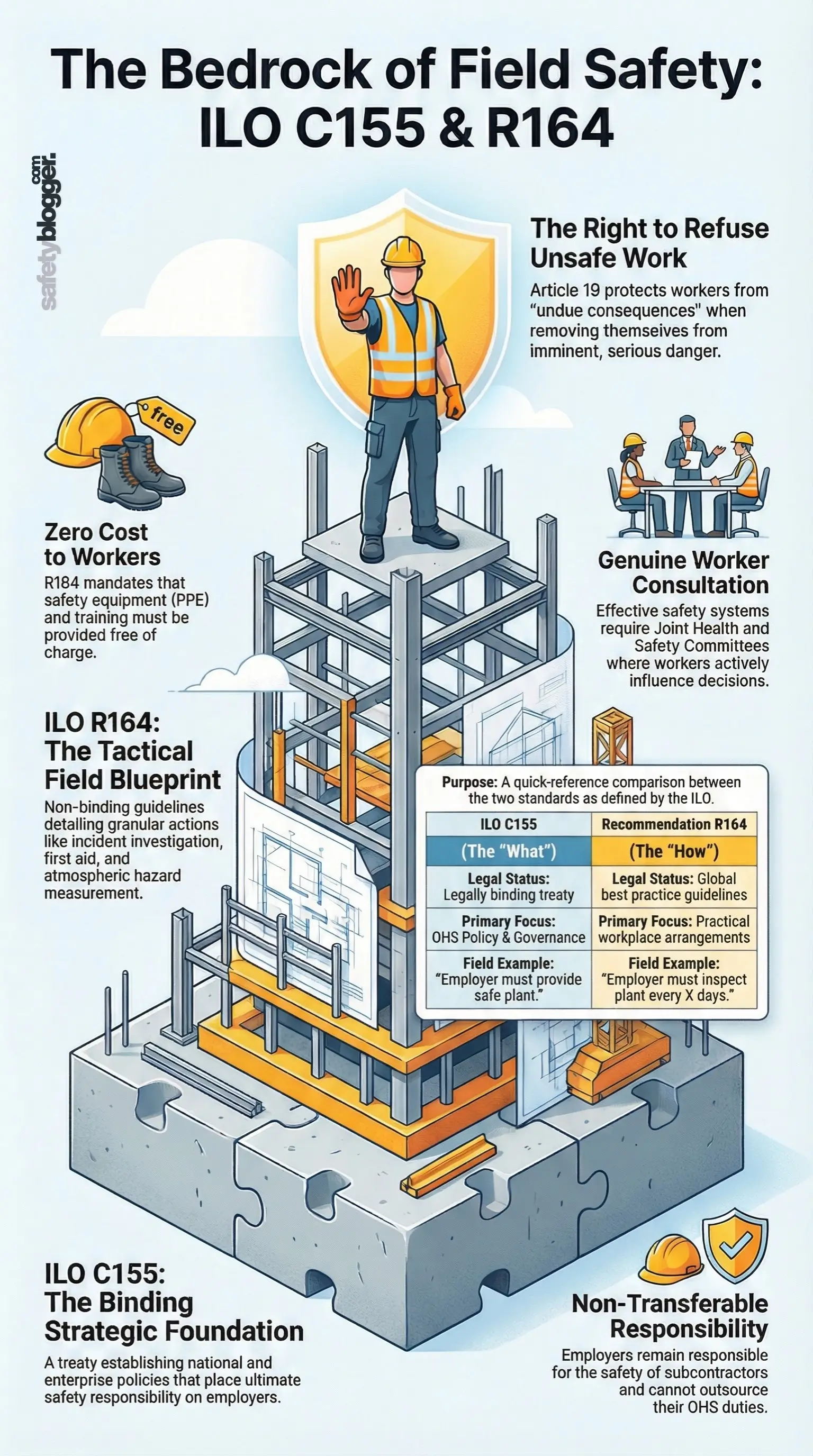
Adopted in 1981, ILO Convention C155 (Occupational Safety and Health Convention) is a binding international treaty for countries that ratify it, and a mandatory benchmark for multinational corporations worldwide. It establishes the principles for a national and enterprise-level OHS policy.
As a Lead Auditor, when I assess a new facility, C155 is the lens through which I view their overarching system. The Convention demands that employers provide a safe working environment, adequate personal protective equipment (PPE), and ensure that machinery and processes do not pose a threat to worker health. It places the ultimate responsibility of workplace safety squarely on the employer's shoulders.
Crucially, C155 mandates that this responsibility cannot be outsourced. If a chemical plant hires subcontractors to clean confined spaces, the host employer remains responsible for the safety of those contract workers under the C155 framework.
What is Recommendation R164? The Field Blueprint
While a "Convention" is a binding treaty, a "Recommendation" is a set of guidelines that supplements it. Recommendation R164 provides the granular, day-to-day details on how to actually comply with C155.
If C155 is the strategic goal, R164 is the tactical field guide. It outlines the specific obligations for employers to investigate incidents, provide first aid, and measure atmospheric hazards. It also details the creation of Joint Health and Safety Committees (JHSC) and the appointment of worker safety representatives.
R164 makes it clear that safety training must be free of charge, conducted during working hours, and delivered in a language the workers understand. When I audit scaffolding contractors, R164 is the standard I use to verify if the riggers actually understood their training, or if they just signed an attendance sheet.
Convention vs. Recommendation: Understanding the Application
To effectively implement these standards on a site, you must understand how they interact. One creates the duty; the other provides the method.
Feature | ILO Convention C155 (The "What") | Recommendation R164 (The "How") |
Legal Status | Legally binding treaty (if ratified by country) | Non-binding, but serves as global best practice |
Primary Focus | Establishing National and Enterprise OHS Policy | Practical workplace arrangements and actions |
Worker Rights | Right to refuse unsafe work | Process for consulting workers and safety reps |
Field Example | "Employer must provide safe plant." | "Employer must inspect plant every X days." |
Blockquote: "There shall be arrangements at the level of the undertaking under which workers... are given adequate information on safety and health matters, enabled to enquire into, and are consulted by the employer..." — ILO Convention C155, Article 19.
The Right to Refuse Unsafe Work
Perhaps the most critical, and often contested, element of C155 is the right to refuse hazardous work. Article 13 and Article 19(f) state that a worker who removes themselves from a work situation which they have reasonable justification to believe presents an imminent and serious danger to their life or health shall be protected from undue consequences.
In the field, this is often treated with suspicion by production managers who fear it will be abused. However, a mature safety culture embraces this.
I once investigated a fatality where a worker was crushed in an aggregate silo. Witness statements revealed he knew the lockout/tagout (LOTO) was faulty, but he feared losing his job if he stopped the line. The failure to enforce the C155 right to refuse was the root cause of that fatality.
Common Audit Failures Against C155/R164
In my experience auditing heavy industries from the Middle East to South Asia, companies frequently fail in the practical application of these standards, despite having ISO 45001 certificates on their walls.
Token Consultation
R164 requires genuine worker consultation. Many sites have safety committees, but they consist only of management talking at workers. Real consultation means workers influence the outcome of safety decisions.
Lack of Psychological Safety
Even if the policy states workers can refuse unsafe work (C155), the culture often says otherwise. If supervisors scream at workers for slowing down production, the right to refuse is dead.
Cost-Shifting to Workers
R164 clearly states that occupational safety and health measures shall not involve any expenditure for the workers. Yet, I routinely find construction sites charging day-laborers for hard hats and safety boots out of their first paycheck.
Pro Tip: During an audit, do not just look at the Safety Committee meeting minutes. Walk the floor, pick a worker, and ask them: "If you saw a hazard right now that could kill you, what exactly would you do, and who would you tell?" Their answer will tell you if C155 and R164 are alive in your organization.
Conclusion
ILO Convention C155 and Recommendation R164 are not bureaucratic hurdles; they are the foundation of moral and operational decency in high-risk environments. They recognize that a worker's life is not a commodity to be traded for operational speed. Implementing these standards shifts an organization from a top-down, punitive culture to a collaborative environment where safety is shared. When production pressure peaks, these standards remind us that we have an ethical obligation to ensure that the people who build our world get to go home to their families.






Comments
Loading...