



During a third-party audit of a mid-sized metal fabrication plant in the Middle East, I found myself holding a pristine, 500-page ISO 45001 manual that the site manager was incredibly proud of. Minutes later, I walked onto the shop floor and immediately stopped work; two welders were operating without flash screens, and a forklift was reversing with a broken backup alarm. The company had a flawlessly documented "Formal" Health and Safety Management System (HSMS) sitting on a shelf, yet their actual safety culture was entirely informal and disconnected. Conversely, I’ve inspected family-owned tunneling operations where the documentation was minimal, but the supervisors knew every hazard intimately, and safety was an unspoken code among the crew.
This disconnect highlights a critical dilemma for organizations: the choice between a certified, rigid formal system and an organic, uncertified informal approach. Both methods have distinct strengths and serious vulnerabilities when applied in high-risk environments. In this article, I will dissect the benefits and limitations of both formal and informal safety management systems based on my years of implementing and auditing them. Understanding this balance is not just an administrative exercise—it is the difference between genuine worker protection and empty bureaucratic compliance.
Defining the Landscape: Formal vs. Informal Systems
Before evaluating their effectiveness, we must understand what separates a formal system from an informal one on a busy job site. It is not just about the volume of paperwork; it is about how risk controls are designed, implemented, and verified.
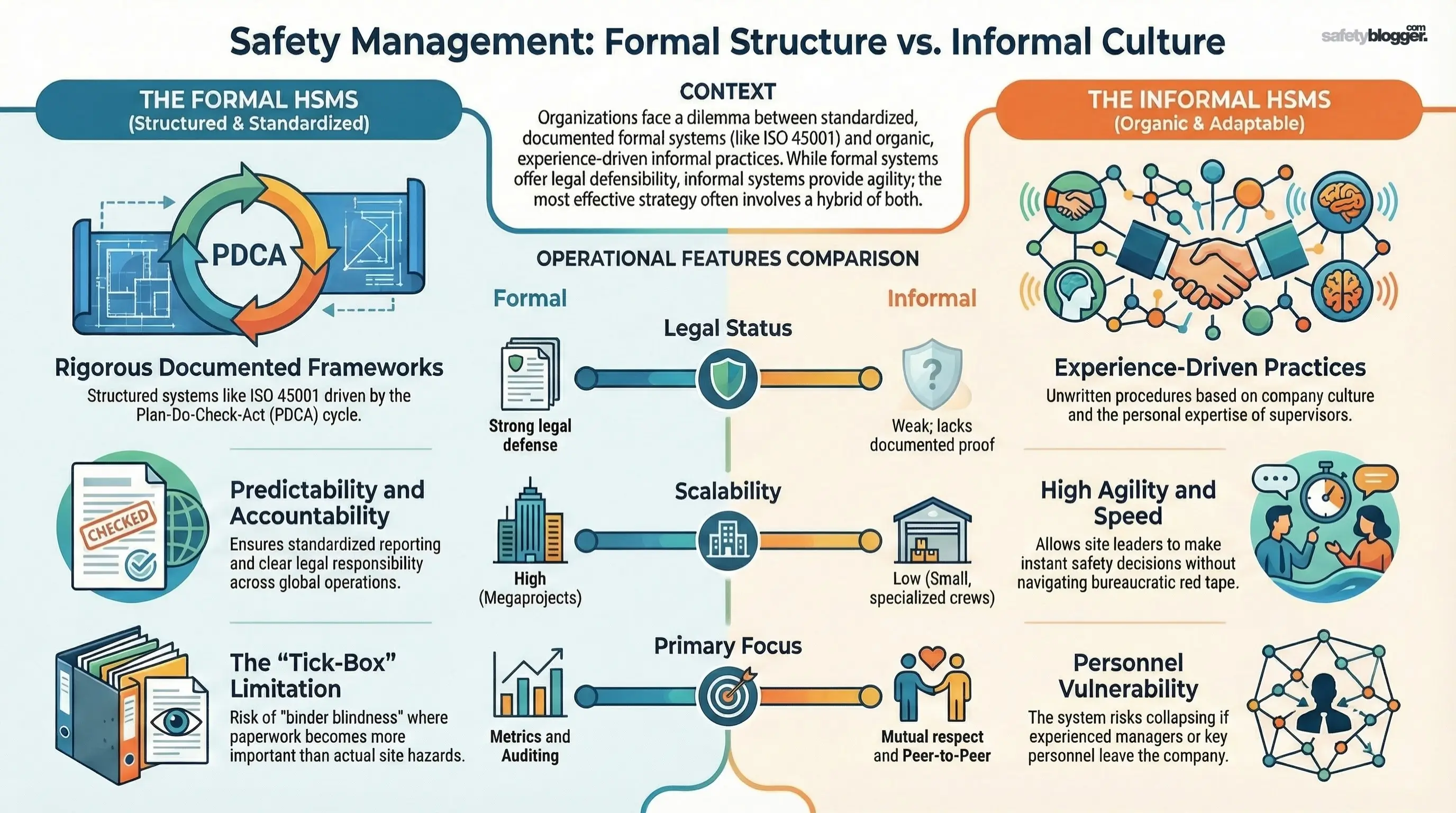
A Formal HSMS is a structured, documented framework designed to meet recognized international or national standards. Examples include ISO 45001, OSHA’s VPP, or specific client-mandated frameworks like the World Bank EHS Guidelines. These systems rely heavily on the Plan-Do-Check-Act (PDCA) cycle, continuous improvement metrics, and rigorous external auditing.
An Informal HSMS, on the other hand, consists of unwritten practices, standard operating procedures that have evolved naturally, and reactive safety measures. It is often driven by company culture, the personal experience of site supervisors, and compliance with the bare minimum of local legal requirements, without the overarching structure of a recognized standard.
The Illusion of Compliance
In my experience, many companies mistake "having a safety officer" for having a formal system. A true system connects hazard identification directly to boardroom governance, whereas an informal system relies heavily on the competence of the individuals on shift that day.
Benefits and Limitations of a Formal HSMS
A formal system brings predictability to chaotic, high-risk environments. When managing megaprojects involving thousands of workers from different cultural backgrounds, you cannot rely on informal understandings; you need a rigid structure.
The Benefits
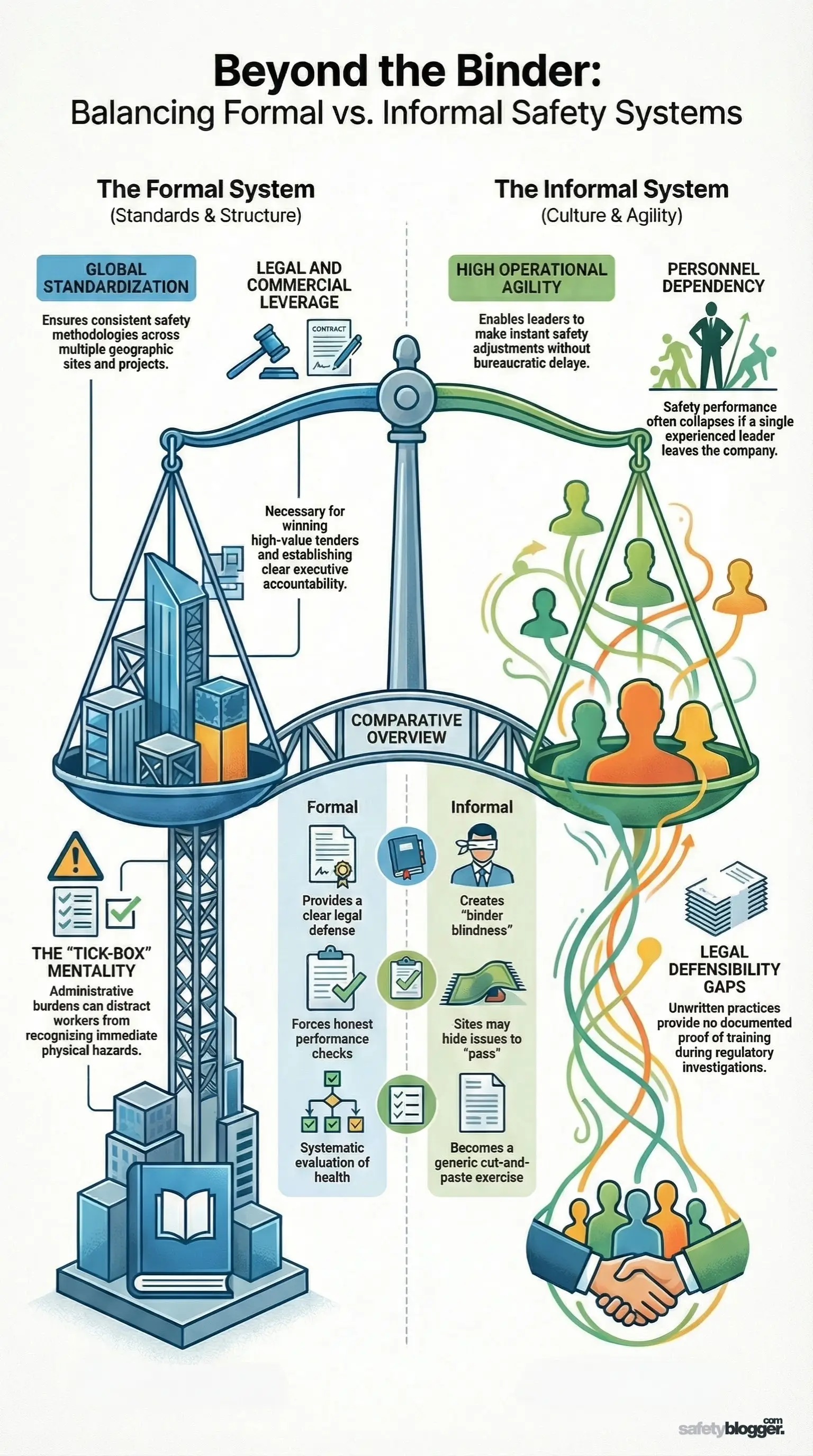
Standardization across operations: Whether the site is in Punjab or Perth, a formal system ensures permits, risk assessments, and incident reporting follow the exact same methodology.
Legal and commercial leverage: Many global EPC (Engineering, Procurement, and Construction) clients demand ISO 45001 certification to even qualify for tenders.
Clear accountability and governance: Formal systems define exactly who is responsible for what, from the site supervisor up to the CEO, leaving no ambiguity during an incident investigation.
Data-driven improvement: Through leading and lagging indicators, formal systems force management to look at trends, such as rising near-misses in a specific zone, before a fatality occurs.
The Limitations
The "Tick-Box" mentality: This is the biggest killer. Workers become so focused on filling out the permit correctly that they fail to look up and see the suspended load swinging above them.
High resource consumption: Maintaining a formal system requires dedicated HSE professionals, expensive external audits, and significant time for administrative upkeep.
Loss of operational agility: In highly bureaucratic systems, implementing a new, safer piece of equipment can take weeks of risk register updates and procedure approvals.
Formal HSMS: Field Comparison
Feature | The Benefit on Site | The Limitation on Site |
Documentation | Provides a clear legal defense in the event of an OSHA or regulatory investigation. | Can create "binder blindness" where safety is seen as paperwork, not physical action. |
Auditing | External audits force the company to stay honest about their safety performance. | Sites often "prepare" for audits by hiding issues rather than fixing them permanently. |
Risk Assessment | Ensures a systematic evaluation of all hazards, including long-term occupational health risks. | Often becomes a generic cut-and-paste exercise for routine tasks. |
Benefits and Limitations of an Informal HSMS
Not every organization needs a multimillion-dollar ISO-certified system. For smaller operations, or highly specialized crews, an informal system can be surprisingly effective if the safety culture is strong.
The Benefits
High adaptability and speed: Without bureaucratic red tape, site leaders can make instant safety decisions based on immediate site conditions.
Cost-effective: Financial resources are spent directly on PPE, better tools, and worker training rather than on administrative software and external auditors.
Culture-centric focus: In the best informal systems, safety is driven by mutual respect and peer-to-peer accountability, rather than the fear of failing an audit.
The Limitations
Extreme vulnerability to personnel changes: If the experienced site manager leaves, the "system" leaves with them, potentially collapsing overnight.
Difficulty in scaling: What works for a team of 10 pipefitters utterly fails when the project expands to 200 workers.
Lack of legal defensibility: If a serious injury occurs, regulatory bodies will look for documented proof of training and hazard communication. "We told them to be careful" holds no weight in court.
Neglect of occupational health: Informal systems are usually good at preventing immediate accidents (like falls), but terrible at managing long-term health risks like silicosis or noise-induced hearing loss.
"A safety management system is only as good as the worst behavior the management is willing to tolerate. A perfect formal system means nothing if you walk past an unsafe act."
Bridging the Gap: The Transition Phase
The most dangerous period for a company is often the transition from an informal to a formal system. I have seen companies try to implement ISO 45001 overnight, resulting in a worker revolt and the system collapsing under its own weight.
To transition effectively, companies must move gradually. Start by formalizing the highest-risk activities—like Confined Space Entry and Lockout/Tagout (LOTO)—while leaving low-risk operational procedures more flexible.
Pro Tip: Never buy an "off-the-shelf" safety manual from a consultant. The procedures will not match your reality. Involve your frontline supervisors in writing the formal procedures; if they write it, they will enforce it.
Conclusion
The debate between formal and informal Health and Safety Management Systems comes down to the scale of risk and the size of the operation. An informal system offers agility and cost-effectiveness but leaves the organization legally exposed and vulnerable to human error. A formal system provides standardization and legal defense but risks becoming a soulless bureaucratic exercise that distracts workers from the real hazards. The ultimate goal is to build a hybrid approach: a system formal enough to meet international standards and legal requirements, but simple and practical enough to be understood by the worker standing at the coalface.
At the end of the day, safety is a moral obligation, not just a compliance target. A perfectly audited system means nothing if a worker does not make it home to their family.





Comments
Loading...