



I once sat across the table from a visibly shaken Project Director during a post-fatality regulatory audit on a major petrochemical expansion. A rigger had been crushed during a complex tandem lift. When the enforcement officers asked to see the credentials of the appointed "Competent Person" who approved the lift plan, the Director produced the file of a junior safety officer with a basic online certificate and zero heavy lifting experience. The Director had assumed that appointing anyone with the word "safety" in their title absolved him of liability. Within an hour, operations were shut down, and the Director was facing personal prosecution for gross negligence.
Appointing senior managers and competent persons for health and safety is not a bureaucratic HR exercise; it is the cornerstone of organizational survival. When you assign these roles, you are placing human lives and the legal continuity of the business into specific hands. This article breaks down the legal obligations, the practical differences between management accountability and technical competence, and how to properly vet and empower the people responsible for keeping your workforce alive.
Defining the "Competent Person" in the Real World
In safety legislation globally—whether it is OSHA in the US or the HSE in the UK—the term "Competent Person" holds strict legal weight. It is not about who holds the most advanced degree.
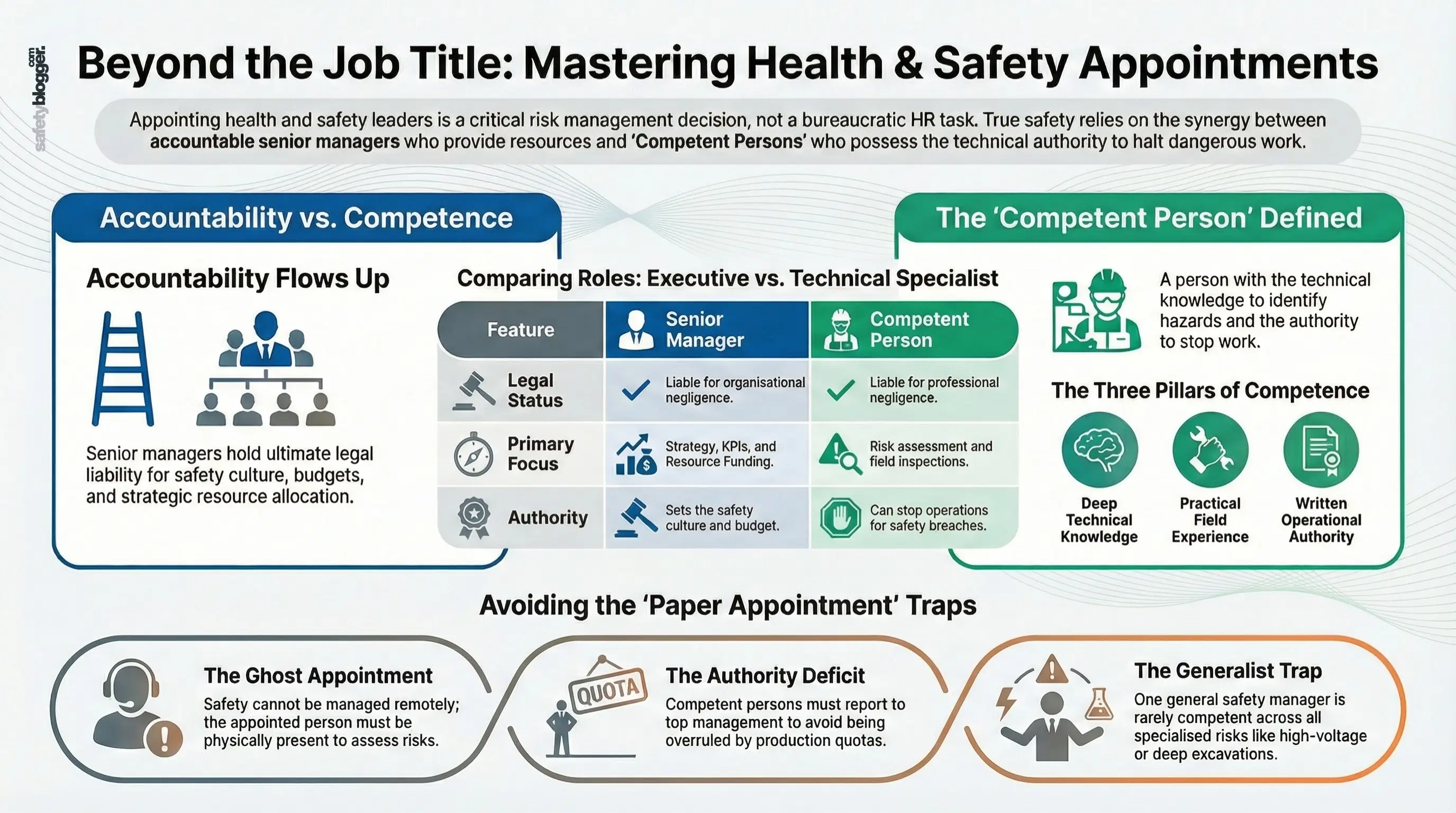
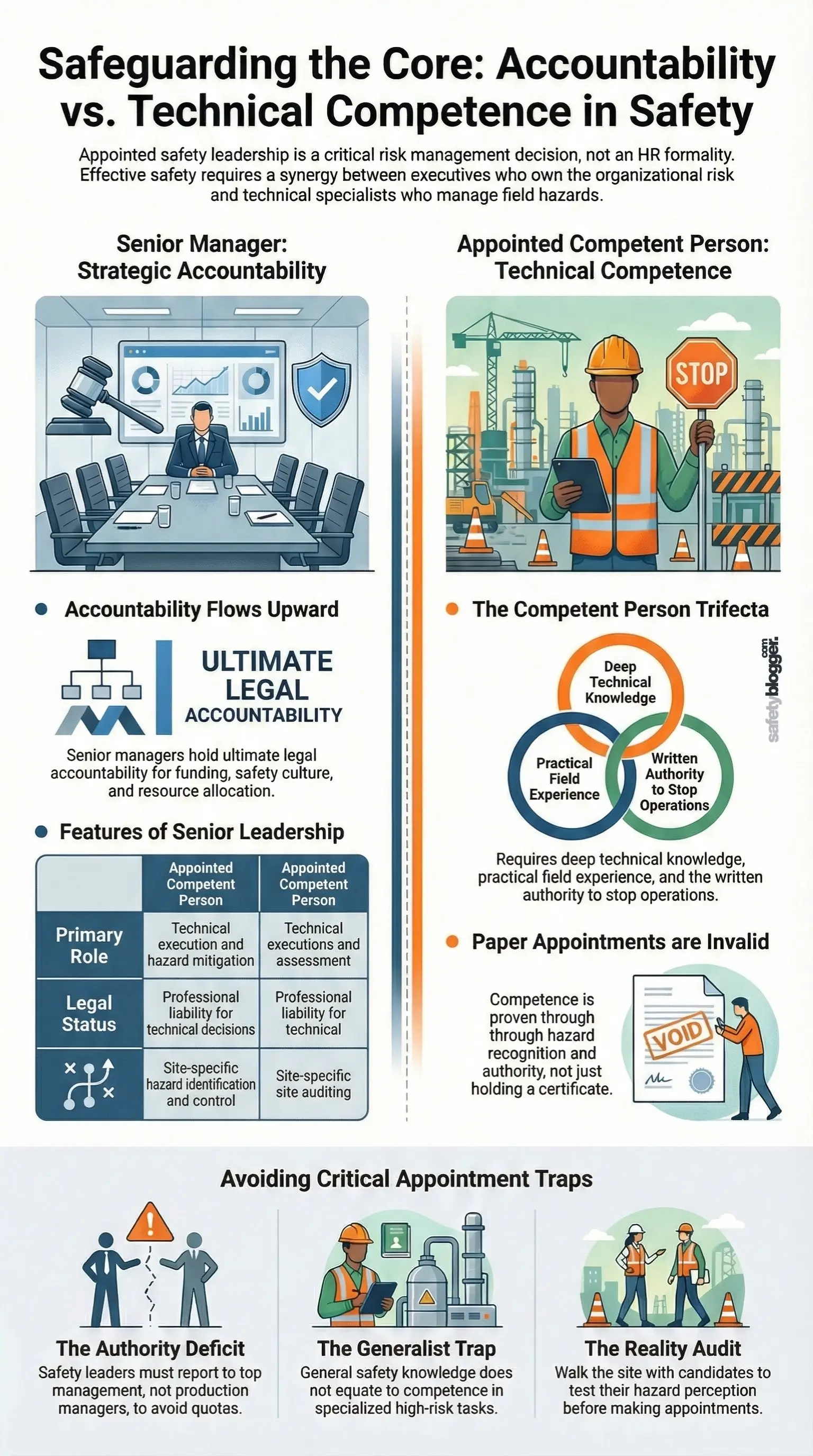
A competent person is defined by their capability to identify existing and predictable hazards in the surroundings, and their authorization to take prompt corrective measures to eliminate them. In the field, a certificate is just paper; competence is proven under pressure. If the appointed person cannot recognize a failure in a shoring system, or lacks the authority to shut down a non-compliant production line, they are not competent.
I have audited dozens of sites where the "Competent Person" was just the most senior worker available. This is a fatal trap. Competence requires:
Technical Knowledge: Deep understanding of the specific hazard (e.g., confined space gas behavior, load charts, chemical reactivity).
Practical Experience: Hands-on time in the specific operational environment.
Operational Authority: The written, management-backed power to stop operations without fear of retaliation.
The Role of Senior Managers in Health and Safety
While competent persons handle the technical realities of hazard control, senior managers hold the ultimate accountability. You cannot outsource your legal duty of care.
In high-governance frameworks like ISO 45001, top management must demonstrate leadership and commitment. This means setting the budget, defining the safety culture, and actively participating in reviews. During an investigation, regulators look straight to the boardroom. If a competent person requests funds for a critical ventilation upgrade and the senior manager denies it to cut costs, the liability rests entirely on the manager.
"Accountability flows up. If a worker fails, we look at the supervisor. If the supervisor fails, we look at the system. If the system fails, we look at the directors who funded it."
Senior managers must ensure that health and safety integration occurs at the strategic planning phase, not just at the operational execution phase.
Accountability vs. Competence: Key Differences
It is critical to distinguish between the executive who owns the risk and the technical specialist who manages it.
Feature | Senior Manager | Appointed Competent Person |
Primary Role | Strategic leadership, resource allocation, and accountability. | Technical assessment, hazard control, and regulatory compliance. |
Legal Status | Held liable for organizational negligence and duty of care. | Held liable for professional negligence and failure to act on known risks. |
Required Skillset | Risk management, financial planning, governance. | Hazard identification, incident investigation, field operations. |
Day-to-Day Focus | Integrating safety into business strategy and KPIs. | Inspecting sites, auditing permits, stopping unsafe work. |
Common Traps in the Appointment Process
Over my years in the field, I have seen the same recurring failures when organizations attempt to structure their HSE leadership. These mistakes often only come to light after a catastrophic event.
The "Ghost" Appointment
This occurs when a highly qualified consultant or senior manager is named on paper as the competent person for a site they rarely visit. Safety cannot be managed remotely. If the appointed person is not physically present to assess dynamic daily risks, the appointment is invalid.
The Authority Deficit
I once stepped into a facility where the HSE Manager had a brilliant technical background but reported to the Production Manager. Every time she tried to halt a line for a safety breach, the Production Manager overrode her to meet quotas. A competent person must report to the highest level of site management, ensuring their decisions are not compromised by operational pressures.
The "Generalist" Trap
Assuming one HSE generalist can be the competent person for all high-risk tasks. A safety manager competent in general manufacturing is not automatically competent in high-voltage electrical safety or deep excavations. Specialized risks require specialized appointments.
Field Checklist: Appointing Your HSE Leaders
Before you sign the appointment letter for a Safety Director, Manager, or Competent Person, verify the reality of their capability.
Audit their history: Do they have experience in your specific industry sector?
Test their risk perception: Walk the site with them. What do they see that you don’t?
Define their authority: Is it in writing that they can stop operations?
Review the reporting line: Do they have a direct line to the CEO or Project Director?
Assess their soft skills: Can they influence supervisors and coach workers, or do they just enforce rules?
Pro Tip for Senior Executives
Never accept a "Zero Accident" KPI from a newly appointed safety manager without scrutinizing the leading indicators. A competent HSE leader will tell you where the systemic gaps are on day one. An incompetent one will tell you everything is fine.
Conclusion
Appointing the right people to manage health and safety is the most critical risk management decision an organization will make. The synergy between accountable senior managers and technically capable competent persons is what stands between standard operations and catastrophic failure.
In my experience, regulatory agencies and courts are unforgiving of "paper appointments." They look at the reality of control, authority, and competence. We must remember that behind every compliance directive, there are workers relying on the capability and integrity of their leaders to return home safely. In this field, competence is not a buzzword; it is a life-saving necessity.




Comments
Loading...